
Table of Contents
Overview
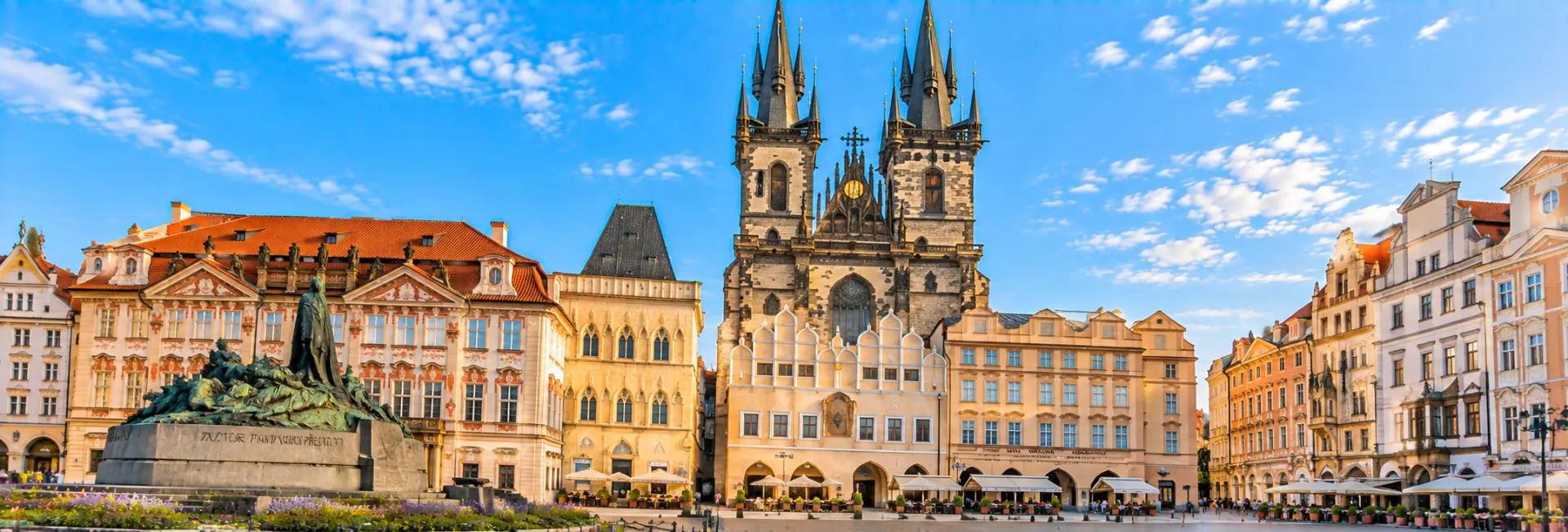
The Church of Our Lady before Týn, known in Czech as Kostel Matky Boží před Týnem or simply Týn Church, is the great Gothic silhouette that dominates the skyline of Prague's Old Town Square. Its twin towers, each roughly 80 metres tall and crowned with a crown of smaller spires, are visible from almost anywhere in the historic centre and have become one of the most recognizable images of the city.
Despite standing directly behind Old Town Square, the church has no entrance facing the square itself. Visitors reach it through a narrow passage beneath the row of townhouses on the square's north side, arriving almost by surprise at a dim, atmospheric Gothic interior that feels far removed from the crowds outside. Active as a Roman Catholic parish church today, it carries a long and turbulent history as the spiritual centre of the Hussite movement before returning to Catholic hands in the seventeenth century.
History
From Merchant Chapel to Parish Church
A church has stood near this spot since at least the 12th century, originally serving foreign merchants trading at the nearby Týn Courtyard, a walled compound where visiting traders lodged and paid customs duties. An early Gothic chapel here became the Old Town's first parish church, and in the second half of the 14th century, backed by donations from wealthy Old Town citizens and merchants, a far larger High Gothic building rose in its place, developed under the influence of the workshop of Peter Parler, the architect also associated with Prague Castle and St. Vitus Cathedral.
The Hussite Church of Prague
In 1427, during the Hussite reform movement that swept through Bohemia after the execution of reformer Jan Hus, the church came under Hussite control and became the movement's main church in Prague. Jan Rokycana, the elected Hussite archbishop, served as parson here and was later buried within its walls. Under King George of Poděbrady, himself a Hussite sympathizer, the northern tower and main gable were finally completed, and a gilded chalice, a central symbol of Hussite communion, was mounted above the facade alongside a bust of the king himself. The taller southern tower followed in 1511, designed by Matěj Rejsek.
Re-Catholicization and Fire
After the Battle of White Mountain in 1620 brought Bohemia back under Catholic Habsburg control, the church's Hussite symbols were removed within a few years; the king's bust came down in 1623, and a statue of the Virgin Mary took its place in 1626, with the old gilded chalice reportedly melted down to form her halo. A lightning-sparked fire in 1679 badly damaged the nave and choir, which were rebuilt with a lower Baroque vault rather than restored to their original Gothic height, leaving the church with the blended Gothic-and-Baroque character it still shows today. Further restoration campaigns followed in the late 19th century and again between 1973 and 1995, focused largely on the exterior stonework and towers.
Architecture & Design
The church is a three-aisle Gothic basilica, its exterior dominated by steep gables, pointed windows, and the famous twin towers that give the building its distinctive crown-like skyline. The two towers are not identical: the southern tower is slightly taller and more heavily built than its northern twin, a difference visitors can often spot even from a distance once they know to look for it.
A Hidden Facade
Because houses were already standing on the square when the church was rebuilt in the 14th century, its main facade had to be set back behind them rather than facing Old Town Square directly. The result is that today's visitors approach through a covered arcade running beneath the Týn School building, entering almost unexpectedly into the church's dim Gothic nave.
Gothic Bones, Baroque Skin
While the side aisles retain their original Gothic ribbed vaulting, the central nave was rebuilt with a Baroque barrel vault after the 1679 fire, giving the interior a layered architectural character: Gothic structure and stonework paired with Baroque altarpieces, gilding, and painted decoration added over the following centuries.
Cultural & Religious Significance
Beyond its architectural weight, the Týn Church carries deep symbolic significance in Czech religious history. As the principal church of the Hussite movement for roughly two centuries, it stood at the centre of one of Central Europe's most consequential religious reform movements, one that predated the Protestant Reformation by decades. Its physical transformation from Hussite stronghold to Catholic parish church, marked by the removal of the king's bust and Hussite chalice in the 1620s, mirrors the broader religious upheaval that reshaped Bohemia after the Thirty Years' War.
Today the church functions as an active Roman Catholic parish under the Archdiocese of Prague, holding regular services alongside its role as one of the city's most visited historic sites, a combination that shapes how and when visitors are able to explore it.
Notable Features
The church's interior functions almost as a small museum of Gothic, Renaissance, and early Baroque religious art, built up over more than six centuries of continuous use.
- The tomb of Tycho Brahe, the Danish astronomer who served at the court of Emperor Rudolf II and died in Prague in 1601, marked with a carved marble memorial inside the church
- A pipe organ dating to the 1670s, the oldest surviving organ in Prague, later restored abroad before being returned to the church
- The Madonna of Týn, a Gothic statue of the Virgin and Child from around 1420, displayed on a Neo-Gothic altar in the right side aisle
- A late-Gothic stone canopy carved around 1493, believed to be the work of Matěj Rejsek, originally sheltering a bishop's tomb
- The Baroque main altar, completed in 1649 with paintings by Karel Škréta depicting the Assumption of the Virgin and the Holy Trinity
- A tin baptismal font from 1414, considered the oldest in Prague
- A carved Crucifixion tympanum above the north portal facing Týnská ulička, a copy of a 14th-century original produced in Peter Parler's workshop
Visiting Etiquette & Tips
A few points of preparation make a visit go more smoothly, since the church operates first and foremost as a working place of worship:
- Find the entrance through the arcade on the north side of Old Town Square rather than looking for a door facing the square itself; it runs beneath the Týn School building toward Týnská ulička
- Sightseeing is paused during Mass, so it's worth checking service times in advance if the goal is a full look around rather than attending a service
- The church is closed to visitors on Mondays, and opening windows on other days are split into a morning and a late-afternoon block rather than one continuous stretch
- Entry is free, though a small donation toward the church's upkeep is customary and appreciated
- Dress and behave as in any active church: quiet voices, no eating or drinking inside, and modest dress out of respect for worshippers
- Wheelchair access is available via a separate entrance on Celetná street rather than through the main arcade passage
Best Time to Visit
Because the interior opens for only a few hours split across morning and late afternoon, timing a visit around the church's published hours matters more here than at many Old Town sights. Arriving soon after the morning opening tends to mean a quieter interior before tour groups moving through the square in the middle of the day reach the arcade entrance.
From outside, the towers are worth seeing at more than one time of day: they catch warm light in the late afternoon and take on a dramatic, floodlit presence over Old Town Square after dark, which is when many visitors get their best photographs of the skyline even without going inside.
Nearby Attractions
The church's location puts it within a short walk of several of Prague's best-known Old Town sights, making it easy to combine with a broader visit to the area:
- Old Town Square itself, directly in front of the church's hidden facade
- The Prague Astronomical Clock and Old Town Hall, a short walk across the square
- Týn Courtyard (Ungelt), the historic merchants' compound the church was originally built to serve
- Kinský Palace and the House at the Stone Bell, both just steps from the church's arcade entrance
- Celetná Street, leading toward the Powder Tower and the start of the historic Royal Route
FAQs about visiting the Church of Our Lady before Týn
Where is the entrance to the church? +
There's no door facing Old Town Square directly; the entrance is through a covered arcade beneath the Týn School building on the square's north side, leading through to Týnská ulička.
Is it free to visit? +
Yes, entry is free, though a small donation toward the church's upkeep is customary.
Why are the two towers different? +
The southern tower, completed in 1511, is slightly taller and more massive than the northern tower, which was finished decades earlier under King George of Poděbrady; the asymmetry reflects the long, interrupted construction process.
Can I visit during a church service? +
No, sightseeing pauses during Mass, so it's worth checking service times in advance if you want time to look around freely rather than attend.
What's the most famous thing to see inside? +
Many visitors come specifically for the marble tomb of astronomer Tycho Brahe, who served at the court of Emperor Rudolf II and died in Prague in 1601.
Is the church open every day? +
No, it's closed on Mondays, and on other days it opens for a morning block and a separate late-afternoon block rather than staying open continuously.
Is the church wheelchair accessible? +
Yes, but not through the main arcade passage; wheelchair access is available via a separate entrance on Celetná street.
How long does a visit take? +
Most visitors spend 20 to 30 minutes inside, longer if joining a guided tour or lingering over the altarpieces and Tycho Brahe's tomb.
Is the Týn Church connected to the Hussite movement? +
Yes, it served as the main church of the Hussite movement in Prague for roughly two centuries, until the city's re-Catholicization in the 1620s removed its Hussite symbols.
What's the best time to photograph the towers? +
Late afternoon light and the floodlit view over Old Town Square after dark are both popular times, since the towers dominate the skyline from almost any angle around the square.
