
Table of Contents
Overview
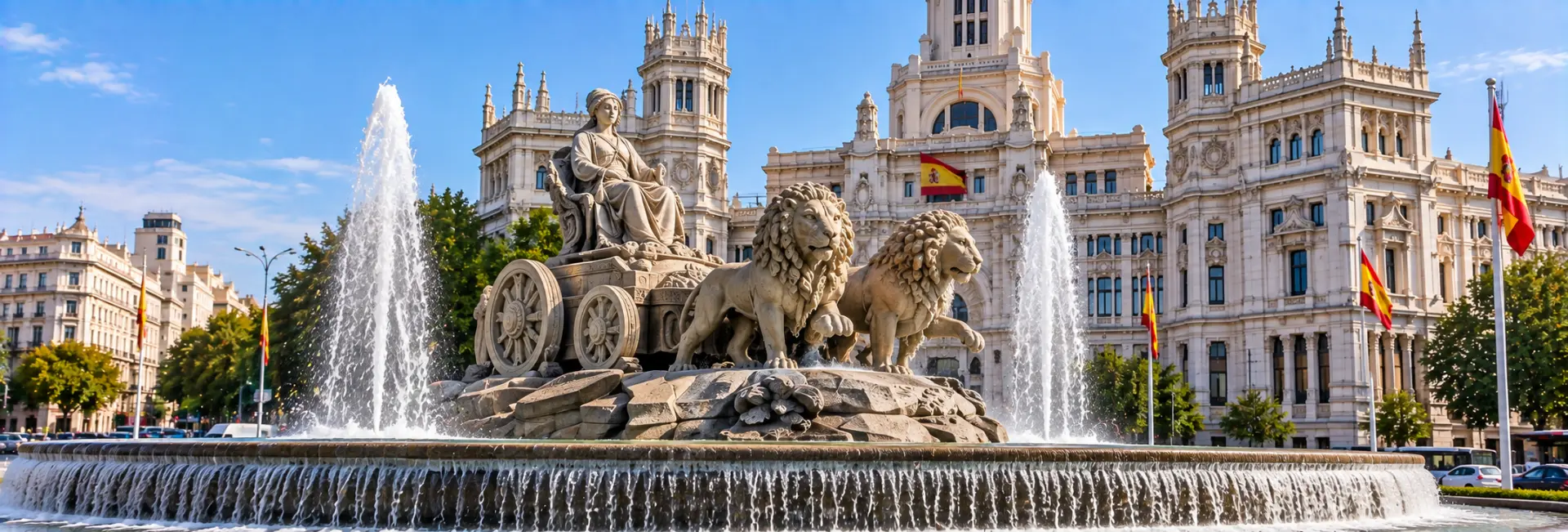
Stand in the middle of the Plaza de Cibeles for a minute and you'll see why this fountain has become shorthand for Madrid itself. Cars circle it constantly, tour groups pause to snap photos, and every so often a crowd of football fans climbs onto it to celebrate a title. At the center of it all is a marble goddess riding a chariot pulled by two lions, carved in the late 18th century and still holding court more than two hundred years later.
It started life as a fairly practical piece of city infrastructure, a decorative fountain tied to Madrid's water supply. Somewhere along the way it outgrew that role entirely and turned into the image most people picture when they think of the city, showing up on postcards, city seals, and just about every "must-see Madrid" list. It also happens to sit right at the start of the Art Walk, so if you're heading toward the Prado or the other big museums, you'll likely pass right by it.
History
Built on the Orders of a King
King Charles III set the fountain in motion in the late 18th century, part of his push to give Madrid's main avenues proper water supply and, frankly, a bit more grandeur. He handed the design work to Ventura Rodríguez, one of the top Spanish architects of the day, and brought in sculptors Francisco Gutiérrez and Roberto Michel to actually carve the figures. By 1782, it was finished and in place.
It Didn't Always Stand Here
Here's something a lot of visitors don't realize: the fountain wasn't originally facing this way, or even in quite this spot. It sat a little further north, near where the Paseo de Recoletos begins, and looked out in a different direction entirely. Madrid's city council moved and turned it in 1895, settling it into the center of the newly formed Plaza de Cibeles, lined up with the streets converging around it. That's the layout you'll still find today.
How It Became a National Symbol
As Madrid grew up around it over the following decades, the fountain and its square slowly became a kind of stand-in for the city as a whole. You'll spot its image on municipal seals and tourism material to this day, and the grand buildings that now ring the plaza only added to that sense of importance, turning the intersection into something closer to a ceremonial gathering point than a simple traffic circle.
Architecture & Design
Look closely and the design tells its own little story. Cybele sits enthroned on a two-wheeled chariot, scepter in one hand and the keys to the city in the other, symbols of the authority she's meant to hold over Madrid. Two lions pull her forward, straining against their harness in mid-stride.
Cybele and her lions aren't the same stone as the rest of the fountain. That trio was carved from a purple-tinted marble brought in from Montesclaros, in the province of Toledo, which gives the figures a warmer, almost rosy cast next to the plain white marble used for the basin below. It's a small detail, but it's part of why the central group seems to glow a bit differently in the afternoon light.
- Stands roughly 8 meters tall from base to crown
- Circular basin measures about 32 meters across
- Cybele and the lions carved from purple marble sourced in Montesclaros, Toledo
- Basin and supporting structure carved from white marble
- Sits at the exact center of the Plaza de Cibeles roundabout
Because it sits in the middle of a large traffic circle rather than a quiet courtyard, the fountain was built to read well from a distance, not just up close. That was probably intentional. From several of the avenues feeding into the square, it works almost like a compass point, something to orient yourself by as the streets fan out around it.
Cultural Significance & Traditions
Who Is Cybele, Anyway?
Cybele was worshipped in the ancient world as a goddess of nature and fertility, her cult traveling from Asia Minor into Rome centuries before this fountain existed. There's a darker footnote to the myth, too: the two lions pulling her chariot are said to have once been a mortal couple, turned into lions as punishment for offending her. It's a strange bit of backstory for what now looks like a very stately, formal monument.
Where Real Madrid Comes to Celebrate
Ask a Madrileño what "La Cibeles" means and football will probably come up before mythology does. Whenever Real Madrid wins a major trophy, thousands of fans pour into the square and climb up onto the fountain itself. It's become such a fixture of the club's celebrations that Spanish sports commentators use "Cibeles" as near shorthand for a Real Madrid title.
More Than Just a Landmark
You'll see the fountain's silhouette on tourism brochures, city signage, and plenty of souvenirs around town, and locals just call the whole square "Cibeles" without needing to explain further. Not many monuments manage to carry that much everyday weight. It's history and civic pride wrapped into one, but it's also just part of how people talk about getting around the city.
What to See There
The fountain draws the eye, but don't rush past the four buildings standing guard around the square. Each has its own story, and together they explain why this particular intersection feels so grand.
- Cibeles Palace: the showstopper of the group, once the city's main post office and now home to Madrid's City Hall, the CentroCentro cultural center, and the Mirador Madrid observation deck
- Bank of Spain: the country's central bank, holding down its corner of the plaza since the late 1800s
- Palace of Linares: a restored 19th-century mansion that today houses the Casa de América cultural institution
- Buenavista Palace: an 18th-century building that now serves as the Spanish Army's general headquarters
If you only have time to step inside one, make it Cibeles Palace. Parts of the building are open to visitors, and the rooftop deck gives you one of the better views in central Madrid, including a good look straight back down at the fountain you just walked past.
Ways to Experience It
Most people end up here simply by walking the Paseo del Prado or Paseo de Recoletos, since the fountain sits right where the two meet and marks the start of the Art Walk toward Madrid's big three museums.
- Take it in from one of the pedestrian corners of the square, which is really the only sensible vantage point given how much traffic circles the fountain
- Ride the elevator up to the Mirador Madrid deck at Cibeles Palace for a wider view over the fountain and the rooftops beyond it
- If you happen to be in town after a Real Madrid title win, expect the square to turn into an impromptu party, worth witnessing even if football isn't your thing
- Fold it into a longer walk toward the Prado, the Thyssen-Bornemisza, or the Reina Sofía
Getting right up to the water's edge isn't really an option here, since the fountain sits inside an active roundabout. Outside of celebration nights, it's mostly a monument you look at rather than one you walk up to.
Best Time to Visit
Go early in the morning if you want the square to yourself, or close to it. The light is softer for photos, and traffic is lighter than it will be later in the day. Come evening, things pick up again, and once Cibeles Palace and the other buildings light up after dark, the square takes on a different mood entirely.
Spring and autumn make for the most pleasant walking weather along the Art Walk that begins here, while Madrid summers can get brutally hot by mid-afternoon. One more thing worth knowing: if Real Madrid wins a major title while you're in town, the square will be packed and loud late into the night. It's a memorable scene, but it's a completely different visit than a calm daytime stop.
Visitor Tips
- Seeing the fountain itself costs nothing, since it's a public monument viewed from the open square
- Stick to the marked crossings, this is a working traffic roundabout, not a pedestrian plaza
- Banco de España, on metro Line 2, is the closest stop and only a short walk away
- The Mirador Madrid deck at Cibeles Palace needs a separate ticket and its hours shift, so check ahead if that view is part of your plan
- For photos with the least clutter, try the corners near the Bank of Spain or the Palace of Linares
Nearby Attractions
Because it sits at such a central crossroads, the Plaza de Cibeles makes a good jumping-off point for several of Madrid's biggest sights, all within walking distance.
- Prado Museum, just a short walk south along the Paseo del Prado
- Retiro Park, Madrid's big green escape, sitting just east of the square
- Puerta del Sol, reachable on foot straight down Calle de Alcalá
- Thyssen-Bornemisza Museum, a bit further along the Art Walk toward the Prado
- Gran Vía, the city's main shopping and theater strip, also off Calle de Alcalá
FAQs about visiting the Cibeles Fountain
What is the Cibeles Fountain? +
It's an 18th-century marble fountain in central Madrid showing the goddess Cybele riding a chariot pulled by two lions, and it's become the closest thing Madrid has to an unofficial symbol.
How old is it? +
It dates back to 1782, commissioned by King Charles III and designed by the architect Ventura Rodríguez.
Do I need to pay to see it? +
No. It sits out in the open in a public square, so there's nothing to buy and no ticket needed.
How long should I plan to spend there? +
Most people spend somewhere between 15 and 30 minutes taking it in, though that easily stretches if you also go up to the Mirador Madrid deck or keep walking along the Art Walk.
What's the easiest way to get there? +
Take the metro to Banco de España on Line 2. It's also a fairly short, flat walk from Puerta del Sol along Calle de Alcalá if you'd rather stroll.
Why do people associate this fountain with Real Madrid? +
Because it's where the club's fans have gathered to celebrate trophies for decades. It's such a tradition now that "Cibeles" often gets used as shorthand for a Real Madrid win in Spanish sports talk.
Can I walk right up to the fountain or touch the water? +
Not really, since it sits inside a busy traffic roundabout rather than a pedestrian plaza. Most people view it from the sidewalks around the edge rather than up close.
What other buildings are around the square? +
Four of them frame it: Cibeles Palace, which now houses Madrid's City Hall, along with the Bank of Spain, the Palace of Linares, and the Buenavista Palace.
Is it worth stopping for even if I only have a few minutes? +
Yes. It's an easy add-on since it sits right along the walking route between the city center and the Art Walk museums, so you don't need to go out of your way for it.
When's the best time of day to go? +
Early morning if you want it quiet and want good photo light, or evening if you'd rather see the square lit up and a bit livelier.
