
Table of Contents
Overview
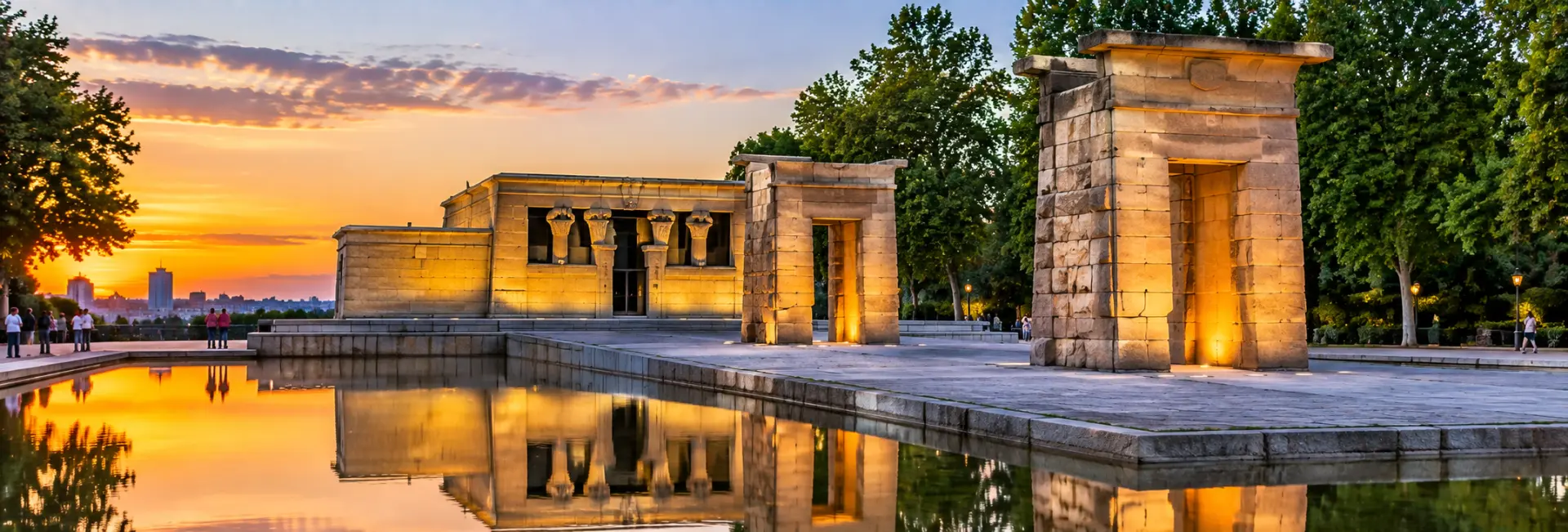
Rising above a still reflecting pool on a hilltop west of Plaza de España, the Temple of Debod is one of Madrid's most unlikely landmarks: a genuine ancient Egyptian temple, over two thousand years old, standing far from the Nile it was built beside. Dismantled stone by stone in Egypt and reassembled in Spain during the early 1970s, it is the only complete Egyptian temple on public display in Spain and one of very few anywhere outside Egypt itself.
The temple's small scale belies its significance. It was rescued from the floodwaters of the Aswan High Dam as part of a wider international effort, and its arrival in Madrid was a gesture of gratitude from Egypt to Spain for the country's role in that rescue. Today it draws history lovers, photographers, and locals alike, particularly in the evening, when its sandstone walls and the surrounding pool catch the last light over the city.
History
Origins in Nubia
Construction of the temple began in the early 2nd century BC on the orders of Adikhalamani, a king of the Kushite kingdom of Meroë, who built a small chapel near Aswan in what was then Nubia. The chapel was dedicated to the god Amun and, in time, to the goddess Isis, whose great cult center at nearby Philae made the area a major religious hub for centuries. Later Ptolemaic rulers enlarged the modest chapel into a proper temple, adding rooms and a forecourt, and under Roman rule the emperors Augustus and Hadrian contributed further additions and decoration after Egypt became a Roman province.
Abandonment and Rescue
As Christianity spread through Nubia in the 6th century AD, the old cults faded and the temple was closed and left to the desert. It stood largely forgotten for well over a millennium. Its fortunes changed in the mid-20th century, when Egypt began building the Aswan High Dam, a project that would flood a vast stretch of the Nile valley, including the temple's original site. UNESCO launched an international appeal to save the threatened Nubian monuments, and Spain was among a handful of countries that answered, contributing expertise and resources to the campaign, notably at Abu Simbel.
Reconstruction and Opening
In gratitude, the Egyptian government dismantled four of the rescued temples and donated them to the nations most involved in the rescue effort; the Temple of Debod was given to Spain in 1968. Nearly one hundred numbered stone blocks made the journey from Egypt to Spain, first by sea and then overland to Madrid, where teams spent roughly two years fitting the pieces back together like an enormous puzzle. The rebuilders preserved the structure's original east-west orientation, though photographs from Egypt suggest the order of the outer gateways was reversed during reassembly. The rebuilt temple opened to the public in July 1972, and it has remained one of the city's most distinctive free attractions ever since.
Architecture & Design
The temple follows the layout of a classic small Egyptian sanctuary, built from sandstone blocks and arranged along a single east-west axis. Visitors approach through a sequence of gateways before reaching the compact main building, which grows narrower and darker toward its innermost chamber, in keeping with the traditional Egyptian idea of moving from the outer, public world toward a sacred, hidden space.
Reliefs and Decoration
Inside, carved reliefs depict Egyptian and Meroitic rulers making offerings to Amun, Isis, and other deities, a visual record of the different dynasties that expanded and decorated the building over the centuries. Some of the finest carving survives in the chapel added under Adikhalamani, where figures and hieroglyphic inscriptions remain legible despite the temple's long exposure to the desert and, later, to a very different European climate.
Setting in Madrid
Rather than being placed indoors, the temple was reconstructed outdoors in a landscaped garden, surrounded by a shallow reflecting pool that echoes the Nile-side setting it once had. This open-air placement, combined with the temple's elevated position on a hilltop above the Manzanares valley, allows the sandstone to be lit dramatically by the setting sun, an effect that has become central to its identity as a Madrid landmark. Unlike many relocated ancient structures that end up sealed inside museum halls, Debod remains exposed to the open sky much as it once was in Egypt, which visitors often say is part of what makes the encounter feel so unexpected in the middle of a modern European capital.
Cultural Significance
A Symbol of International Rescue
The Temple of Debod stands as one of the lasting monuments to the International Campaign to Save the Monuments of Nubia, one of the first and largest heritage-preservation efforts UNESCO ever coordinated. Alongside Debod, other rescued temples were sent to Italy, the Netherlands, and the United States, making it part of a small family of Egyptian temples now scattered across the world as reminders of that campaign.
A Layered Hilltop
The ground the temple now occupies carries its own separate history. It was previously the site of the Cuartel de la Montaña army barracks, and long before that, prisoners from Madrid's 1808 uprising against Napoleon's occupying forces were executed on this same hill, an event famously depicted in Francisco de Goya's painting "The Third of May 1808." The barracks themselves were later destroyed during the Spanish Civil War, leaving the hill vacant by the time officials were looking for a home for the newly arrived Egyptian temple. The temple's peaceful gardens today sit atop ground that has witnessed conflict, occupation, and demolition across more than two centuries, and now serve as one of the city's favorite spots for a quiet evening out.
What to See There
A visit combines the temple's ancient interior with the surrounding gardens and skyline views, giving the site broader appeal than its small footprint might suggest.
- The reconstructed gateways (pylons) leading toward the main sanctuary, arranged in their original processional order
- Carved relief panels showing offerings to Amun and Isis, some dating to the temple's earliest construction phase
- The reflecting pool encircling the temple, which mirrors the structure and is especially striking at dusk
- Explanatory panels, scale models, and audiovisual displays inside the temple that outline its Nubian origins and its journey to Madrid
- Sweeping views over Parque del Oeste and western Madrid from the hilltop gardens
Ways to Experience It
Entry inside the temple is free, though visits are tightly managed to protect the ancient stonework: groups are capped at a limited number of visitors at a time, group tours are not permitted inside, and each visit is capped at a set number of minutes. Booking a time slot in advance through the city's official reservation system is recommended, especially in peak season, since spaces can fill quickly.
Many visitors choose to skip the interior queue altogether and simply enjoy the temple from the gardens, which are open and unrestricted, taking in the reflecting pool and skyline views without needing a booking at all. The site is also a regular stop on hop-on hop-off bus routes and walking or bike tours of central Madrid, thanks to its short distance from Plaza de España, and it works equally well as a quick standalone visit or as one stop on a longer self-guided route through the surrounding neighborhood.
- Reserve a free interior time slot online ahead of your visit
- Walk the gardens and pool at your own pace with no reservation needed
- Combine it with a guided walking or cycling tour of the surrounding Príncipe Pío and Palacio Real area
Best Time to Visit
Sunset is the single most popular time to visit, when the temple and pool are bathed in warm light and the surrounding gardens fill with locals watching the sky change color over the city. Arriving an hour or so before sunset generally means a calmer experience and better light for photos than showing up right at the peak moment.
For visiting the interior, mornings tend to be quieter than afternoons, and weekdays are less crowded than weekends. The temple closes on Mondays and a handful of public holidays, and its opening hours shift seasonally, running later into the evening during the warmer months, so it's worth checking current hours before planning around a specific time of day.
Visitor Tips
- Interior visits are capped in group size and duration, so reserve a free time slot in advance rather than risk being turned away
- Flash photography is not permitted inside the temple to help protect the ancient carvings
- The temple's narrow, uneven ancient passageways mean it is not well suited to wheelchairs or strollers, though the surrounding gardens are fully accessible
- Bring water and sun protection in summer, as the hilltop gardens offer little shade during the day
- The nearest metro stations are Plaza de España and Ventura Rodríguez, both an easy walk from the site
Nearby Attractions
- Plaza de España, Madrid's landmark square, just a short walk east of the temple
- Parque del Oeste, the larger park surrounding the temple, including its cable car (Teleférico de Madrid) over the Manzanares valley
- Royal Palace of Madrid (Palacio Real), a few minutes away by foot or public transport
- Gran Vía, Madrid's major shopping and entertainment avenue, easily reached from Plaza de España
FAQs about visiting the Temple of Debod
What is the Temple of Debod? +
It's an authentic ancient Egyptian temple, originally built around the 2nd century BC near Aswan, that was dismantled and rebuilt in Madrid in the early 1970s as a gift from Egypt to Spain.
Why is an Egyptian temple in Madrid? +
Egypt gifted the temple to Spain in 1968 in gratitude for Spanish support during the international campaign to rescue Nubian monuments threatened by the construction of the Aswan High Dam.
Is entry to the Temple of Debod free? +
Yes, both the surrounding gardens and the temple's interior are free to visit, though interior visits are limited in group size and duration and a free advance reservation is recommended.
How much time should I plan for a visit? +
Seeing the interior takes around 30 minutes given the visit-length limits, while most visitors spend an hour or so overall enjoying the gardens, pool, and views, longer if timed around sunset.
When is the best time to visit? +
Sunset is the most popular and rewarding time, when the temple and reflecting pool are lit in warm evening light; for a quieter interior visit, aim for a weekday morning instead.
Is the Temple of Debod accessible for wheelchairs or strollers? +
The gardens around the temple are accessible, but the temple's original ancient passageways are narrow and uneven, making the interior difficult for wheelchairs or strollers to navigate.
What else is nearby the temple? +
It sits within easy walking distance of Plaza de España, the Royal Palace, Gran Vía, and the wider Parque del Oeste, including the park's cable car, making it easy to combine with a broader day of sightseeing in central Madrid.
