Table of Contents
Overview
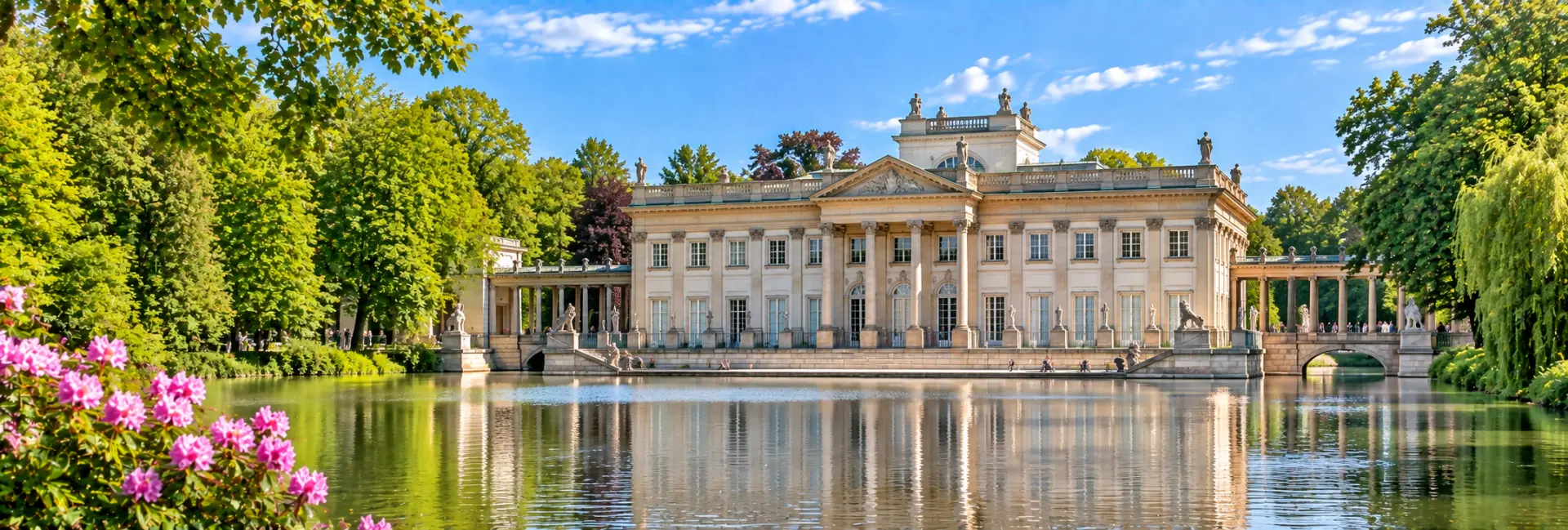
The Palace on the Isle (Pałac na Wyspie), also known as the Palace on the Water or the Łazienki Palace, is the crown jewel of Warsaw's Royal Łazienki Park. It stands on a small artificial island that divides the park's lake into two ponds, and it meets the shore by way of two bridges lined with Ionic colonnades. Its pale classical façades, mirrored in still water, make it one of the most photographed sights in the Polish capital.
The building was the summer retreat of Stanisław August Poniatowski, the last king of Poland, who turned a Baroque bathhouse into a refined home for art, conversation and Enlightenment ideas. Today it forms part of the Royal Łazienki Museum, and visitors can walk through its ballroom, galleries and the king's private rooms.
History
A Baroque Bathhouse
The story begins in the late seventeenth century, when Stanisław Herakliusz Lubomirski, a powerful magnate and owner of nearby Ujazdów Castle, added several garden pavilions to his estate. The largest was a marble bathhouse, designed by the architect Tylman van Gameren, begun before 1683 and completed in 1689. It combined bathing rooms with a habitable garden pavilion and a grotto-like interior, and it was richly decorated with stucco, sculpture, paintings and Dutch blue tiles.
The King's Summer Residence
King Stanisław August Poniatowski acquired the estate in the 1760s and decided to make the bathhouse his private summer home. From 1772, working with the architects Domenico Merlini and Johann Christian Kamsetzer, he had it rebuilt over several decades into the classical palace we see today. The ballroom was added in the late 1780s and early 1790s, and the surrounding grounds were reshaped into a park.
Here the king hosted his famous Thursday Dinners, informal gatherings that brought together writers, artists and politicians of the Polish Enlightenment. His reign ended with the partitions of Poland, and after the Third Partition in 1795 he abdicated and never saw the palace's final form.
After the King
Following Poniatowski's death in 1798, the estate passed to his family, and from 1817 it belonged to Tsar Alexander I. In the interwar years, when Poland was independent again, the Łazienki complex served representative purposes for the Republic. During the German occupation, the palace was used as a barracks.
War and Restoration
In 1944, during the destruction of Warsaw, German troops looted the palace and set it on fire. They drilled around a thousand holes in the walls for explosives, but the approaching front prevented them from blowing it up. The fire consumed the first floor, several ceilings and key painted decorations, including the Solomon Room paintings, although much of the collection had been evacuated to the National Museum earlier in the war.
The first restored rooms reopened to the public on 16 May 1960. A major conservation project between 2012 and 2015, costing over 48 million złoty, renewed the roof, façades, terrace structure and drainage, and uncovered hidden wall paintings by Jan Bogumił Plersch in the Ballroom.
Recognition / Status
The Palace on the Isle is part of the Historic Monument of Poland titled "Warsaw - historic city center with the Royal Route and Wilanów", a national designation dating from 8 September 1994. Łazienki lies roughly halfway along the Royal Route, the historic line of residences that links the Royal Castle in the Old Town with Wilanów Palace to the south.
The palace is the centerpiece of the Royal Łazienki Museum, which manages the park and around forty buildings on its 76 hectares. It is regularly counted among Poland's most visited heritage attractions, and it is one of the few Warsaw palaces to have survived the war in recognizable form.
Architecture & Setting
A Villa on the Water
The palace is a neoclassical building of two floors, with façades unified by a horizontal entablature carried on giant Corinthian pilasters. A balustrade along the roofline carries statues of mythological figures, giving the silhouette a lively rhythm against the sky. The north front is relieved by a central portico with a pediment, while the south front opens behind a screen of Corinthian columns.
Bridges and Lake
The island setting is central to the palace's charm. Two arcaded bridges with Ionic colonnades connect the building to the park, and the lake is divided into a smaller northern pond and a larger southern one.
Traces of the Original Bathhouse
Although Merlini and Kamsetzer transformed the exterior, elements of Lubomirski's building survive inside. In the Bathing Room you can still see seventeenth-century Dutch blue tiles, Baroque stucco and grotto features, including a fountain. These older layers give the palace a unique character, blending grotto, bathhouse and Enlightenment residence in one structure.
Notable Rooms on the Ground Floor
The Rotunda
At the heart of the ground floor, the Rotunda by Domenico Merlini is lined with yellow and white marble and decorated with figures of Polish kings. It is one of the finest neoclassical spaces in the palace and it links the Bathing Room with the Ballroom. It came through the 1944 fire comparatively unharmed.
The Ballroom
The Ballroom is a tall, two-tiered hall with rich stucco and painted decoration, added in the late eighteenth century to designs by Kamsetzer. Among its sculptures are statues of the Apollo Belvedere and the Farnese Hercules, which were saved from the wartime destruction. It remains one of the most impressive interiors in the palace.
The Solomon Room
The Solomon Room was the palace's grand reception space, and its walls once held a cycle of paintings by Marcello Bacciarelli showing the story of King Solomon, with Poniatowski's own features given to the biblical ruler. The original cycle was destroyed in 1944, and today Bacciarelli's easel paintings fill the wall niches. The room looks out over the northern pond and still conveys the ceremony of the king's court.
The Bacchus Room and the Dining Room
The Bacchus Room is decorated with seventeenth-century Dutch blue tiles and a painting from the circle of Jacob Jordaens showing Silenus and the Bacchantes. Its 1778 ceiling by Jan Bogumił Plersch was lost in the fire. The Dining Room recalls the Thursday Dinners, and its classical furniture and paintings evoke the intellectual spirit of the king's table.
The Picture Gallery and Chapel
On the far side of the Rotunda, the lower Picture Gallery shows works from the king's collection, including paintings by Rubens and Rembrandt, and is followed by a small chapel. Together the rooms give a sense of how the ground floor was arranged for both entertaining and quiet reflection.
Royal Apartments & Art Collections
The King's Private Rooms
The first floor holds the royal apartments, and this is where the palace feels most personal. Rooms here include the King's Study, the Bedchamber, the Dressing Room, a Library and the Balcony Room, all furnished in the style of the late eighteenth century. The fire of 1944 destroyed much of this floor, so its careful reconstruction is part of the story.
A Collector King
Poniatowski was one of the great collectors of his age, and he owned more than two thousand works of art. The palace's picture galleries preserve a sense of his arrangement, with Dutch and Flemish paintings given pride of place. Look for portraits and figure paintings by Rubens, Anthony van Dyck, Jan Brueghel the Younger and Frans Pourbus the Younger, among many others.
Decorative Arts
- Porcelain and vases from China and Japan, reflecting the era's taste for Asian decorative art.
- Sculpture and furniture from the king's circle, including Rococo and neoclassical pieces.
The Park Around the Palace
A Royal Park in the Heart of the City
The Royal Łazienki covers about 76 hectares, of which nearly five are water. The park was laid out largely in the 1770s and 1780s and combines the ordered lines of a French garden with the softer, curving landscape of an English one. It has around ten gates and forty buildings, making it much more than a backdrop for the palace.
Other Buildings to See
- The Old Orangery with the Royal Theatre, one of the few surviving court theatres in Europe.
- The Amphitheatre on the shore of the south pond, built as an open-air stage.
- The Myślewicki Palace and the White House, two smaller residences built for the king's circle.
- The Chopin Monument in the upper part of the park, a favorite gathering point in summer.
Life Around the Lake
Swans, ducks and squirrels are common sights, and peacocks wander the paths near the palace. Lawns, benches and shaded avenues make the park a favorite with locals as well as tourists.
Ways to Experience It
Touring the Interiors
Entry to the palace rooms requires a museum ticket, and you can choose between a ticket for the palace alone or combined tickets that include other sites in the complex. Guided tours are typically available in Polish and English, and they are worth considering if you want the stories behind the paintings and the Thursday Dinners. Plan on at least 45 minutes for the interiors.
A Slow Circuit of the Lake
Many visitors spend as much time outside the palace as in it. A gentle walk around both ponds lets you see the building from the bridges, the south shore and the upper park, and each viewpoint gives a different feel.
Chopin Concerts in Summer
From late spring to early autumn, free piano recitals are held on Sundays at the Chopin Monument in the upper part of the park. The palace sits in the lower part of the park, so allow time to walk between the two.
Best Time to Visit
By Season
- Spring: fresh greenery and blossoms frame the palace, and the park begins to fill with visitors.
- Summer: the busiest season, with full foliage, open-air concerts and long evenings, but also the biggest crowds at weekends.
- Autumn: golden and amber trees around the lake create some of the best photographs of the year.
- Winter: quiet and atmospheric, with frost on the lawns and fewer visitors in the interiors.
By Time of Day
The interiors do not open until mid-morning, but the park itself is pleasant early on, when the lake is calm and the light is soft. For a quieter experience inside the palace, aim for a weekday shortly after opening. Late afternoon is best for photography, when low sun warms the façade.
Visitor Tips
- The palace is inside the Royal Łazienki complex at ul. Agrykola 1. The park grounds are free to enter, but a ticket is needed for the palace interiors.
- Opening hours and ticket prices change seasonally, and the museum is usually closed on Mondays, so check the official Royal Łazienki website before you go. The museum has also offered free-entry days, so it is worth checking for these.
- Buses 116, 166 and 180 stop at Łazienki Królewskie on the northern edge of the park, and from there it is roughly a 10-minute walk to the palace. There is no metro or tram stop close by.
- Parking near the park is limited, especially on weekends and Sundays with concerts, so public transport or a bike is often easier. Veturilo city bike stations are available near the main entrances.
Nearby Attractions
Within the Park
The Old Orangery and Royal Theatre, the Chopin Monument, the Amphitheatre, the White House and the Myślewicki Palace are all a short stroll from the Palace on the Isle. Together they make it easy to fill half a day without leaving the grounds.
Just Beyond the Gates
Belweder Palace, a neoclassical residence, stands close to the park's northern edge, and the reconstructed Ujazdów Castle is a few minutes away and now serves as a center for contemporary art. The University of Warsaw Botanical Garden lies along Aleje Ujazdowskie, making a pleasant addition to a garden-focused day. For a longer excursion, the Royal Route continues south to Wilanów Palace.
FAQs about visiting the Palace on the Isle
What is the Palace on the Isle? +
It is a neoclassical royal residence in Warsaw's Royal Łazienki Park, built on an artificial island in the lake. It began as a Baroque bathhouse and became the summer home of King Stanisław August Poniatowski, the last king of Poland.
Do I need a ticket to visit the Palace on the Isle? +
Yes, a museum ticket is needed to enter the interiors, while the park grounds and the exterior views are free. The museum offers both single-site and combined tickets, and prices and free-entry days can change, so check the official website before your visit.
How long should I spend at the palace? +
Plan on at least 45 minutes for the interiors. If you also want to walk around the lake and see other buildings in the park, allow two to three hours.
When is the palace open? +
Opening hours vary by season, and the museum is usually closed on Mondays. Check the official Royal Łazienki site for current times, as they can change from year to year.
How do I get to the Palace on the Isle? +
Buses 116, 166 and 180 stop at Łazienki Królewskie at the northern edge of the park, and from there it is about a 10-minute walk to the palace. There is no metro or tram station nearby, and parking is limited on busy days.
What are the highlights inside the palace? +
The Rotunda, the Ballroom and the Solomon Room are the main ground-floor highlights, along with the Bacchus Room and the Picture Gallery. Upstairs, the royal apartments show how the king lived and worked.
Was the palace damaged in World War II? +
Yes. In 1944 German troops looted and burned it and prepared it for demolition, but the explosives were never detonated. The interiors were restored after the war, and the first rooms reopened in 1960.
What else is there to see nearby? +
Within the park you can visit the Old Orangery with the Royal Theatre, the Chopin Monument and the Amphitheatre. Just outside are Belweder Palace and Ujazdów Castle, both a short walk away.