
Table of Contents
Overview
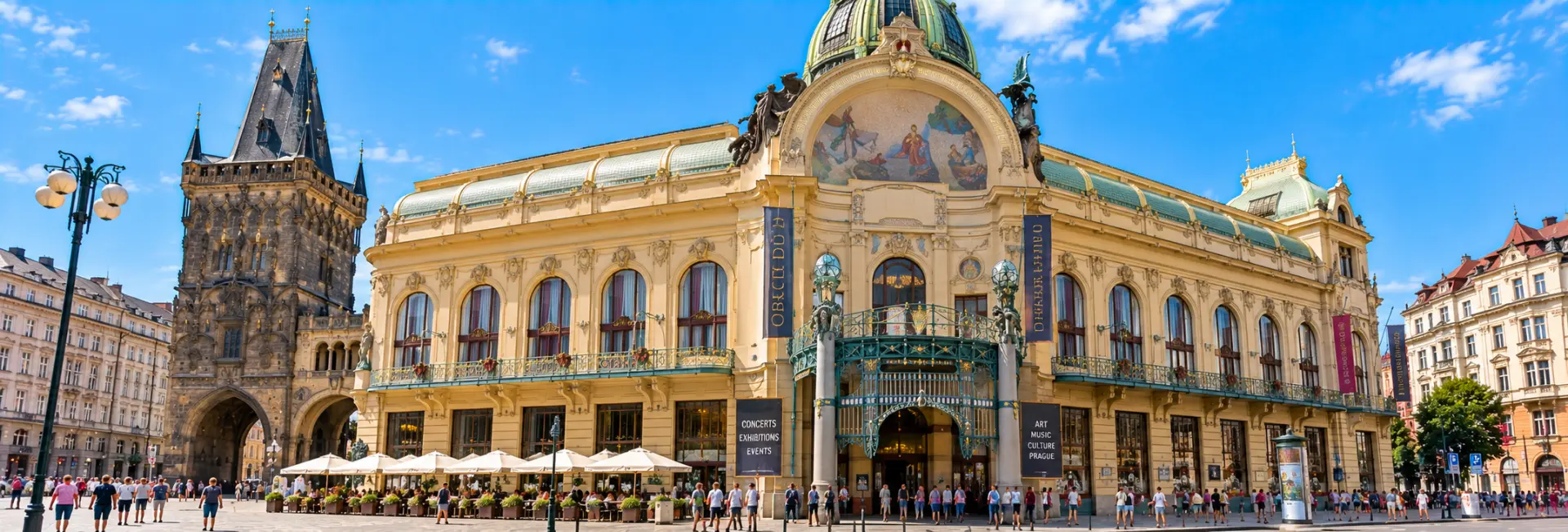
Standing beside the Gothic Powder Gate on Republic Square, the Municipal House is widely considered the most complete Art Nouveau building in Prague, a lavish civic hall completed in 1912 through the combined work of roughly thirty of the leading Czech artists of the day. Its facades, stained glass, mosaics, and sculpture were designed as a unified statement of Czech cultural identity at a time when the country was still part of the Austro-Hungarian Empire.
Beyond its decoration, the building carries real political weight: Czechoslovak independence was proclaimed inside its Smetana Hall on 28 October 1918, and the same hall hosted negotiations between the Civic Forum and the outgoing communist leadership during the 1989 Velvet Revolution. Today it functions as a concert venue, restaurant, café, and exhibition space, open to visitors both casually and through guided tours of its more ornate interior rooms.
History
A Royal Site Repurposed
The Municipal House stands on the site of the former Royal Court, a medieval palace that served as the residence of the Kings of Bohemia from 1383 until 1483, when King Vladislaus II relocated the royal seat to Prague Castle. The Royal Court fell into disrepair over the following centuries and was eventually demolished at the end of the 19th century, leaving the site available for the city's ambitions.
Building a Symbol of Czech National Life
Prague's city council approved construction of a new civic building on the site in the early 1900s, intended as a cultural counterweight to nearby German-associated institutions and as a home for Czech social and artistic life. Following an architectural competition, the project was awarded to architects Antonín Balšánek and Osvald Polívka, with construction running from 1905 to 1912 and drawing on the talents of numerous painters, sculptors, and decorative artists working in the Art Nouveau style then at its height.
The Birthplace of Czechoslovakia
On 28 October 1918, representatives of the Czechoslovak National Committee proclaimed the independence of Czechoslovakia inside the building's Smetana Hall, making the Municipal House one of the country's most significant sites of modern political history. Just over seven decades later, in November 1989, the hall again played a political role when representatives of the opposition Civic Forum movement met with officials of the outgoing communist government there during the Velvet Revolution.
Architecture & Design
The Facade and Homage to Prague
The building's main facade is dominated by a large semicircular mosaic titled Homage to Prague, created by Karel Špillar, flanked by allegorical sculpture groups by Ladislav Šaloun representing the humiliation and rebirth of the Czech nation. Further sculptural figures along the roofline personify history, literature, painting, music, and architecture, summarizing the cultural ambitions behind the entire project.
Smetana Hall
At the heart of the building lies Smetana Hall, a grand concert space seating around 1,200 people beneath an Art Nouveau glass dome, designed by Antonín Balšánek with ceiling paintings by František Ženíšek and stucco decoration by Karel Novák. The hall remains home to the Prague Symphony Orchestra and traditionally opens the annual Prague Spring music festival each May with a performance of Smetana's symphonic cycle Má vlast.
The Lord Mayor's Hall and Mucha's Murals
Among the building's more exclusive interior spaces, the octagonal Lord Mayor's Hall was decorated by artist Alfons Mucha between 1910 and 1911, who painted its domed ceiling with an allegory titled Slavic Concord along with wall panels celebrating Slavic history and unity. The room remains one of the most significant surviving examples of Mucha's work in a public interior setting.
Recognition & Status
The Municipal House lies within the Historic Centre of Prague, part of the UNESCO World Heritage Site inscribed in 1992, and is separately protected as a Czech national cultural monument in recognition of both its architecture and its political history. It is widely regarded by architectural historians as the fullest expression of Art Nouveau civic design in the Czech Republic, distinguished by the sheer number of major artists who contributed to a single building.
Its dual significance, as a masterwork of early 20th-century design and as the site of Czechoslovakia's 1918 founding declaration, gives it a status in Czech public memory that extends well beyond its architectural merits alone.
What to See Inside
The building's ground-floor café, restaurant, and American Bar are accessible without a ticket and are themselves richly decorated in Art Nouveau style, offering a taste of the interior's craftsmanship without booking a tour. The more elaborate ceremonial rooms upstairs, including Smetana Hall and the Lord Mayor's Hall, are generally seen only through a guided tour or by attending a concert.
- The Homage to Prague mosaic and sculptural facade, visible from Republic Square
- Smetana Hall, with its glass dome and concert stage
- The Lord Mayor's Hall, decorated by Alfons Mucha
- The ground-floor café, restaurant, and American Bar
- Rotating exhibitions held in the building's gallery spaces
Ways to Experience It
Visitors can experience the Municipal House at several levels of depth, from simply admiring the exterior on Republic Square to attending a concert in Smetana Hall or joining a guided tour of the upper-floor reception rooms. Guided tours, run in multiple languages, are typically the only way to see the Lord Mayor's Hall and other decorated interiors not open to casual visitors.
- Book a guided tour to see Smetana Hall, the Lord Mayor's Hall, and other ceremonial rooms
- Attend a concert in Smetana Hall, particularly during the Prague Spring festival each May
- Have a coffee or meal in the ground-floor café or restaurant to see Art Nouveau interiors without a ticket
- View temporary exhibitions held in the building's gallery space
- Combine a visit with a walk through the adjoining Powder Gate
Best Time to Visit
Guided tours run throughout the year, though booking ahead is worthwhile in peak summer months when demand is highest. Attending a concert in Smetana Hall offers a different, more immersive way to experience the building, and the Prague Spring festival each May draws particular attention to the hall with its opening night tradition.
Because much of the appeal lies indoors, the Municipal House makes a reasonable stop regardless of weather or season, unlike many of Prague's outdoor landmarks.
Visitor Tips
A little planning helps visitors see more of the building than its public ground floor alone.
- Book a guided tour in advance if visiting Smetana Hall and the Lord Mayor's Hall is a priority, since access outside of tours or concerts is limited
- Check the concert schedule if interested in seeing Smetana Hall in use rather than on a static tour
- Visit the ground-floor café or restaurant for a lower-cost way to see the building's Art Nouveau interiors
- Look up at the facade from across Republic Square to take in the full Homage to Prague mosaic
- Combine a visit with the neighboring Powder Gate, which can be climbed separately
Nearby Attractions
The Municipal House sits on the edge of Old Town, close to several of Prague's other major landmarks.
- Powder Gate, directly adjacent to the building
- Old Town Square and the Astronomical Clock, a short walk down Celetná Street
- Wenceslas Square, reachable via Na Příkopě Street
- Municipal House's own café and restaurant, for a stop without a full tour
- Náměstí Republiky shopping and transit hub, including the Palladium mall
FAQs about visiting the Municipal House
What is the Municipal House? +
The Municipal House, or Obecní dům, is an Art Nouveau civic building in Prague completed in 1912, home to Smetana Hall and decorated by dozens of leading Czech artists of the early 20th century.
Why is the Municipal House historically important? +
Czechoslovak independence was proclaimed inside its Smetana Hall on 28 October 1918, and the hall later hosted negotiations during the 1989 Velvet Revolution, giving the building a central place in modern Czech political history.
Can you visit the inside of the Municipal House for free? +
The ground-floor café, restaurant, and bar are open without a ticket, but the upstairs ceremonial rooms, including Smetana Hall and the Lord Mayor's Hall, generally require a guided tour or concert ticket.
What did Alfons Mucha paint in the Municipal House? +
Mucha decorated the octagonal Lord Mayor's Hall between 1910 and 1911 with a domed ceiling allegory called Slavic Concord along with wall panels on Slavic unity and history.
What is Smetana Hall used for today? +
It remains an active concert hall, home to the Prague Symphony Orchestra and the traditional opening venue of the annual Prague Spring music festival each May.
Where is the Municipal House located? +
It sits on Republic Square in Prague's Old Town, directly beside the Gothic Powder Gate.
Do you need to book a tour in advance? +
Booking ahead is recommended, particularly in peak season, since guided tours are the main way to see the building's most decorated interior rooms.
What else is nearby? +
The Powder Gate sits right next door, and Old Town Square and Wenceslas Square are both within easy walking distance.
