
Table of Contents
Overview
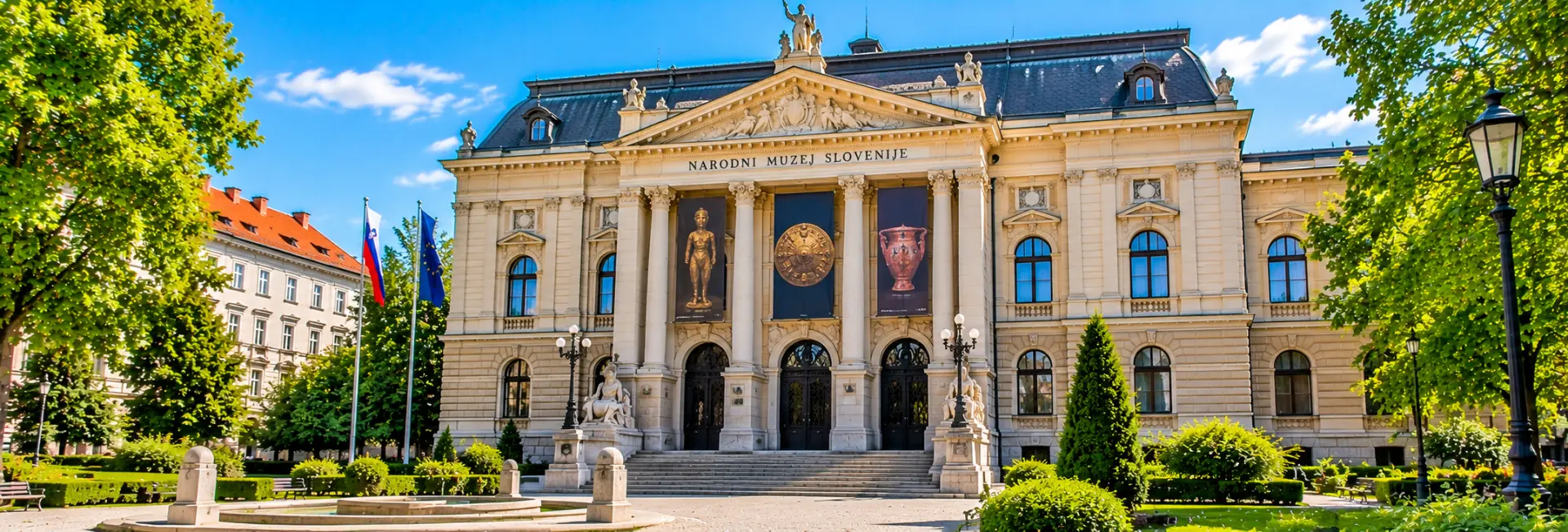
The National Museum of Slovenia is the country's oldest museum and the best single place in Ljubljana to understand how people lived on this land, from Stone Age hunters to the generations who shaped modern Slovenia. Its main home is a grand palace in the heart of the city, just a few steps from the Slovenian Parliament and the Opera and Ballet Theatre.
The museum is best known for its archaeology. Here you can see a flute made by Neanderthals, a richly decorated Iron Age bucket from the village of Vače, a gilded Roman statue found in the ancient city of Emona and the only Egyptian mummy held in Slovenia. Alongside these headline objects sit thousands of finds from lake dwellings, river beds, Roman streets and early medieval graves.
The experience is calm, compact and rewarding. You do not need to be a history expert to enjoy it, because the displays are built around stories and striking objects rather than long lists of dates. Many visitors give it an unhurried hour or two and leave with a much clearer picture of the ground they have been walking on in Ljubljana.
History of the Museum
A Provincial Museum from 1821
The story begins in 1821, when the Provincial Museum of Carniola was founded, making it the oldest museum institution in Slovenia. It started life as a place to gather natural specimens, antiquities and curiosities from the region, and its early collections included minerals gathered by the Carniolan nobleman Baron Sigmund Zois.
Becoming the National Museum
The institution took the name National Museum after the First World War, in 1921. In the following decades it gradually shed some of its broader holdings to new specialist institutions. The ethnographic collections left in 1923 to form the Slovene Ethnographic Museum, and much of the fine art went to the new National Gallery of Slovenia in 1933. The natural science collections became an independent museum in 1944, though they stayed in the same building.
A Second Venue and a Bicentenary
A major step came in 2008, when the museum opened additional premises in the Metelkova museum quarter, giving its applied arts and history collections a modern home of their own. The museum also looks after the permanent displays at Bled Castle and Snežnik Castle. In 2021 it marked its 200th anniversary, an occasion that drew fresh attention to how much of the national story its objects tell.
Architecture & Building
A Palace for Culture
The main museum building on Prešernova cesta is a neo-Renaissance palace designed by the Slovenian architect Viljem Treo and built in the 1880s. It was completed in 1888 as the home of the Provincial Museum, which is why it was originally called the Rudolfinum, after Crown Prince Rudolf. It was the first building in Slovenia intended purely for culture, and it still looks the part.
Inside the Rudolfinum
Visitors climb a monumental staircase lined with sculpture and pass beneath richly painted ceilings before reaching the galleries. The building wraps around an inner courtyard with two wings. In 1991 that courtyard was covered over to create a bright atrium, which now hosts temporary exhibitions and events.
A Shared Home
The palace also houses the Slovenian Museum of Natural History, which has stayed here since it became independent in 1944. This means that on a single visit to the building you can step from Roman archaeology to a mammoth skeleton and a collection of minerals and mounted animals. The two museums are separate institutions with their own displays, so check which one you are entering.
Collections & Exhibits
Prehistoric Treasures
The prehistoric exhibition brings together the most important archaeological finds from the Stone Age through to the Iron Age. This is where the Neanderthal flute and the Vače situla are on show. The displays also cover the lake-dwelling communities of the Ljubljana Marshes, who were building pile-dwelling settlements as far back as the third millennium BC, and an ancient wooden dugout canoe that survived in the marsh peat.
Roman Stories from the Crossroads
This exhibition covers the centuries when the territory of present-day Slovenia belonged to the Roman Empire. It was created for the 2000th anniversary of Emona, the Roman city that stood on the site of modern Ljubljana. More than a thousand objects are displayed, along with films, sculptural reconstructions and reconstruction paintings that help you picture the streets, homes and workshops of the time. A key piece is an imperial building inscription dated to 14 or 15 AD, which offers evidence for when Emona was founded.
The Roman Lapidarium
Alongside the main Roman displays, a lapidarium shows carved stone monuments, inscriptions and architectural fragments from across the Roman-era lands of Slovenia. Stone has a way of surviving where other materials do not, and these pieces are a direct link to people who lived here nearly two thousand years ago.
Rivers, Migration and the Middle Ages
Rich discoveries from the Ljubljanica River, including weapons, tools and personal items deposited or lost over thousands of years, fill another part of the story. Later periods are represented by Germanic ornaments from the age of migrations, early medieval jewellery and arms, and wooden traps from the early Middle Ages. A further exhibition follows the history of the Slovenes from the arrival of the Slavs to the present, using the Slovenian language as its central thread.
Must-See Highlights
If your time is limited, these are the objects that visitors and the museum itself tend to single out:
- The Neanderthal flute: found in the Divje Babe cave, it is widely presented as the oldest known musical instrument in the world. The museum dates it to roughly 60,000 years ago, though scholars have debated its exact age and origin.
- The Vače situla: a bronze ritual vessel from around 500 BC, decorated with scenes of feasting, riding and processions. It is a familiar image in Slovenian schoolbooks.
- The Citizen of Emona: a monumental gilded bronze statue from Roman times. A copy stands on a column in nearby Kongresni trg.
- The ancient dugout canoe: a wooden boat from the Ljubljana Marshes, remarkable for the fact that something so fragile endured for thousands of years.
- The Egyptian mummy: the only mummy of its kind in Slovenia, known by the name Ishata, with related objects from ancient Egypt.
- The imperial inscription from Emona: a stone text that helps date the founding of Roman Ljubljana.
The Metelkova Branch
The second venue of the museum is found a few blocks from the main building, at Maistrova ulica 1 in the Metelkova museum quarter. The site was once a military barracks, and it now forms part of a district of museums and cultural institutions. The museum's building there combines the restored old structure with a glass-clad extension.
Applied Arts and History
On the upper floors, the permanent collection presents the heritage of applied arts in Slovenian lands, with arts and crafts items, industrial design and unique design pieces made from the 14th century to today. It is a good complement to the archaeology on Prešernova cesta, since it shows how everyday objects and craft traditions developed across five centuries.
Temporary Exhibitions
The ground floor hosts changing exhibitions and public events. Past shows at Metelkova have ranged from medieval warriors and knights to Slovenes who explored the lands along the Nile. Because the programme changes, it is worth checking what is on before you plan your visit.
Ways to Experience It
Exploring on Your Own
The permanent exhibitions are easy to follow independently, with clear themes and objects that speak for themselves. Starting with the prehistoric collection and moving on to the Roman galleries follows the order of history, and each section can be enjoyed separately if you only have time for one.
Guided Visits and Workshops
The museum runs guided tours and educational programmes for groups, school classes and families. If you want a deeper interpretation of the finds, or an activity suited to children, it is worth contacting the museum in advance to see what is on offer for your dates.
Combined Tickets
A combined ticket is available for the museum's two departments, one on Prešernova cesta and the other at Metelkova. That makes it easy to see both in one go, and it is a good choice if you are interested in the full sweep from prehistory to design. Some groups, such as preschool children, are admitted free, so check the official conditions.
Events in the Atrium
The covered atrium above the entrance foyer is also used for concerts, receptions and other events when it is not needed for the museum's main work. If you are planning a private occasion, the museum is a distinctive setting.
Best Time to Visit
Opening Hours
The museum is open every day of the week, generally from 10:00 to 18:00, with a late opening until 20:00 on Thursdays. It is closed on 1 January, 1 May, 1 November and 25 December. These are the hours published for 2026, and they can change, so confirm them on the official website before you go.
Time of Day and Season
The museum is rarely overwhelming, but quieter periods are generally easiest to find on weekday mornings and during the Thursday evening session. As a fully indoor attraction, it is a reliable plan in any season, especially on wet or cold days when outdoor sightseeing in Ljubljana is less appealing.
How Long to Allow
A focused visit to the main building takes around an hour to two hours, depending on your level of interest. If you add the Metelkova branch or a temporary exhibition, allow a good half-day in total.
Visitor Tips
A few practical points will help you get the most from your visit:
- Know which museum you are entering: the building is shared with the Slovenian Museum of Natural History, and the two have separate displays.
- Start with the prehistoric rooms: the Neanderthal flute and the Vače situla are the most famous objects, and seeing them first gives context for everything that follows.
- Take your time on the labels: the stories behind the objects are what bring them to life, and the exhibitions include films and reconstructions that make the past easier to picture.
- Plan for accessibility: the museum can be reached by wheelchair users through the entrance at Prešernova cesta 20, and the Metelkova venue is also accessible.
- Check ticket options: admission prices and free-entry categories can change, and a combined ticket may suit you if you want to see both venues.
- Check the temporary programme: special exhibitions rotate, so look at the official website for what is on during your dates.
- Allow for the weather: since the museum is in the city centre, it is easy to combine with a walk, but it also works nicely as a shelter on a rainy day.
Nearby Attractions
The museum's central position on Prešernova cesta makes it easy to build a longer walk around it. Some good additions:
- Slovenian Museum of Natural History: housed in the same building, with its mammoth skeleton and natural history collections.
- National Gallery of Slovenia: just along the street, it holds the fine art that once belonged to the National Museum's collections.
- Slovenian Parliament and the Opera and Ballet Theatre: imposing neighbours that are worth a look from the outside as you pass.
- Tivoli Park: the city's large central park is a short walk away and is ideal for stretching your legs after a museum visit.
- Kongresni trg and Zvezda Park: here you can see the copy of the Roman Citizen of Emona statue, which links back to what you have just seen inside the museum.
- Metelkova museum quarter: the museum's second venue, set among several other cultural institutions in a former barracks complex.
FAQs about visiting the National Museum of Slovenia
What is the National Museum of Slovenia known for? +
It is the oldest museum in Slovenia and is best known for its archaeology, including the Neanderthal flute from Divje Babe, the Vače situla, Roman finds from Emona and the country's only Egyptian mummy.
Where is the museum and how do I find it? +
The main building is at Prešernova cesta 20 in central Ljubljana, right beside the Slovenian Parliament and the Opera and Ballet Theatre. The building is also referred to as being on Muzejska street, which is the side street it faces.
What are the opening hours? +
The museum is generally open daily from 10:00 to 18:00, with a late opening until 20:00 on Thursdays. It closes on 1 January, 1 May, 1 November and 25 December, but you should confirm the current hours on the official website.
How much does it cost to get in? +
Prices vary by ticket type, and some categories of visitor are admitted free, so check the official website for current rates. A combined ticket is available for the main building and the Metelkova venue.
How long should I spend there? +
Plan on roughly one to two hours for the main building. If you also visit the Metelkova branch or a temporary exhibition, a half day is a comfortable allowance.
Is the museum suitable for children? +
Yes, and the mummy, the Roman reconstructions and the ancient canoe tend to capture young imaginations. The museum also offers educational programmes, so ask about activities for families or school groups.
Is the museum accessible for wheelchair users? +
Wheelchair users can access the main building via the entrance at Prešernova cesta 20, and the Metelkova venue is also accessible. If you have specific needs, contact the museum in advance.
What is the Metelkova branch? +
It is the museum's second venue at Maistrova ulica 1, in the Metelkova museum quarter, and it presents Slovenian applied arts from the 14th century to the present along with changing exhibitions.
What should I combine with a visit? +
The Slovenian Museum of Natural History is in the same building, and the National Gallery, Tivoli Park and Kongresni trg are all a short walk away.
