
Table of Contents
Overview
Sponza Palace stands at the eastern end of Stradun, where Dubrovnik's main street opens into Luža Square. It is one of the most graceful buildings in the Old Town, and one of the very few major public buildings that came through the great earthquake of 1667 largely intact.
The palace was built in the early 16th century to serve the Republic of Ragusa as its customs house and trading hub. Goods, coins, weights and measures, and official business all passed through its doors, which made it the commercial heart of a city-state that lived on the sea.
Today the building has a very different role. It houses the Dubrovnik State Archives, hosts exhibitions and concerts in its arcaded courtyard, and contains a Memorial Room dedicated to the defenders who died during the siege of the city in the early 1990s.
For visitors, Sponza Palace works on three levels at once: as an architectural showpiece, as a window into how the old republic functioned, and as a place of remembrance. It is compact enough for a short visit, yet rich enough to be one of the most rewarding stops on a walk through the Old Town.
History of the Palace
A customs house for a trading republic
Work on the palace began in 1516 and finished in 1522. The design is credited to Paskoje Miličević Mihov, a leading Dubrovnik architect of his day, while the stone carving was carried out by skilled masons from the island of Korčula, including the Andrijić brothers. The building replaced earlier customs facilities and gave the republic a purpose-built home for its trade administration.
Merchants arriving by sea and by land brought goods here to be weighed, taxed and stored. The palace also housed the state mint, so the coins of the republic were struck within the same walls where its commerce was recorded.
Many roles over the centuries
Over time the building took on a series of other functions. At different periods it served as a treasury, an armory, a bank and a school, a flexibility that reflects how central it was to public life in Ragusa.
Surviving the 1667 earthquake
On the morning of 6 April 1667, a powerful earthquake devastated Dubrovnik, destroying much of the city and killing many of its people. Sponza Palace was among the few major structures that remained standing with little damage. Historians point to the solid stonework and sound construction of the building, although the exact reasons it fared so well are not fully understood.
That survival matters for visitors today. Because so much of the Old Town was rebuilt in the Baroque style afterward, Sponza is one of the best places to see what Dubrovnik looked like before the disaster.
From republic to archives
After the republic ended, the palace continued to serve the city in different capacities. In the mid-20th century it became the permanent home of the State Archives, whose records had earlier been kept at the Rector's Palace.
Architecture and Notable Features
A blend of Gothic and Renaissance
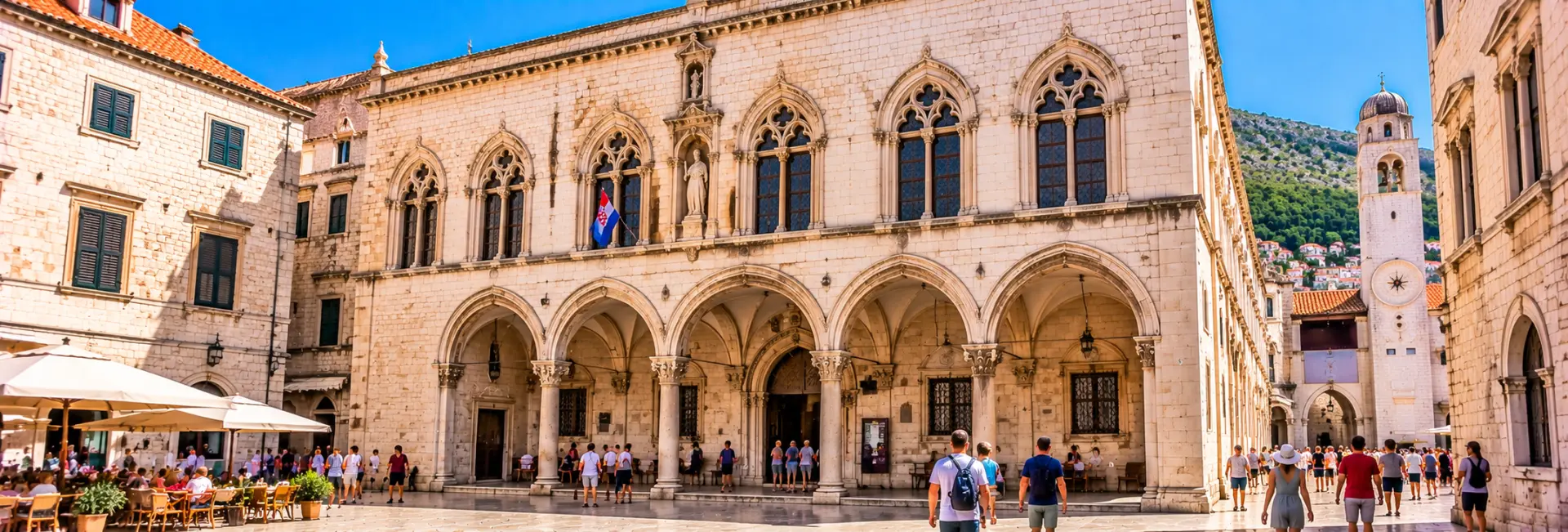
The palace is a rectangular building arranged around an inner courtyard, and its facade is a textbook example of the transitional Gothic-Renaissance style found in Dubrovnik. You can read its design from bottom to top, as the lower and upper floors express different tastes.
- The ground floor opens onto Stradun through a Renaissance portico, with round arches resting on slender columns.
- The first floor has elegant late-Gothic windows with delicate stone tracery.
- The upper floor has Renaissance-style windows, and an alcove holds a statue of Saint Blaise, the patron saint of the city.
The atrium
Inside, a calm and shaded courtyard is surrounded by arcades. Doors around it once led to storage rooms for goods awaiting inspection and taxation. Today the space is used for exhibitions, recitals and festival events, and its acoustics and atmosphere make it a favorite venue.
The inscription on the scales
One of the best-known details is a Latin inscription above an arch in the courtyard. It declares that the weights here prevent both cheating and being cheated, and adds that when merchandise is weighed, God himself weighs it alongside the official. It is a neat summary of the republic's pride in honest trade.
Materials and craftsmanship
The palace is built of fine local limestone, and the carved details, reliefs and decorative stonework show the quality of the craftsmen who worked on it. Look closely at the capitals and ornamental sculpture, which reward a slower look than most visitors give them.
Culture, Memory and Meaning
A home for scholars and writers
Sponza was not only a place of commerce. In the 16th century it became associated with a literary academy known as the Academia dei Concordi, which gathered local writers and thinkers. The building therefore stood for both the practical and the intellectual sides of life in the republic.
A keeper of the city's memory
The State Archives held here are among the richest collections of their kind in Europe. The earliest surviving document dates to 1022, and the records cover centuries of the republic's laws, diplomacy, trade and daily life. The original documents are kept in storage and are not open to the general public, but copies of important pieces are displayed for visitors.
Remembering the siege
Just inside the entrance, the Memorial Room of the Defenders of Dubrovnik honors the people who lost their lives between 1991 and 1995. The room is made up largely of photographs of the defenders, many of whom were very young. It is a quiet, moving space that connects the long history of the city to its modern experience of war.
A center of festival life
Luža Square, in front of the palace, is the traditional setting for the opening ceremony of the Dubrovnik Summer Festival, which has been held every summer since 1950. The palace atrium also serves as one of the festival's venues, so the building remains very much part of the city's cultural calendar.
What to See Inside
The Memorial Room
Many visitors choose to begin here, just inside the entrance and before the courtyard. The gallery of black-and-white portraits gives helpful context to the city you are walking through, and it deserves a few quiet minutes.
The courtyard and arcades
The atrium is the architectural highlight of the interior. Stand in the center and look up at the arches, balconies and stonework, then walk the arcades to see the old doorways that once opened onto the storerooms.
Archive displays
Rooms around the courtyard present reproductions of historical documents, including charters, maps and manuscripts that reveal how the republic handled trade and diplomacy. Some explanatory text is provided in English. The displays are modest in scale, so most visitors find that a short visit is enough.
Temporary exhibitions
The courtyard and nearby halls sometimes host temporary exhibitions and cultural events. What is on varies from season to season, so it is worth checking the current program before your visit.
Ways to Experience It
As part of an Old Town walk
The simplest way to see Sponza is to include it in a stroll along Stradun. You can admire the facade from the street or from Luža Square, then step inside for the courtyard and the memorial room. Most people spend between twenty minutes and an hour here.
On a guided tour
Many walking tours of the Old Town pass the palace and explain its role in the republic's trade and its survival in 1667. A guide can also help you spot details, such as the portico, the windows and the statue, that are easy to miss on your own.
At a festival or concert
If your dates line up, attending an evening event in the atrium can be one of the most atmospheric experiences in the Old Town. Check festival and event schedules in advance, as popular performances can sell out.
For photography
The portico and facade are especially photogenic in soft morning or late-afternoon light. The view from Luža Square, with the bell tower beside the palace, is among the most photographed scenes in Dubrovnik.
Best Time to Visit
Seasons
The palace can be visited through the year, although the exact opening times and the program of exhibitions change with the season. The busiest period is summer, when cruise ships and tour groups fill Stradun, while spring and autumn offer a calmer pace and more comfortable temperatures for walking.
Winter is the quietest time, and the courtyard feels especially peaceful then, though some events and opening hours are reduced.
Time of day
- Early morning is the best moment for photos of the facade and for a quiet look inside before the crowds arrive.
- Midday is the busiest period on Stradun, so the square in front of the palace can feel packed.
- Evening can be magical in summer, when festival performances and the glow of the stone create a memorable atmosphere.
Opening hours differ between the summer and winter seasons, so confirm the current times before planning your day.
Visitor Tips
- Check the current opening hours and ticket details before you go, as they vary by season and may change from year to year.
- Start with the Memorial Room, then continue to the courtyard, to follow the story in a natural order.
- Allow around thirty to sixty minutes, or longer if you want to browse the archive displays or attend an event.
- Dress respectfully and keep your voice low in the Memorial Room, which is a place of remembrance.
- Go early in summer to avoid crowds around Luža Square and the bell tower.
- Look up as well as ahead, since the windows, reliefs and statue on the facade are easy to miss from street level.
Accessibility
The Old Town is pedestrian only, with polished stone paving that can be slippery when wet. The palace is at the flat, central end of Stradun, which makes it easier to reach than much of Dubrovnik, but visitors with mobility needs should confirm access to the interior and the courtyard in advance.
Nearby Attractions
City Bell Tower
The slender bell tower stands right beside the palace and marks the eastern end of Stradun. Its distinctive clock face and the old bell are among the city's best-known sights.
Orlando's Column
This carved stone column in Luža Square has long been the center of public life in Dubrovnik. Proclamations were read here in the days of the republic, and flags are still raised beside it during the summer festival.
Church of St Blaise
The Baroque church on the square is dedicated to the city's patron saint, whose image appears in sculpture throughout the Old Town, including on Sponza Palace itself.
Rector's Palace
A short walk away, the former seat of the republic's government is now a museum and offers a counterpart to Sponza, showing the political rather than the commercial side of Ragusa.
Dubrovnik Cathedral and the Old Port
The cathedral and the old harbor are both close by, and together with Stradun and the city walls they make it easy to build a full day of sightseeing around the palace.
FAQs about visiting Sponza Palace
What is Sponza Palace? +
It is a Gothic-Renaissance palace built between 1516 and 1522 as the customs house and trading center of the Republic of Ragusa. Today it holds the Dubrovnik State Archives, a memorial room and a courtyard used for exhibitions and events.
Where is Sponza Palace located? +
It stands at Stradun 2, at the eastern end of Dubrovnik's main street, beside the City Bell Tower and facing Luža Square. It is within easy walking distance of everything in the Old Town.
Why is Sponza Palace so famous? +
It is one of the few major buildings in the Old Town that survived the earthquake of 1667 with little damage. It is also admired for its mix of Gothic and Renaissance architecture and for its long role in the life of the republic.
How long should I spend at Sponza Palace? +
Most visitors need around thirty to sixty minutes to see the courtyard, the Memorial Room and the archive displays. Allow more time if you plan to attend a concert or exhibition.
Do you need a ticket to visit Sponza Palace? +
Entry arrangements, prices and opening hours can change by season and over time, so check the current details with the official source before you go. The facade can always be admired for free from Stradun and Luža Square.
What is the Memorial Room of the Defenders of Dubrovnik? +
It is a gallery just inside the entrance that honors the people who died defending the city between 1991 and 1995. It consists mainly of black-and-white photographs and is a place for quiet reflection.
Can you see the original archives at Sponza Palace? +
The original records are kept in storage and are not open to general visitors. Copies of important documents, maps and manuscripts are displayed in the rooms around the courtyard.
Is Sponza Palace suitable for children and visitors with limited mobility? +
It is a short and easy visit for most families, though the Memorial Room deals with a serious subject. The paving can be uneven and slippery, so visitors with limited mobility should check access to the interior before going.
