Table of Contents
Overview
The Magritte Museum is dedicated entirely to Belgium's best-known surrealist, Rene Magritte, and holds the largest collection of his work found anywhere. Inside a stately 18th-century mansion on the Place Royale, familiar images of bowler-hatted men, pipes that insist they are not pipes, and skies folded into ordinary rooms line the walls in roughly chronological order.
Rather than a single-building highlight reel, the museum functions as a full archive of Magritte's career, tracing his shifts in style over four decades and reaching beyond painting into his photography, films, and personal archives.
History of the Museum
Filling a Gap
Despite Magritte's international fame, Brussels had no museum dedicated solely to his work until relatively recently. The Magritte Museum was created to fill that gap, drawing together paintings and archival material scattered across private and public collections into a single dedicated institution.
Opening in 2009
The museum was inaugurated in May 2009 and opened its doors to the public shortly after, in early June of that year, becoming one of the constituent museums of the Royal Museums of Fine Arts of Belgium. Its opening was widely covered as a long-overdue tribute to one of the country's most recognizable cultural exports.
Building the Collection
Much of the museum's collection comes from the estate of the artist's widow, Georgette Magritte, along with the holdings of Irene Hamoir-Scutenaire, one of Magritte's most significant early collectors. Public funding and corporate sponsorship also supported the renovation of the museum's building, allowing archival material and artworks previously held in private hands to be brought together under one roof.
Architecture & Building
The Hotel du Lotto
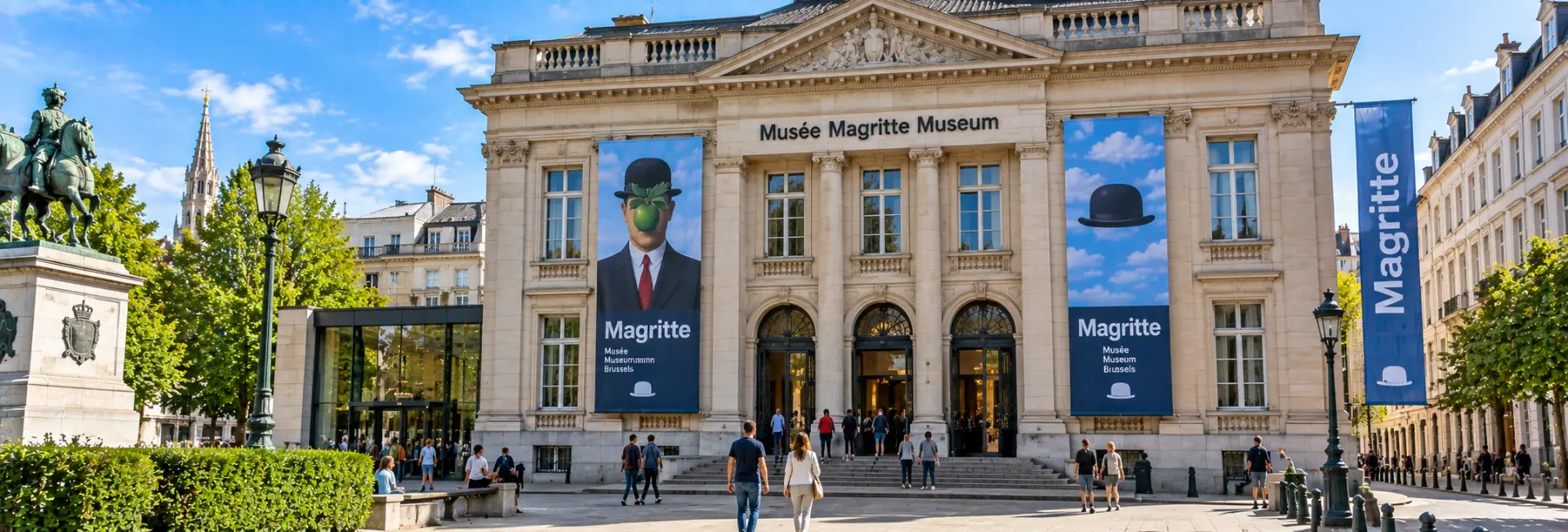
The museum occupies the Hotel du Lotto, also known as the Hotel Altenloh, a five-level neoclassical townhouse dating from the late 18th century. The building forms part of the elegant row of white facades lining the Place Royale, a square built after fire destroyed the earlier Coudenberg Palace that once stood on the site.
From Mansion to Museum
Originally built as a private residence, the building later passed through several commercial uses before its interior was substantially reworked to accommodate the museum's galleries. The renovation preserved the mansion's grand exterior while creating a more contemporary, climate-controlled exhibition space inside.
Connected to the Old Masters Museum
An underground passage links the Magritte Museum to the neighboring Old Masters Museum, allowing visitors to move between the two collections without stepping back outside, part of the wider museum complex on and around the Place Royale.
Collections & Exhibits
The permanent collection includes roughly 200 original paintings, drawings, and sculptures, making it the most complete gathering of Magritte's work in a single location. Galleries are arranged to follow the artist's development chronologically, moving from his early experiments through the mature surrealist style for which he became famous.
Beyond the paintings, the museum holds a significant archive of Magritte's photography, personal letters, and short surrealist films he directed later in his career, giving a fuller picture of an artist who worked across several media rather than painting alone.
Must-See Highlights
- Several of Magritte's best-known compositions, exploring his signature imagery of bowler hats, pipes, and impossible skies
- Early works showing the artist's brief cubist and other experimental phases before he settled into his mature surrealist style
- Personal photographs and short films directed by Magritte himself, offering a more intimate view of his working life
- Archival letters and documents drawn from the estate of the artist's widow and his early collectors
- A short documentary screened regularly in the museum, providing context on Magritte's life and career
Ways to Experience It
Most visitors move through the galleries in the chronological order they're arranged, tracing Magritte's evolution from early influences toward his mature, instantly recognizable style. Regular screenings of a documentary on the artist's life are available for those wanting more context than the wall text alone provides.
Since the museum connects underground to the Old Masters Museum, many visitors combine both collections in a single, longer museum visit rather than treating them as separate trips.
Best Time to Visit
Weekday mornings tend to be quieter, particularly outside peak summer tourist season, giving more room to spend time in front of individual works. As with many single-artist museums, a visit can be relatively compact, so pairing it with a nearby collection or a walk around Place Royale makes for a fuller morning or afternoon.
Because the museum draws Magritte fans from well beyond Brussels, weekends and holiday periods can bring larger crowds, so early entry is worth considering if the goal is a quieter viewing experience.
Visitor Tips
- Photography rules can be stricter here than in some other museums, given the sensitivity of certain works and archival material, so check current policy before assuming photos are allowed
- The connected Old Masters Museum makes a natural add-on, so consider a combined ticket if visiting both
- The museum's compact size means a visit can be shorter than expected for those used to larger art institutions, so plan the rest of the day accordingly
- Metro stations Parc and Trone both sit within walking distance, along with a short walk from Brussels-Central train station
Nearby Attractions
The museum sits directly on Place Royale, within easy walking distance of the Royal Palace, Mont des Arts, and the Musical Instruments Museum, which faces it from across the square.
The Grand Place and the historic city center are a short walk downhill, making it easy to pair a Magritte Museum visit with a broader tour of central Brussels landmarks.
FAQs about visiting the Magritte Museum
When did the Magritte Museum open? +
It was inaugurated in May 2009 and opened to the public shortly afterward in early June of that year.
How many works are in the collection? +
The museum holds roughly 200 original paintings, drawings, and sculptures, making it the largest single collection of Magritte's work anywhere.
What building is the museum in? +
It occupies the Hotel du Lotto, an 18th-century neoclassical mansion on the Place Royale, one of Brussels' grandest public squares.
Is the Magritte Museum connected to another museum? +
Yes, an underground passage links it directly to the neighboring Old Masters Museum, allowing visitors to see both without going back outside.
How long does a visit take? +
Most visitors spend one to two hours in the galleries, making it easy to combine with another museum or a walk around the surrounding Royal Quarter.
Where does the collection come from? +
Much of it comes from the estate of the artist's widow, Georgette Magritte, along with the holdings of his early collector Irene Hamoir-Scutenaire.
Does the museum show anything besides paintings? +
Yes, it also displays Magritte's photography, personal letters, and short surrealist films he directed later in his career.
How do you get to the Magritte Museum? +
The Parc and Trone metro stations are both within walking distance, and it's a short walk from Brussels-Central train station.