
Table of Contents
Overview
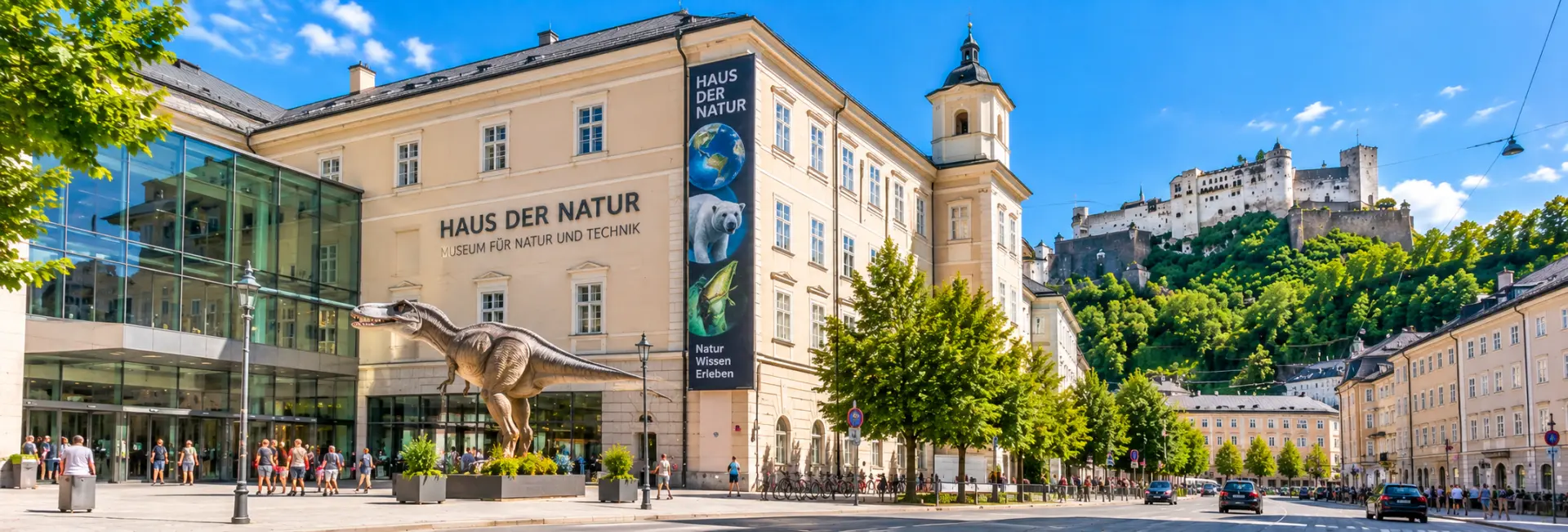
Haus der Natur is Salzburg's big museum of nature and technology, and it is a place where a family can easily spend a whole rainy morning. Spread across more than 7,000 square metres, it combines a classic natural history museum, a live-animal section and an interactive Science Center under one roof.
Visitors move through very different worlds in a single visit. Rooms are devoted to prehistoric life and the Ice Age, the cosmos and a hall about space, the human body, crystals and the oceans. Elsewhere, tanks of fish and terrariums of reptiles and amphibians bring the animal kingdom to life.
The museum is aimed at curious people of all ages. Children enjoy the experiments and the animals, while adults often linger over the historic dioramas, the science of everyday phenomena and the stories of Salzburg's natural environment. The museum itself says its approach is to let people discover things for themselves rather than simply read labels.
History of the Museum
A Private Initiative from 1924
Zoologist Eduard Paul Tratz founded the museum in 1924 under the name New Natural History Museum. It began in the former Hofstallkaserne, a stable barracks on the site now occupied by the Salzburg Festival Hall. In 1936 it was renamed Haus der Natur, the name it still carries.
The Nazi Era and Its Aftermath
After Austria's annexation by Germany in 1938, the museum was folded into the SS research organisation Ahnenerbe. According to the museum's own account, Tratz led a department there, identified with its aims and expanded the Haus der Natur in line with Nazi ideology. After the war, management passed to the Viennese psychologist Maximilian Piperek, and Tratz returned as director in 1949 and remained in the post until 1976.
The museum describes this chapter in its own history pages, and it also presents a permanent exhibition titled Tibet and the museum's history.
Moving and Growing
In 1959 the museum moved to its current home, the former Ursuline convent on Museumsplatz. Under the next director, Eberhard Stüber, the inner courtyard was renovated, the reptile zoo opened in 1982 and the aquarium in 1983. After the Salzburg Museum left its old premises in 2007, the vacated rooms next door were adapted for an expansion. The museum reopened in 2009 as the Museum of Nature and Technology, with a new Science Center and a hall for special exhibitions.
Architecture and Building
The main wing of the museum occupies a historic building built by Fischer von Erlach between 1713 and 1726. It is a listed monument and forms part of the Historic Centre of the City of Salzburg, which UNESCO added to the World Heritage List in 1996.
The museum entrance opens onto Museumsplatz, and the building stretches back towards the Salzach river and Franz-Josefs-Kai. Despite its age, the whole museum was redesigned to be barrier-free, with an access ramp at the entrance, stairlifts to some areas and accessible toilets on the ground floor and in the café.
The interior shows how an old convent can be turned into a modern museum. Historic rooms and courtyards sit beside bright new exhibition spaces, and the Science Center and the special exhibition hall were created after the Salzburg Museum vacated the neighbouring premises. As a result, a visit mixes baroque architecture with contemporary exhibition design.
Collections and Exhibits
The permanent exhibitions cover a wide sweep of natural science. Many are built around dioramas, for which the museum is well known.
- Prehistoric Times and Dinosaurs: Colossal animals from a bygone age.
- Ice Age and Evolution: Displays that explain how life and landscapes changed over time.
- Our Universe: Planets, stars and galaxies, presented in the outer space hall, which includes a Mercury space capsule from the early days of spaceflight.
- Journey into the Human Body: A tour through the organs and systems of the body.
- The Animal Kingdom on Earth: Mammals, birds and many other groups arranged in lifelike scenes.
- The World of Oceans: Marine habitats and the creatures that live in them.
- Salzach Lifeline: The river that runs through the city and its role for nature and people.
- Earth Through the Ages and Crystal Treasures: Geology, minerals and the history of the planet.
- Habitats Diorama: Diorama scenes of different habitats.
- Christian Doppler, Genius from Salzburg: A tribute to the physicist born in the city, famous for the Doppler effect.
- Man and Animal in Fables and Myths: A look at animals in folklore and storytelling.
The museum also acts as a research hub. It houses the national natural science collections and runs a biodiversity database documenting species in the city and province of Salzburg, as well as in the High Tauern National Park.
Aquarium and Reptile Zoo
The Aquarium
The aquarium has 38 display tanks, and the largest holds nearly 60,000 litres of water. Each tank recreates a habitat, from tropical coral reefs and the Mediterranean to waters in Africa, South America and Southeast Asia, as well as local rivers and lakes. The tanks aim to show animals behaving as they do in nature.
On certain weekdays the aquarium hosts public feedings, with different species on different days, including octopus and moray eel, archerfish and piranhas. No reservation is needed, but the schedule can change, so check the museum's website before you visit.
The Reptile and Amphibian Zoo
The reptile zoo opened in 1982 and was among the most modern live-animal departments in Europe at that time. After a major renovation that began in November 2022, it reopened on 28 March 2025 with larger terrariums that recreate tropical Africa and Asia, savannahs, deserts and native habitats. Species that live alongside each other in the wild share the same enclosure.
A dedicated room now focuses on the amphibians and reptiles of Austria, which supports the museum's emphasis on local biodiversity and conservation. The zoo combines display space with live-animal presentations.
The Science Center
The Science Center is described as the most comprehensive in Austria, and it invites visitors to touch, test and try rather than just look. It is spread over several floors, each with its own theme.
- Energy and lifting (bottom floor): Levers, a large hydraulic lift, water-power and solar experiments, and an area where you can dam and redirect water.
- Acoustics and music (first floor): Experiments with sound waves and hearing, including a violin you can walk on so you can feel Mozart's music through your feet, plus singing and volume tests.
- Physics and technology (second floor): Bridge building, compressed-air rockets, floating balls and experiments on forces, gears and powders.
- Body and fitness (second floor): A ski jump simulator, a balance test on skis once used by a world champion and a wheelchair course that gives a first-hand sense of physical limitations.
The hands-on style makes this part of the museum especially popular with school groups and families, and it is the section where adults are most likely to forget the time.
Ways to Experience It
- Do a full circuit: Plan on around three hours to see the main exhibitions, the live animals and a good part of the Science Center.
- Focus on one theme: If time is short, choose between the animals, the space and dinosaur halls, or the experiments.
- Time your visit to a feeding: Check the aquarium schedule so you can watch octopus, archerfish or piranhas at mealtime.
- Ask about guided options: Contact the museum in advance if you would like a tour or a programme for a group.
- Look into the observatory: The museum operates an observatory with guided tours, and visits there need separate arrangements.
- Take a break at the Science Café: The café and restaurant on the first floor offer a place to rest between sections.
- Add a temporary exhibition: The special exhibition hall hosts changing shows, so see what is on before you go.
Best Time to Visit
As an indoor museum, Haus der Natur works in every season, and it is a reliable plan for rainy afternoons or cold winter days. It is also a useful counterweight to a morning outdoors on the Mönchsberg or in the Old Town.
School holidays and rainy days are likely to bring more visitors, since this is a popular indoor option. Arriving soon after opening is a sensible way to start more calmly.
If you want to see the aquarium feedings, plan the visit around the day and time listed on the museum's website. The reptile zoo opens at a fixed hour each morning, so build it into the first part of your day rather than leaving it for the end.
Visitor Tips
- Check the official website for current opening hours, ticket prices and the latest temporary exhibitions, as these change.
- Online tickets are available through the museum's website.
- Allow about three hours for a thorough visit, and more if you travel with children who like to experiment.
- The museum is largely barrier-free, with a ramp at the entrance, stairlifts in some areas and accessible restrooms, and staff are on hand to help.
- If you arrive by car, the Altstadtgarage A is the nearest car park, and the museum suggests having your parking ticket stamped at the box office for a discount.
- Public transport is the easiest option. Buses stop at the Mönchsbergaufzug stop, about 50 metres from the entrance.
- The Salzburg Card includes admission, which can make the museum a good-value stop if you plan several sights.
- Wear comfortable shoes and bring a small bag, as the visit involves a lot of walking and stairs between floors.
Nearby Attractions
The museum sits in the middle of the Old Town between the Salzach river and Museumsplatz, so many of Salzburg's headline sights are within a short walk.
- Mönchsberg lift and Museum der Moderne: The lift station is only a few steps away and takes you up to the cliff-top museum and terrace.
- Getreidegasse and Mozart's Birthplace: The famous shopping street and the composer's birthplace are just a few minutes' walk.
- Mozartplatz and Residenzplatz: These two baroque squares, with the Mozart monument and the grand fountain, lie close to the museum.
- Salzburg Cathedral: The cathedral stands near the Residenz and is one of the key religious landmarks in the Old Town.
- Salzach riverbank: A stroll along the river gives views towards the fortress and the Old Town skyline.
- Hohensalzburg Fortress: The hilltop castle can be reached on foot or by funicular and rewards the effort with sweeping views.
FAQs about visiting Haus der Natur
What is Haus der Natur? +
Haus der Natur is Salzburg's natural history and science museum, with more than 7,000 square metres of exhibits. It includes dinosaur and Ice Age displays, an aquarium, a reptile and amphibian zoo, a space hall and a hands-on Science Center.
Where is Haus der Natur located? +
The museum is at Museumsplatz 5 in the Old Town, between the Salzach river and the square it is named after. The nearest bus stop is Mönchsbergaufzug, about 50 metres from the entrance.
How much time do I need? +
Plan about three hours for a full visit. If you are short on time, concentrate on one or two areas such as the aquarium and reptile zoo or the Science Center.
Is Haus der Natur good for children? +
Yes, it is one of the best family attractions in the city. The live animals, the space and dinosaur halls and the hands-on experiments are popular with children of many ages.
Is the museum accessible for wheelchair users and strollers? +
Yes, the museum was designed to be barrier-free, with an access ramp at the entrance, stairlifts to certain areas and accessible restrooms. Staff can assist if needed.
Can I visit with a Salzburg Card? +
Yes, admission is included with the Salzburg Card according to travel information. Check the current terms on the museum's or the tourist board's website before you go.
Are there animal feedings I can watch? +
The aquarium holds public feedings on some weekdays, with different species featured on different days, and no advance reservation is needed. Check the museum's website for the current schedule.
How do I get to Haus der Natur by car or public transport? +
Buses stop at Mönchsbergaufzug and Ferdinand-Hanusch-Platz within a short walk. By car, the nearest parking is the Altstadtgarage A, and you follow the exit signed for the Mönchsberg lift and Haus der Natur.
