
Table of Contents
Overview
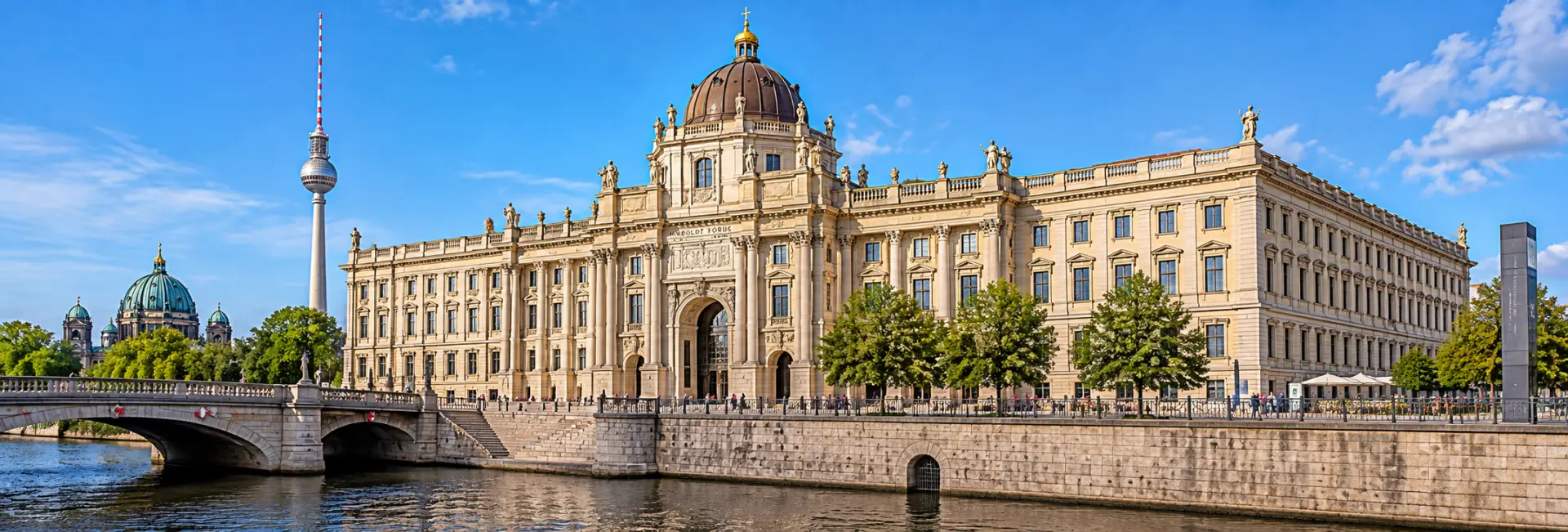
The Humboldt Forum occupies one of the most contested and closely watched building projects in modern Berlin: a near-complete reconstruction of the city's Baroque royal palace, rebuilt on the same spot in the historic centre after decades of political and public debate. Behind its restored facades sits a thoroughly contemporary institution, bringing together non-European art collections, a permanent exhibition on Berlin's global history, and free public spaces under one roof.
Named after the Prussian brothers Wilhelm and Alexander von Humboldt, the Forum sits directly across the Spree from Museum Island, making it a natural extension of Berlin's most concentrated cluster of museums. Visitors can move between centuries-old baroque courtyards and strikingly modern galleries within the same visit, which is part of what makes the building itself as much a draw as anything inside it.
History
The Original Berlin Palace
A residence has stood on this site since the 15th century, when the Elector of Brandenburg laid the foundation stone for a fortified castle in 1443. Over the following centuries it was expanded and rebuilt repeatedly, taking on its familiar Baroque form largely through the work of architect Andreas Schlüter from 1702 onward, with later additions including the dome designed by Karl Friedrich Schinkel's student, Friedrich August Stüler. For roughly two centuries the palace served as the main residence of the Electors of Brandenburg, the Kings of Prussia, and eventually the German Emperors.
Demolition and the Palace of the Republic
The palace suffered heavy damage during Allied bombing raids in the Second World War, but its structure was largely salvageable. East Germany's government chose to demolish the ruins in 1950 anyway, for ideological reasons tied to erasing symbols of the Prussian and imperial past, and replaced the site with a parade ground before building the Palace of the Republic there in 1976. That modernist GDR-era building, a parliament and cultural venue, was itself closed in 1990 after asbestos contamination was discovered, and demolition of it was completed by 2008.
Reconstruction and Opening
Following German reunification, a lengthy and often heated public debate unfolded over what should replace the site. In 2002 the German Bundestag voted to reconstruct three of the palace's Baroque facades and its dome, while giving the river-facing fourth side a contemporary design by Italian architect Franco Stella. Construction began with a ceremonial first stone laid in 2013, and the sandstone ornamentation for the facades was hand-carved over several years at a dedicated workshop in Berlin-Spandau.
The building was structurally completed in 2020, and its collections and exhibitions opened to the public in stages starting in July 2021, with further sections following over the next year. The total cost of the reconstruction ran to roughly €700 million, funded through a mix of public money and private donations, making it one of the most expensive and most debated cultural building projects in Germany's recent history.
Architecture
Three of the Humboldt Forum's four sides faithfully reproduce the Baroque facades and portals of the original Berlin Palace, rebuilt from historical plans and surviving fragments using traditional stone-carving techniques. The fourth, river-facing side takes a deliberately different approach: Franco Stella's contemporary design uses the same proportions as the historic building without imitating its ornamentation, creating a visible seam between old and new.
Inside, the building organizes its roughly 30,000 square metres of exhibition space around large courtyards that function as informal public squares, open to anyone regardless of whether they have a museum ticket. A dome rising to about 30 metres tops the building and offers views across the surrounding historic centre, including Berlin Cathedral, the Rotes Rathaus, and the boulevard Unter den Linden toward the Brandenburg Gate.
Collections & Exhibitions
The Humboldt Forum functions less like a single museum than a shared building for several institutions, each occupying its own floors and galleries.
- Ethnologisches Museum (Ethnological Museum) — around 20,000 objects on display from Africa, the Americas, and Oceania, including carved meeting houses, ceremonial masks, and archived sound recordings; its Africa galleries include an exhibition on the history of the Benin Bronzes and Germany's ongoing restitution of looted colonial-era objects to Nigeria
- Museum für Asiatische Kunst (Museum of Asian Art) — collections spanning Buddhist sculpture, Chinese court art, and a reconstructed Japanese tea room, exploring both historical craftsmanship and contemporary Asian art
- BERLIN GLOBAL — an interactive exhibition on the ground floor exploring Berlin's relationship with the rest of the world through themed rooms covering topics such as revolution, boundaries, fashion, and war
- The Palace Cellar — excavated foundations and archaeological remains from earlier structures on the site, viewable free of charge
- Humboldt Laboratory — a changing exhibition space run in partnership with Humboldt University, free to enter
Several areas of the building, including the stairwell mural cycle, the sculpture hall, and the video panorama, are open to the public without a ticket, which means visitors can experience a meaningful part of the Forum without paying for admission to the ticketed collections.
Ways to Experience It
Because the building houses several distinct institutions, most visitors plan their time around which collections matter most to them rather than trying to see everything in one pass.
- A single combined ticket covers the Ethnological Museum, the Museum of Asian Art, BERLIN GLOBAL, and most temporary exhibitions, so one purchase unlocks the whole ticketed program
- The free areas — the Palace Cellar, sculpture hall, video panorama, and Humboldt Laboratory — can be visited without any ticket at all
- A dedicated smartphone app offers self-guided tours through the building, including a room-by-room audio tour of BERLIN GLOBAL, available free of charge
- Guided tours and workshops can be booked in advance for both the permanent collections and temporary exhibitions
- Time-slot tickets are recommended, since individual exhibitions can each take upward of ninety minutes to see properly
Best Time to Visit
The Humboldt Forum's exhibitions are generally open Wednesday through Monday, with Tuesday as a regular closing day; hours typically run from mid-morning into the early evening, with last admission around an hour before closing. Because opening days and hours shift around holidays, it's worth checking the current schedule before planning a visit, especially around the December holiday period.
Weekday mornings tend to be quieter than weekend afternoons, and booking a specific time slot in advance helps avoid queuing, particularly for the popular BERLIN GLOBAL exhibition. Visiting outside the main summer tourist season also makes it easier to move through the building's larger galleries at a relaxed pace.
Visitor Tips
- Book time-slot tickets online in advance, since walk-up admission can mean longer waits, especially for BERLIN GLOBAL
- Budget at least half a day if you want to see both the Ethnological Museum and the Museum of Asian Art properly, since each runs to around ninety minutes on its own
- If short on time or budget, the free areas — the Palace Cellar, sculpture hall, and video panorama — offer a worthwhile 30 to 45 minute visit without a ticket
- Enter through Portal 3 on the west side for the main exhibitions, or via the revolving-door entrance in the Passage through Portals 2 and 4
- Reach the Forum via U-Bahn line U5 to Museumsinsel, or by bus and tram routes stopping at Lustgarten and Am Kupfergraben; it's also an easy walk from Alexanderplatz or Unter den Linden
FAQs about visiting the Humboldt Forum
What is the Humboldt Forum? +
It's a cultural institution in Berlin's reconstructed Baroque palace that combines non-European art collections, a Berlin history exhibition, and free public spaces under a single roof.
Is the Humboldt Forum a new building or a historic one? +
Both — three of its facades are faithful reconstructions of the original 18th-century Berlin Palace, while the fourth side and much of the interior are entirely new, completed in 2020.
Is entry to the Humboldt Forum free? +
Some areas are free, including the Palace Cellar, sculpture hall, video panorama, and Humboldt Laboratory, while the Ethnological Museum, Museum of Asian Art, and BERLIN GLOBAL require a ticket.
How much time should I plan for a visit? +
Each major exhibition takes roughly ninety minutes to see properly, so a full visit covering both museums and BERLIN GLOBAL is realistically a half-day outing; the free areas alone can be seen in 30 to 45 minutes.
How do I get to the Humboldt Forum? +
The closest stop is Museumsinsel on U-Bahn line U5, with additional bus and tram connections nearby; it's also within easy walking distance of Alexanderplatz and Unter den Linden.
What are the Benin Bronzes and why are they at the Humboldt Forum? +
They're historic bronze and ivory artworks from the Kingdom of Benin, looted by British troops in 1897 and later acquired by German museums; Germany transferred ownership of most of them to Nigeria in 2022, and a portion remain on loan for display in the Ethnological Museum's galleries, which explain this history directly.
What's nearby the Humboldt Forum? +
Museum Island sits directly across the Spree with its cluster of major museums, and the Berlin Cathedral, Unter den Linden, and the Nikolai Quarter are all within a short walk.
Do I need to book tickets in advance? +
Booking a time-slot ticket online in advance is recommended, since it secures entry for a specific time and helps avoid queues, especially for the popular BERLIN GLOBAL exhibition.
