Table of Contents
Overview
Iglesia del Salvador is Seville's second-largest church after the Cathedral, and for visitors willing to look past its plain exterior, it holds one of the most richly decorated Baroque interiors in the city. Locals simply call it "El Salvador," and it stands on the Plaza del Salvador, one of the liveliest small squares in the old town, only a short walk from the Cathedral itself.
What sets El Salvador apart from most Baroque churches is what lies underneath and around it: the building rises on the footprint of Seville's principal medieval mosque, itself built over an earlier Roman and Visigothic site, and traces of every layer of that history are still visible today. A single ticket typically covers both the gilded 18th-century church above ground and an excavated crypt below it that walks visitors back through more than two thousand years of the city's past.
Despite drawing far fewer visitors than the Cathedral just around the corner, many people who make the short walk over come away considering it one of the more rewarding stops in the historic centre, precisely because it rarely feels crowded even during peak tourist season.
History
From Roman Site to Great Mosque
The ground beneath El Salvador has been used for public and religious buildings since Roman times, when a basilica is believed to have stood on the site, followed by a Visigothic-era structure. After the Muslim conquest of Iberia, the site became home to Seville's main mosque, built in the 9th century during the reign of the Umayyad emir Abd al-Rahman II. For several centuries this was the city's principal place of worship, larger and older than the later Almohad mosque whose minaret survives today as the Cathedral's Giralda tower.
Conversion and Slow Decline
When Seville fell to the Christian forces of King Ferdinand III in 1248, the mosque was consecrated as a church, much as other mosques across the city were converted rather than demolished outright. For roughly four centuries the building continued to serve as a church largely within its original Moorish structure, gradually deteriorating until it was judged unsafe. By the mid-17th century the ageing structure had become such a concern that church authorities began planning a full replacement rather than further patchwork repairs, a decision that would take decades to carry out.
Rebuilding as a Baroque Church
The old building was largely torn down around 1670, and construction of the church seen today ran from about 1674 to 1712 under the Sevillian architect Leonardo de Figueroa, one of the leading names in the city's Baroque period. Work did not go entirely smoothly: part of the new structure is said to have collapsed during construction, prompting the use of deep reinforced piling to stabilize the final building. Figueroa incorporated the base of the old mosque's minaret into the church's own bell tower rather than starting the tower from scratch, physically fusing the two periods of the building's history into one structure.
Later Restoration and the Crypt
The church underwent an extensive restoration in the early 2000s, completed around 2008, which included excavating and opening the underground levels beneath the building to the public for the first time. That work uncovered building remains spanning the Roman, Visigothic, and Islamic periods, which are now presented together as an underground archaeological route beneath the Baroque church above.
Architecture & Design
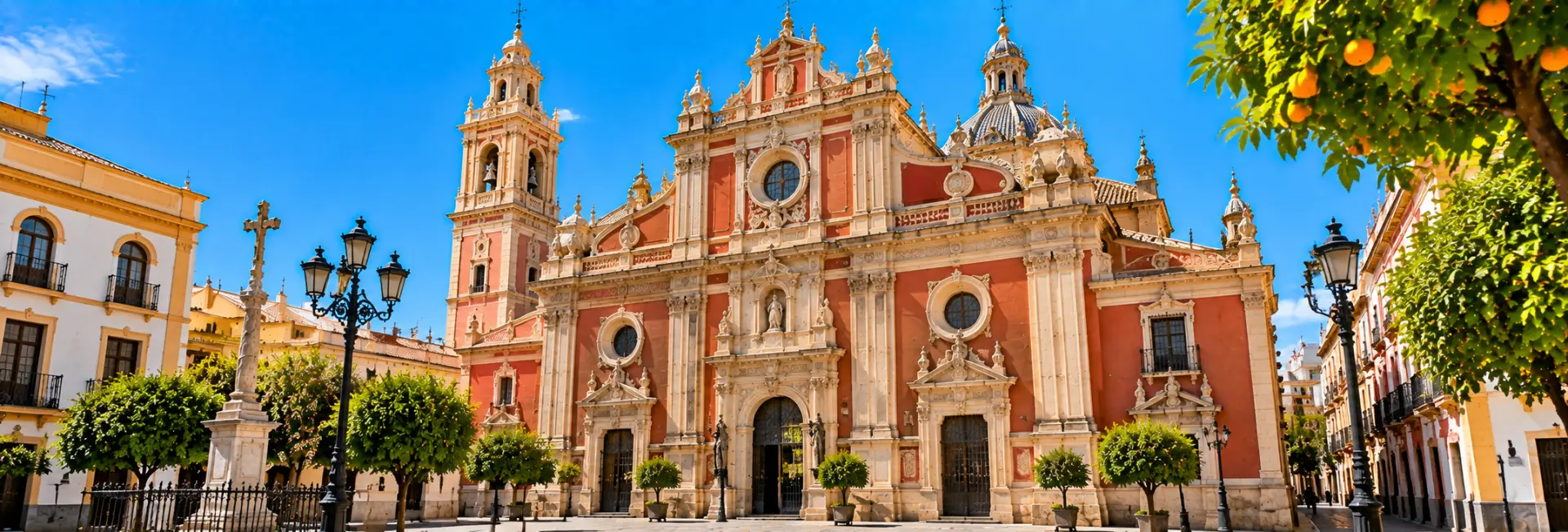
From the outside, El Salvador is deliberately understated: a wide Mannerist facade in warm-toned stone and brick gives little hint of the lavish interior beyond its doors, and the church's slender bell tower, built around the base of the old mosque's minaret, is often mistaken for just another rooftop among the surrounding buildings of the old town. That contrast between a modest exterior and an overwhelming interior is part of what makes a first visit so striking.
Inside, the church follows a Latin cross plan with three naves and a dome over the crossing, lined on both sides with a remarkable fourteen separate altarpieces, most dating from the 18th century. The nave itself frames long sightlines toward the towering main altarpiece at the far end, drawing the eye upward through tier after tier of gilded woodwork. Thick piers and reinforced foundations, added after part of the structure reportedly gave way during construction, support the building's considerable weight, a practical response to the collapse that shaped how the rest of the church was engineered.
Just outside the main church, the Patio de los Naranjos, or Courtyard of the Orange Trees, preserves the layout and some physical fabric of the original mosque's ablutions courtyard, complete with rows of orange trees, a central fountain, and fragments of Roman and Visigothic columns and arches built into its walls. The courtyard can be entered separately from either the main square or the neighbouring street, and it offers one of the clearest visual links anywhere in Seville between the city's Islamic-era past and its later Christian architecture.
Cultural & Religious Significance
El Salvador functions as an active parish church as well as a visitor attraction, and it plays a significant role during Seville's Holy Week, or Semana Santa, one of the most important religious festivals in Spain. Several of the sculpted images kept inside the church are carried in Holy Week processions each year, drawing large crowds who follow the routes through the city's streets, with the church itself serving as the starting point for its own religious brotherhood's annual procession.
The church's underground crypt also holds the remains of members of the Spanish royal family from the Bourbon-Orléans branch, adding a layer of national historical significance to what is otherwise primarily a religious and civic landmark for the city of Seville. Beyond its formal religious role, the building also stands as a physical record of how Seville's different ruling cultures each left their mark on the same patch of ground rather than replacing it outright, something local guides often point to as one of the clearest examples of that layered history anywhere in the city.
Notable Features
The main altarpiece, completed between 1770 and 1778 by the sculptor Cayetano de Acosta, is considered one of the finest examples of Sevillian Baroque woodcarving, rising in gilded tiers toward the ceiling and depicting scenes including the Transfiguration of Christ. The Sacramental Chapel holds a second altarpiece by the same artist, often singled out by visitors and art historians alike as an equally accomplished piece of work, and together the two altarpieces are usually treated as the highlight of any visit.
- Sculptures by Juan Martínez Montañés, including a revered image of Jesus of the Passion carried in Holy Week processions
- A Christ figure by Juan de Mesa, another leading sculptor of Seville's Golden Age religious art
- An 18th-century organ, still used for services and occasional concerts
- A 14th-century Mudéjar-Gothic funerary chapel belonging to the Pineda family, accessible from the orange tree courtyard
- The underground "Footprint of the Sacred" route, displaying Roman, Visigothic, and Islamic-era remains beneath the church
- Remnants of the original mosque's minaret, preserved within the base of the current bell tower
Visiting Etiquette & Tips
As an active place of worship, El Salvador expects the same quiet, respectful behaviour as any working church: modest dress, lowered voices, and no visiting during scheduled Mass times, when tourist access to parts of the building is typically paused. Shoulders and knees are generally expected to be covered, and hats are usually removed on entering.
- A combined ticket with Seville Cathedral is available and often works out cheaper than paying separately
- Photography is generally allowed without flash, though this can vary during services
- The underground crypt route involves stairs, so those with mobility concerns should ask staff about alternative access
- The church tends to be quieter than the Cathedral, making it a good option for a calmer visit
- Check opening hours before visiting, since they can shift around religious holidays and Holy Week
- Guided tours of the crypt and side chapels run at set times and are worth checking for on arrival
Best Time to Visit
Mornings and early afternoons on weekdays tend to be the quietest time to visit, since many travelers head straight for the Cathedral and only add El Salvador as a second stop later in the day, if at all. Visiting during Holy Week offers a very different experience, with the church at the centre of citywide processions, though it is also by far the busiest and most crowded time to be in Seville generally, so anyone visiting mainly for a peaceful look at the interior may prefer to avoid that particular week.
Because most of the visit takes place indoors, including the underground crypt, the church makes a comfortable option during the hottest hours of a Seville summer afternoon, when many outdoor sights are best avoided.
Nearby Attractions
El Salvador sits right in the heart of Seville's historic centre, within a few minutes' walk of several of the city's best-known sights.
- Seville Cathedral and the Giralda tower, a short walk away and often visited on the same ticket
- The Real Alcázar, the city's royal palace and gardens
- Casa de Pilatos, a noble palace known for its tilework and courtyards
- The lively tapas bars and shops around Plaza del Salvador itself
FAQs about visiting Iglesia del Salvador
What is Iglesia del Salvador known for? +
It's known for being Seville's second-largest church, built over a former mosque, with an understated exterior that hides an elaborately gilded Baroque interior and fourteen separate altarpieces.
Is it included with the Seville Cathedral ticket? +
A combined ticket covering both the Cathedral and Iglesia del Salvador is generally available and tends to be better value than buying separate tickets; check current pricing when booking.
How much time should I plan for a visit? +
Around 45 minutes to an hour is usually enough to see the main church and the underground crypt without rushing.
Can I visit the underground crypt? +
Yes, an archaeological route beneath the church, opened after restoration work in the 2000s, shows Roman, Visigothic, and Islamic-era remains and is included with general admission.
Is the church still used for religious services? +
Yes, it functions as an active parish church, so visiting hours pause around scheduled Masses and a respectful dress code applies throughout.
Is Iglesia del Salvador suitable for visitors with mobility needs? +
The main church is accessible, but the underground crypt involves stairs, so visitors with mobility concerns should check with staff about alternative arrangements.
What's the best time to visit to avoid crowds? +
Weekday mornings tend to be quieter, since most visitors prioritize the Cathedral first and treat this church as a secondary stop.
What's nearby if I want to see more of the historic centre? +
It's a short walk from Seville Cathedral, the Real Alcázar, and Casa de Pilatos, making it easy to combine with a wider day exploring the old town.