
Table of Contents
Overview
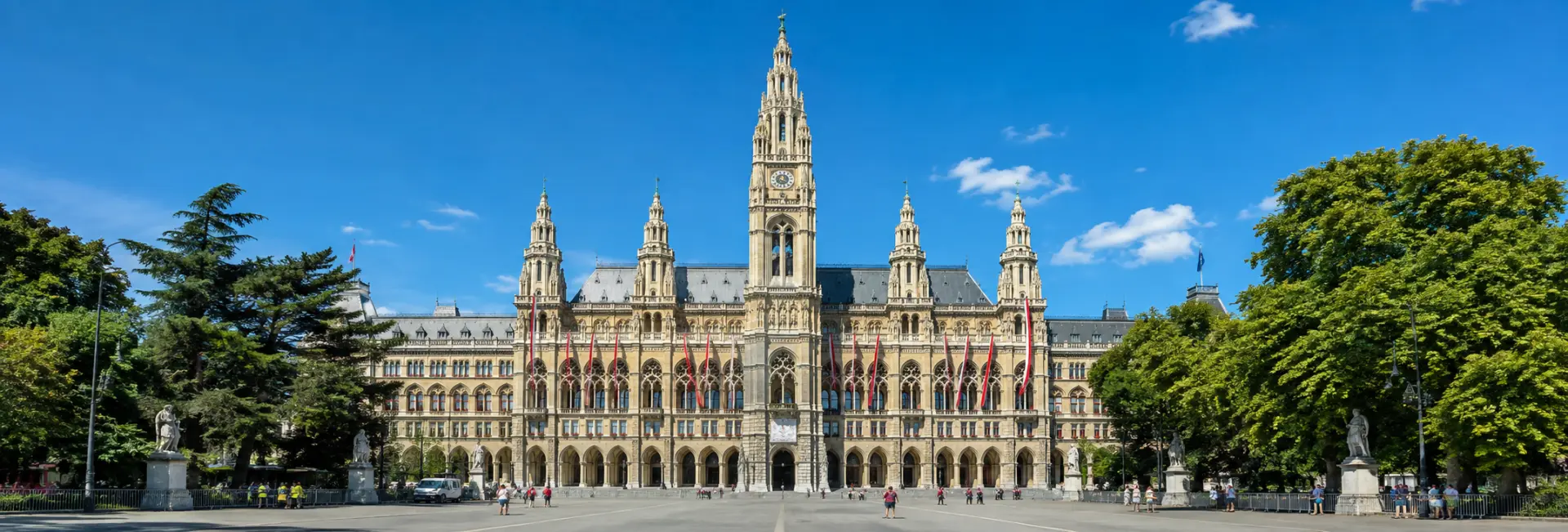
Vienna City Hall, known locally as the Rathaus, is one of the most recognizable buildings along the city's grand Ringstrasse boulevard. Completed in 1883, it serves as the working seat of Vienna's mayor, municipal council, and state parliament, making it very much a functioning government building rather than a museum piece.
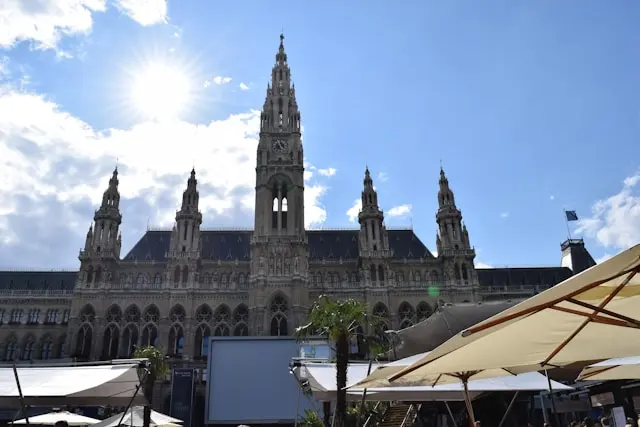
What draws most visitors, though, is its striking Neo-Gothic silhouette: a sprawling stone facade punctuated by a soaring central tower topped with a knight-shaped weathervane called the Rathausmann. The building anchors Rathausplatz, a public square that doubles as Vienna's busiest outdoor events venue, hosting everything from a sprawling Christmas market to open-air opera screenings.
History
Outgrowing the Old City Hall
By the mid-1800s, Vienna's older town hall on Wipplingerstraße had become too small for a rapidly growing capital. The chance to build something grander arrived when the medieval city walls were torn down between 1858 and 1865, freeing up land for the new Ringstrasse and the string of monumental buildings that would line it.
A Design Competition and a New Landmark
City officials launched an architectural competition in 1868, and the commission went to Friedrich von Schmidt, an architect who had previously worked on the restoration of Cologne Cathedral. Construction ran from 1872 to 1883, consuming an enormous quantity of material, reportedly around 30 million bricks and tens of thousands of cubic metres of stone, to raise a building with dozens of courtyards and well over a thousand rooms.
A Civic Stage Ever Since
Since opening, the Rathaus has remained the administrative heart of Vienna while also becoming the backdrop for the city's public life, from political rallies to the Wiener Festwochen arts festival, whose opening ceremony traditionally takes place right in front of the building.
Architecture & Design
Friedrich von Schmidt worked in the Gothic Revival style, drawing on the pointed arches, tracery, and vertical emphasis of medieval town halls and cathedrals, while folding in Renaissance touches elsewhere in the composition. The result is a building that reads as unmistakably historic, even though it postdates the Ringstrasse's construction boom by only a decade or two.
The Tower and the Rathausmann
The building's defining feature is its central tower, which rises to just under 98 metres. According to a long-repeated piece of city lore, Emperor Franz Joseph decreed that no new secular building could exceed the roughly 99-metre spires of the nearby Votivkirche, so Schmidt kept the tower itself just under that limit and then added a statue on top to reclaim the height. That statue, the Rathausmann, is a metal figure of an armored knight modeled on the armor of Emperor Maximilian I, and it brings the total height to just over 100 metres.
Facade Details
Look closely at the exterior and you'll find rows of carved figures, many representing historical personalities, alongside heraldic shields for Austria's provinces and the city itself, reinforcing the Rathaus's role as a symbol shared across the country rather than a purely municipal one.
Key Areas
The Arcaded Courtyard
Behind the main facade lies a large colonnaded courtyard, one of the biggest of its kind in Europe. It is regularly pressed into service as an open-air venue for concerts, film screenings, and seasonal markets, giving the building's interior the same festival energy found outside on Rathausplatz.
The Festival Hall
The Festsaal, a long ceremonial hall running the length of much of the building, is used for civic receptions, balls, and official functions. Its scale is part of the spectacle: reports suggest well over a thousand couples could theoretically waltz across its floor at once.
Rathausplatz and Rathauspark
In front of the building spreads Rathausplatz, the square that hosts most of the events people associate with the Rathaus, while a landscaped park wraps around the sides and back. A full-size replica of the Rathausmann statue stands in the park, letting visitors examine up close the details that are otherwise impossible to see from ground level on the tower itself.
Recognition & Status
The Rathaus sits within the Ringstrasse ensemble that forms part of the Historic Centre of Vienna, a site added to the UNESCO World Heritage List in 2001 in recognition of the city's layered urban history and architecture. While the Rathaus itself is a working government building rather than a heritage attraction managed for tourism, it is consistently ranked among Vienna's defining landmarks and is one of the most photographed stops along the Ringstrasse route.
Ways to Experience It
Visitors have several ways to engage with the Rathaus beyond simply admiring it from the square.
Guided Interior Tours
Free guided tours run on select weekdays, typically covering ceremonial rooms such as the Festival Hall and the council chambers. Tours are generally conducted in German, though English-language visits can sometimes be arranged in advance for groups.
Climbing the Tower
On selected occasions the tower itself is open to the public, and reaching the top means tackling 331 steps split across two spiral staircases. It's a workout, but the payoff is a rare rooftop view over the Ringstrasse and the city center.
- Free walk-through of Rathausplatz and Rathauspark at any time
- Scheduled guided interior tours on select weekdays
- Occasional public tower ascents
- Major seasonal events held on the square throughout the year
Seasonal Events on Rathausplatz
The square in front of the building transforms with the calendar. From mid-November through late December it hosts the Christkindlmarkt, widely considered Vienna's flagship Christmas market, followed by the Wiener Eistraum ice-skating installation that runs into early spring. In summer, the Film Festival brings free open-air screenings of opera, ballet, and concert recordings to a big screen facing the building, usually running from July into August.
Best Time to Visit
Because the Rathaus doubles as an events venue, timing your visit around the calendar can shape the experience as much as the building itself.
- Winter (mid-November to early January): the Christkindlmarkt and ice-skating rink turn the square into Vienna's most festive spot, though it's also the most crowded time to visit
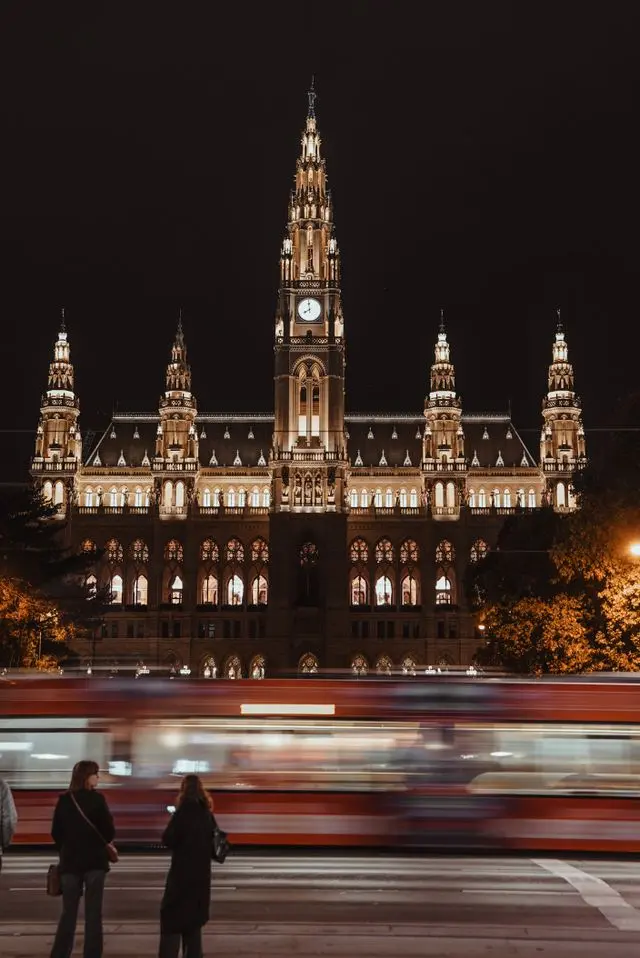
- Summer (July-August): the open-air film festival adds free evening screenings against the illuminated facade
- Spring and early autumn: quieter months for admiring the architecture without a market or festival crowding the square
- Evening: the building's floodlit facade is a highlight after dark, regardless of season
Visitor Tips
A little planning helps visitors get the most out of a stop at the Rathaus.
- Guided interior tours are free but typically run on a fixed weekly schedule, so check current days and times before planning around one
- Tower access is not a daily fixture, so treat any opportunity to climb it as a bonus rather than something to count on
- The building is reachable via tram lines 1, 71, and D, or the U2 metro line's Rathaus station, both stopping just outside
- Ramps and elevators make the ground-floor public areas accessible, though the tower climb involves a long stone staircase with no lift option
- During the Christmas market and Ice Dream season, expect the square to be busy on weekends, so weekday visits tend to be calmer
Nearby Attractions
The Rathaus sits in one of the densest concentrations of sights in Vienna, making it easy to combine with other stops.
- Burgtheater, Austria's national theatre, directly across the Ringstrasse
- Austrian Parliament Building, a short walk south along the boulevard
- University of Vienna's main campus, a few minutes' walk away
- Volksgarten and the Hofburg palace complex, within easy walking distance
- Café Landtmann, a historic Viennese coffeehouse facing the Rathaus across the Ringstrasse
FAQs about visiting Vienna City Hall (Rathaus)
What is Vienna City Hall famous for? +
It's known for its Neo-Gothic architecture, its 98-metre tower topped by the knight-shaped Rathausmann statue, and for the square in front of it, which hosts Vienna's biggest seasonal events including the Christmas market and summer film festival.
Is Vienna City Hall free to visit? +
Yes, walking around Rathausplatz and the surrounding park costs nothing, and the guided interior tours of the building are also free, though they run on a limited schedule.
How much time should I plan for a visit? +
Admiring the exterior and square takes as little as 20-30 minutes, but joining a guided tour or timing a visit around an event on the square can easily stretch a stop to an hour or two.
Can visitors climb the tower? +
The tower is only open to the public on occasional scheduled dates rather than every day, and reaching the top means climbing 331 steps with no elevator, so it's worth checking current availability before counting on it.
Is the Rathaus suitable for kids or visitors with mobility needs? +
The square and park are easy for families and strollers, and the ground-floor public areas of the building have ramps and elevators, though the tower's staircase isn't accessible to wheelchair users or anyone who can't manage a long climb.
What's the best time of year to visit? +
Winter draws the biggest crowds for the Christmas market and ice rink, while summer evenings bring free open-air film and concert screenings; visiting in spring or early autumn gives a quieter look at the architecture itself.
What's nearby that I can combine with a visit? +
The Burgtheater, Austrian Parliament, University of Vienna, and the Volksgarten and Hofburg palace grounds are all within easy walking distance, making the area easy to explore on foot for half a day or more.
Do I need to book guided tours in advance? +
Regular tours generally don't require advance booking for individuals, though larger groups are usually asked to arrange visits with the city's visitor services beforehand.
