Table of Contents
Overview
L'Albufera Natural Park sits roughly 10 kilometers south of Valencia's city center, wrapped around Spain's largest freshwater lake. The lagoon and its surrounding wetlands, rice paddies and pine-forested dunes form a landscape that feels far removed from the city, even though it is easily reached in a short drive or bus ride.
The park is as much a working agricultural landscape as a nature reserve. Its rice fields, still cultivated using traditions passed down for centuries, give the area its distinctive seasonal color, shifting from flooded, mirror-like paddies in winter to vivid green in summer. This is also the place credited with giving rise to paella, and the fishing village of El Palmar within the park remains one of the best places in the region to eat it.
More than 200,000 people visit L'Albufera each year, drawn by a combination of open water, wetland trails, undeveloped beaches and one of the richest concentrations of birdlife in Spain, all within easy reach of a major city.
Formation and Natural History
A Lagoon Cut Off from the Sea
The Albufera formed over thousands of years as sediment carried by the Túria and Júcar rivers built up along the coast, eventually creating a sandy barrier around 30 kilometers long, known locally as the restinga, that sealed off a former gulf of the Mediterranean between the two river mouths. What remained inland became a shallow coastal lagoon, today averaging only about a meter in depth, connected to the sea only through a handful of narrow channels, or golas, whose gates can be opened or closed to regulate the lake's water level.
The lagoon's watershed extends well inland, drawing water from a catchment area that stretches from sea level up into low hills further from the coast. That inland drainage, combined with the network of irrigation channels feeding the surrounding rice fields, continues to shape the lake's water levels and quality today.
From Saltwater Lake to Freshwater Wetland
The lagoon was originally saline, but centuries of freshwater draining in from irrigation channels and canals gradually diluted it, and by the seventeenth century it had become the freshwater lake seen today. The Romans referred to it as Nacarum Stagnum, or "Mother-of-Pearl Lake," for the iridescent light on its surface at sunset, while its current name comes from the Arabic al-buhayra, meaning "small sea," reflecting centuries of Moorish presence in the region.
Recognition and Protected Status
L'Albufera was formally declared a Natural Park by the Generalitat Valenciana on 8 July 1986, becoming the first protected area of its kind in the Valencian Community. The park covers approximately 21,120 hectares, encompassing the lagoon itself, its surrounding wetlands and the Devesa del Saler, the pine-covered sand barrier that separates the lake from the Mediterranean.
In recognition of its ecological importance, L'Albufera was designated a Wetland of International Importance under the Ramsar Convention in December 1989, and it has been classified as a Special Protection Area (SPA) for birds since 1991, reflecting its role as a stopover and breeding ground for large numbers of migratory and resident species.
- Declared a Natural Park in 1986, the first in the Valencian Community
- Ramsar Wetland of International Importance since 1989
- Special Protection Area (SPA) for birds since 1991
These layered protections govern how the lagoon, its rice fields and the surrounding dunes can be used and developed, and they underpin the park's ongoing restoration projects, including efforts to reduce pollution runoff from agriculture and to recover wetland areas that were degraded by earlier land reclamation.
Flora and Fauna
L'Albufera is one of the most important wetlands for birdlife on the Iberian Peninsula, with more than 300 recorded species passing through or nesting in the park over the course of the year. In winter, tens of thousands of waterfowl gather on the lagoon, including shovelers, red-crested pochards and glossy ibises, while herons, flamingos, cormorants, gulls and terns are regular sights throughout the seasons.
The park's habitats extend well beyond the open water. The Devesa del Saler's stabilized dunes support a Mediterranean pine forest and coastal scrub, the rice paddies act as an artificial but important wetland habitat for wading birds outside the growing season, and the reedbeds fringing the lagoon shelter species found in few other parts of the region, including a small number of endemic and endangered fish such as the Spanish toothcarp and the Valencia toothcarp.
The six small islets scattered across the lagoon, along with the restored lagoons at Racó de l'Olla, provide some of the park's most undisturbed habitat, supporting nesting colonies of terns and gulls that are considered among the most significant in Spain.
Key Areas
The park's main visitor access points and landmarks are spread around the lagoon's edges and the sand barrier that separates it from the sea.
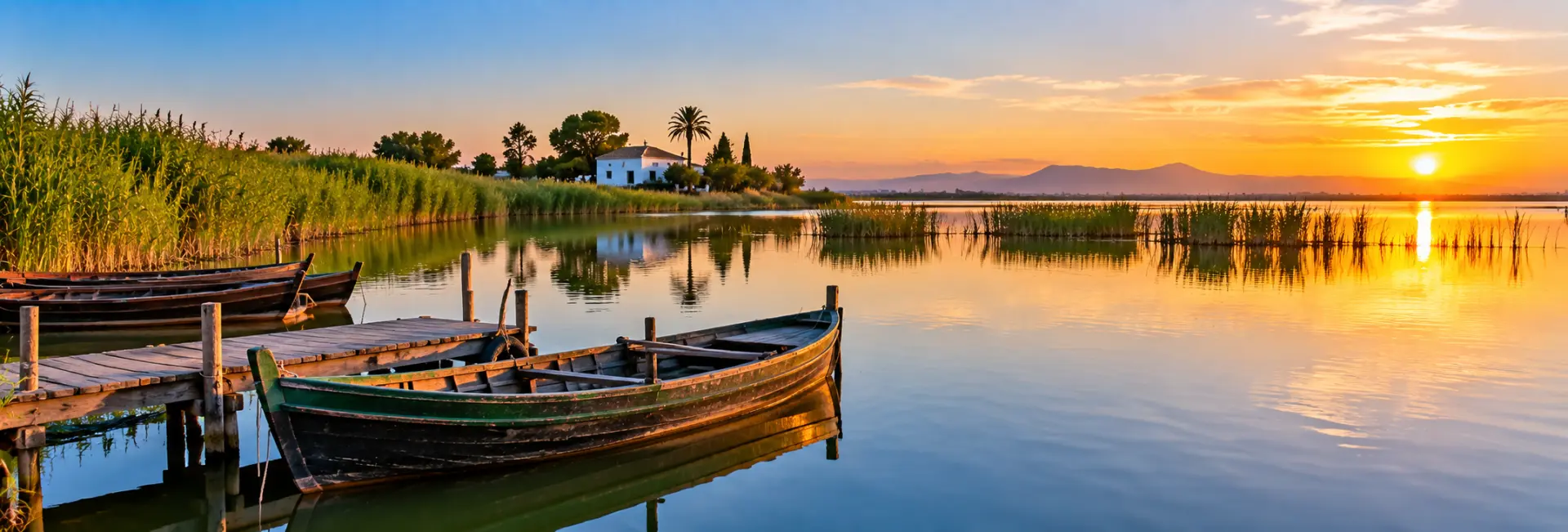
- The Lagoon and Its Islets – the open lake itself, dotted with six small islets and traditionally worked by fishermen and rice farmers using flat-bottomed boats.
- El Palmar – a small village within the park, historically a fishing settlement and now known for its paella restaurants and boat departure points.
- Racó de l'Olla – a restored wetland reserve and interpretation center, considered one of the most important bird nesting sites in the park.
- Devesa del Saler – the forested dune barrier between the lagoon and the Mediterranean, with walking and cycling trails and undeveloped beaches.
- El Saler and El Perellonet – coastal settlements at the park's edge, offering additional beach access.
- The Rice Fields – the flooded paddies ringing the lagoon, which change appearance dramatically through the growing cycle and remain central to the park's economy and landscape.
Ways to Experience It
Most visits to L'Albufera combine time on the water with time on foot, and the park is set up to make both straightforward for independent travelers.
- Take a traditional boat trip across the lagoon, typically departing from El Palmar, for close-up views of the lake, its islets and its birdlife.
- Walk or cycle the trails through the Devesa del Saler, following routes through the pine forest and dunes to the beach.
- Visit the Racó de l'Olla interpretation center for background on the park's ecosystems and access to a birdwatching hide and observation tower.
- Watch the sunset over the lagoon, when the water reflects red and gold light across the rice fields, widely considered the park's signature experience.
- Eat paella in El Palmar, where the dish is prepared using recipes tied to the area's rice-growing and fishing traditions.
- Cycle the flat roads and trails threading through the rice fields on the lagoon's landward side, an easy way to cover more ground than on foot.
Best Time to Visit
L'Albufera can be visited year-round, but the experience varies considerably by season. Spring and autumn bring mild weather and strong birdwatching conditions, as migratory species pass through the park. Winter is the best time to see the largest concentrations of waterfowl, when the flooded rice fields and open lagoon draw tens of thousands of birds.
Summer offers warmer weather for combining a park visit with the nearby beaches, though it is also the busiest season. Whatever the time of year, sunset is consistently recommended as the best moment to be on or near the lagoon, when boat trips and lakeside restaurants are at their most popular.
Visitor Tips
A few practical points help in planning a visit to the park.
- The park is most easily reached by car via the CV-500 road from Valencia, though public buses also connect the city to El Palmar and the Devesa del Saler.
- Boat trips are typically offered in fixed time slots, particularly around sunset, so booking ahead during busy periods is advisable.
- Bring insect repellent, since the wetland environment can be mosquito-prone, especially in warmer months and near dusk.
- Wear comfortable, flat footwear for walking trails through the Devesa del Saler, which include both paved and sandy sections.
- Confirm current opening hours for the Racó de l'Olla interpretation center before visiting, as these can vary seasonally.
- Bring binoculars if birdwatching is a priority, since much of the lagoon's wildlife is best observed from a distance around the reserve areas and hides.
Nearby Attractions
L'Albufera's location just south of Valencia makes it easy to combine with a wider visit to the city.
- Valencia's Ciutat Vella – the historic old town, roughly a 20-minute drive north, with the Cathedral, La Lonja de la Seda and Central Market.
- City of Arts and Sciences – Valencia's modern architectural complex, located between the city center and the park.
- El Saler Beach – an undeveloped stretch of coastline along the park's sand barrier, popular for a swim after a day exploring the lagoon.
- Turia Gardens – the long park running through Valencia's former riverbed, offering an easy cycling or walking route between the city and the Albufera area.
FAQs about visiting L'Albufera Natural Park
What is L'Albufera Natural Park? +
L'Albufera is a large freshwater lagoon and wetland south of Valencia, protected as a Natural Park since 1986 and recognized internationally as a Ramsar wetland for its importance to birdlife.
Is L'Albufera free to visit? +
Access to the park's public areas, trails and the Devesa del Saler is free. Boat trips, guided tours and paella meals in El Palmar are paid activities booked separately.
How do you get to L'Albufera from Valencia? +
The park is around 10 kilometers south of central Valencia, reachable by car along the CV-500 road or by public bus lines that run to El Palmar and the Devesa del Saler.
What is the best time of day to visit? +
Sunset is widely considered the best time to be on the lagoon, when the water reflects red and gold light, though mornings offer calmer conditions for birdwatching.
What is the best time of year to visit? +
Winter draws the largest numbers of waterfowl, while spring and autumn bring strong migratory birdwatching and milder weather; summer suits combining the park with nearby beaches.
Do I need to book a boat trip in advance? +
It is recommended, particularly for the popular sunset departures from El Palmar, since boats run on fixed schedules and can fill up during busy periods.
Is L'Albufera suitable for families and casual visitors? +
Yes. Trails in the Devesa del Saler are flat and manageable, boat trips require no special preparation, and the interpretation center at Racó de l'Olla is designed with general visitors in mind.