
Table of Contents
Overview
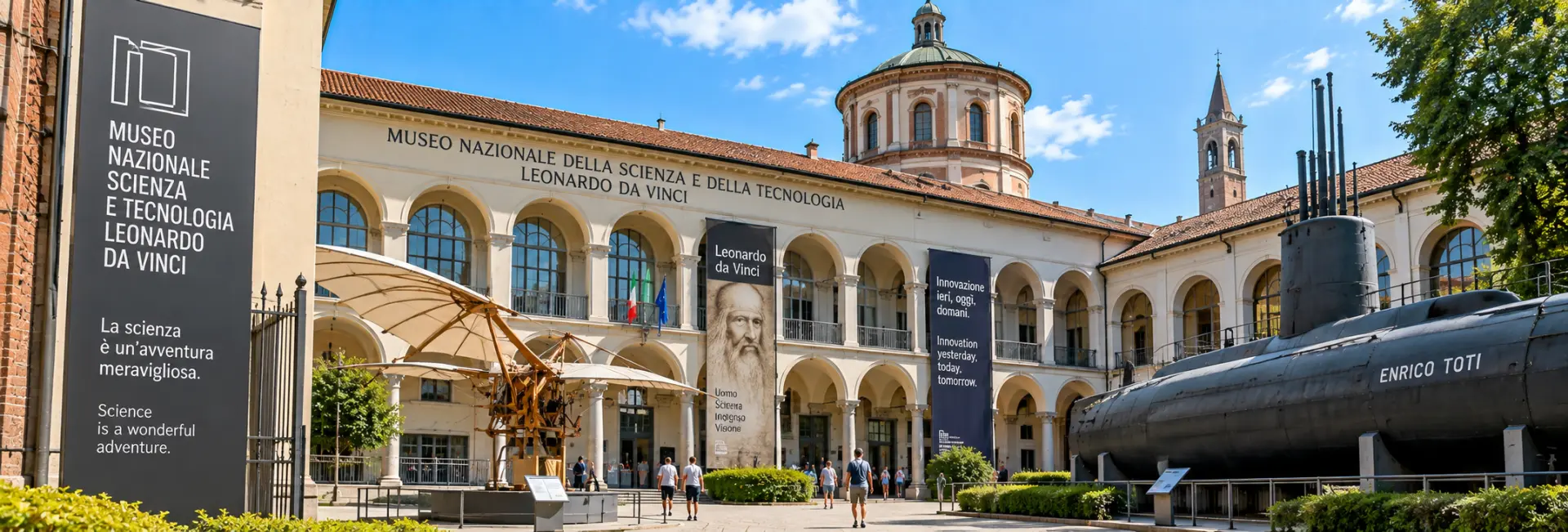
The museum's biggest draw is its dedication to Leonardo da Vinci himself: a whole gallery is built around wooden models made from his notebook sketches, standing alongside sections on transport, energy, materials, communication and space. Outside the main halls, visitors can walk through a decommissioned Italian navy submarine, climb aboard vintage locomotives and inspect historic aircraft, making it one of the most hands-on museum visits in the city.
What sets the place apart from a typical city-center museum is scale: this is less a single building than a small campus, with the original monastery buildings connected to purpose-built pavilions added over the decades. Families, school groups and engineering enthusiasts all tend to find something that holds their attention, which is part of why it draws well over half a million visitors every year.
History
Long before it held any machines, the site was a Benedictine cloister that became an Olivetan monastery in the early 1500s, attached to the church of San Vittore al Corpo. Traces of an older Roman-era fortified enclosure and mausoleum have been found within the museum's cloisters, hinting at just how much history the grounds have absorbed over the centuries. The monastic complex later served other purposes, including use as a hospital and a military site, before being badly damaged during the bombing raids of the Second World War.
Founding and Growth
Reconstruction of the building began in 1947, and the museum opened its doors on 15 February 1953, inaugurated by then Prime Minister Alcide De Gasperi. The timing was tied to Leonardo da Vinci, whose 500th birth anniversary had recently been marked, and the founders wanted a permanent home in Milan dedicated to his inventive spirit alongside the wider story of Italian science and industry.
Since 2000, the museum has operated as a private-law foundation whose founding members include Italy's education, university and culture ministries, with the Lombardy region, the City of Milan and Milan's Chamber of Commerce as supporting participants, and the city's major universities represented on its scientific council. Over the decades the collection has grown from a few founding donations into a network of galleries and pavilions covering nearly every branch of applied science, with major additions like the submarine pavilion joining the site in the mid-2000s and new interactive spaces continuing to be added as the museum's focus keeps pace with modern science.
Architecture & the Former Monastery
Beyond the historic core, the museum has expanded with purpose-built pavilions for its transport collections: separate halls house the rail, air and water sections, including the outdoor Padiglione Navale, a large hangar-like structure built specifically to hold full-size vessels and the museum's submarine. This mix of restored monastic architecture and functional exhibition space gives the museum a layered, sometimes surprising layout that rewards visitors willing to wander rather than follow a single fixed route.
Collections & Exhibits
The transport collection is one of the most popular parts of the museum and is split across rail, air and water. Inside the rail pavilion, visitors can see historic steam and early electric locomotives up close, while the aviation hall displays aircraft spanning several decades of Italian and international flight. The water section centers on the Padiglione Navale, where the retired Italian navy submarine Enrico Toti sits alongside ship models and a full-scale vessel; guided tours let visitors climb inside the submarine's cramped original compartments.
- Materials: the journey of raw materials into finished products and back into recycled goods
- Transport: rail, aviation and naval collections, including the Toti submarine
- Energy: how power generation and distribution have evolved in Italy
- Communication: telecommunications, radio and early computing equipment
- New Frontiers: genetics, space and other emerging fields of science
- Science for Young People: dedicated hands-on activity areas designed around younger visitors' curiosity
Across all departments the museum holds thousands of objects, from early motor cars and navigational instruments to radios, scientific instruments and industrial machinery, giving a broad view of how Italian industry modernized over the 19th and 20th centuries rather than focusing on any single field.
The Leonardo Gallery
Highlights include his studies for an aerial screw, an early ancestor of the helicopter concept, along with armored vehicle designs, hydraulic devices and machinery for textile production. Because the gallery focuses on mechanical reconstructions rather than original manuscripts or paintings, some visitors expecting to see Leonardo's actual drawings or artwork are surprised; those wanting to see his written notebooks or sketches firsthand should look elsewhere in Milan, since this gallery's strength is in bringing the machines themselves to life.
Ways to Experience It
- Guided submarine tours: timed entries take small groups through the Enrico Toti's original compartments, in Italian or English
- Self-guided gallery visits: most departments, including the Leonardo Gallery, can be explored at your own pace
- Family laboratories: hands-on workshops in areas like cooking science, textiles and simple game design, aimed at children and school groups
- The MUST Shop: a science-themed store near the exit selling books, design objects and gadgets connected to the collections
Because several outdoor pavilions require a short walk between buildings, comfortable shoes are worth planning for, and families visiting with young children may want to build in extra time for the interactive laboratory areas, which tend to hold their interest longest.
Best Time to Visit
The museum works well as a visit in any season since most of the collection is indoors, though the outdoor walk between pavilions is more pleasant in spring and autumn than during Milan's hottest summer weeks or its damp winter days. Submarine tours run on a timed schedule and can fill up, so booking a slot in advance is worthwhile whenever school term is in session and group visits are more frequent.
Visitor Tips
- Allow at least three to four hours for a full visit, or around ninety minutes to two hours if focusing only on the Leonardo Gallery and the submarine
- The closest metro stop is Sant'Ambrogio on line M2, a short walk from the entrance, and several tram and bus lines also stop nearby
- The museum is wheelchair accessible throughout, with ramps, elevators and a free wheelchair loan service available on request
- Submarine tours have limited capacity and are not recommended for visitors who are uncomfortable in very tight, enclosed spaces
- Milan's restricted traffic zone covers this area, so visitors arriving by car should check current entry rules before driving in
Nearby Attractions
- Santa Maria delle Grazie and Leonardo's Last Supper mural, roughly a ten-minute walk, with tickets best booked well ahead
- Sforza Castle, about twenty minutes on foot, where Leonardo painted the Sala delle Asse ceiling
- Pinacoteca Ambrosiana, around twenty minutes away, home to Leonardo's Codex Atlanticus and other works
FAQs about visiting the Leonardo da Vinci Museum of Science and Technology
What is the Leonardo da Vinci Museum of Science and Technology known for? +
It's known for being Italy's largest science and technology museum, and specifically for its Leonardo Gallery, which holds more than 170 full-scale wooden models built from Leonardo da Vinci's own mechanical drawings.
How much time should I plan for a visit? +
A full visit through all the departments and pavilions takes around three to four hours, though focusing only on the Leonardo Gallery and the submarine tour can be done in about ninety minutes to two hours.
Is it possible to go inside the submarine? +
Yes, guided tours take small groups through the original compartments of the Enrico Toti, a retired Italian navy submarine housed in the museum's naval pavilion, with tours offered in both Italian and English.
Do I need to book tickets in advance? +
Booking ahead is recommended, especially for the submarine tour, which runs on a timed schedule with limited capacity, and for weekends or periods when school groups are likely to visit.
Is the museum good for children? +
Yes, several departments include hands-on laboratories and workshops built specifically for children, covering topics like cooking science, textiles and simple design, alongside large interactive exhibits in the transport and energy sections.
Is the museum wheelchair accessible? +
Yes, the museum offers ramps, elevators and accessible routes throughout, along with a free wheelchair loan service for visitors who need one.
How do I get to the museum without a car? +
The Sant'Ambrogio stop on metro line M2 is a short walk from the entrance, and several tram and bus routes also serve the area, which is generally easier than driving given Milan's restricted traffic zone downtown.
What else can I see near the museum? +
The Basilica of Sant'Ambrogio and Leonardo's vineyard are both a short walk away, and Santa Maria delle Grazie, home to the Last Supper mural, is about ten minutes on foot, making it easy to pair with a museum visit.
