
Table of Contents
- Overview
- Reclaimed Land and the Creation of a Public Garden
- Trees, Palms and Subtropical Character
- Paths, Fountains and Decorative Features
- Civic Buildings and the Park’s Urban Edges
- Ways to Enjoy a Short or Longer Visit
- Best Time, Shade and Seasonal Expectations
- Accessibility and Respect for a Living Collection
- Nearby Attractions and a Green-to-Waterfront Walk
Overview
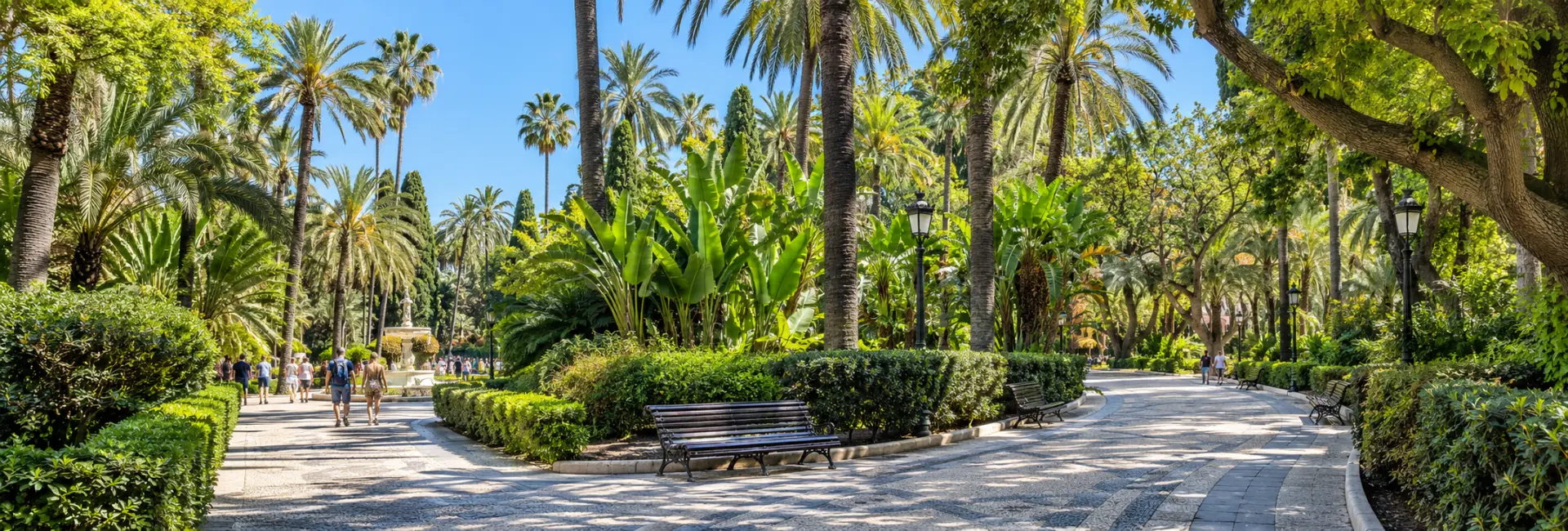
Málaga Park, or Parque de Málaga, is a historic planted space between the central city and the harbour. Its mature trees and subtropical vegetation offer a contrasting environment to the nearby stone streets and open waterfront, making it a useful attraction in its own right as well as a pleasant walking connection.
The park is compact enough to include in a central itinerary, yet varied enough to reward slower attention. Fountains, monuments and changes in planting break up the route, while the surrounding civic buildings remind visitors that this is an urban garden rather than a remote natural area.
A short crossing provides shade and a change of pace. A more deliberate visit might take forty-five minutes to an hour, especially if you enjoy trees or stop to examine the decorative features. There is no need to complete a fixed circuit to appreciate the place.
Think of the park as a designed landscape shaped over time. Its plants, paths and monuments form part of Málaga’s urban history, not simply a green space that happened to remain undeveloped.
Reclaimed Land and the Creation of a Public Garden
The park developed on land gained from the sea during the late nineteenth-century transformation of the waterfront. Municipal history links its origins to an 1896 law associated with Cánovas del Castillo. This makes the garden part of the changing relationship between Málaga and its port.
That origin is worth considering while walking beneath mature trees. What now feels like an established natural setting was created through major changes to the shoreline and the city’s infrastructure. The landscape represents planning, planting and continued care rather than untouched nature.
The collection of vegetation has been enriched over time, so the park should not be understood as a single planting scheme frozen at its opening. A living garden changes as trees grow, plants are replaced and public needs evolve. Its historical value includes that continuity of management.
Look towards the harbour and then back into the planted area to appreciate the contrast. The proximity of water, civic streets and subtropical vegetation gives the park a character closely tied to Málaga’s particular urban setting.
Trees, Palms and Subtropical Character
Municipal information highlights a varied collection that includes palms, dragon trees, plane trees and ficus, alongside other tropical and subtropical planting. The appeal lies partly in the differences between their forms: upright trunks, spreading branches, large leaves and contrasting textures.
You do not need to identify every species to enjoy the collection. Begin by comparing shape and scale, then use any available labels or reliable plant information to add names. Observing first helps prevent a garden visit from becoming only a search for labels.
Mature trees create a sense of enclosure that differs from the more open palm-lined harbour promenade nearby. Notice how the canopy changes the light and how views of the surrounding city appear between trunks. Those visual relationships are as much a part of the design as individual specimens.
Avoid treating unusual roots, branches or trunks as climbing equipment. Large plants can be vulnerable to repeated pressure even when they look robust. Keep to the public paths and give maintenance work room, remembering that preserving living features requires different care from preserving a stone monument.
Paths, Fountains and Decorative Features
The park’s paths encourage a slower route than the adjacent traffic corridors. Rather than choosing the shortest line through, take time to notice where a path opens towards a fountain or monument and where planting creates a more enclosed section. These changes provide a rhythm to the walk.
Fountains add sound and a visual focus, while monuments introduce references to the city’s cultural memory. Read inscriptions when accessible, but avoid assuming that every decorative feature belongs to the park’s earliest phase. Public gardens often accumulate additions across several generations.
A useful way to visit is to choose one fountain, one tree and one monument for closer attention. This creates a manageable structure without turning a relaxed park walk into an exhaustive inventory. It also suits groups whose interests differ.
Keep the park’s scale in mind. It is not a vast landscape where distance is the main challenge; its interest lies in detail, variety and the way greenery is fitted into a central setting. A short, attentive visit can therefore be more satisfying than a fast end-to-end walk.
Civic Buildings and the Park’s Urban Edges
The surrounding area includes important civic and institutional buildings, among them the City Hall, Bank of Spain and former post-office building associated with the university. Their presence adds an architectural dimension to the walk without requiring entry to each one.
Look outward from the garden as well as inward. A façade framed by trees can reveal the relationship between public architecture and public landscape, while a view from the street shows the park as part of a larger civic ensemble. These perspectives complement each other.
Use proper crossings whenever moving between the planted areas and surrounding buildings. The park may feel sheltered, but roads remain close and the route is not a single uninterrupted pedestrian precinct. Plan crossings especially carefully with children or visitors who need more time.
An architectural walk can remain selective. Choose one building that catches your attention and compare its scale or style with the planting nearby. This provides context without requiring a detailed history of every institution along the avenue.
Ways to Enjoy a Short or Longer Visit
For a brief visit, enter from a convenient central approach, choose a shaded route and pause at one feature before continuing towards the harbour or old town. This works well between booked attractions when you want a change of atmosphere without a long detour.
A longer visit can focus on plant forms, photography or the park’s historical setting. Move slowly enough to notice differences in leaf size, trunk texture and the density of the canopy. These observations are more dependable than arriving with an expectation of a particular flower being in bloom.
Families can use the garden for simple looking activities, such as finding three different leaf shapes or comparing a palm with a broad-canopied tree. Keep such activities on paths and away from fragile planting. A public garden should not be treated as an unrestricted play area.
Visitors travelling alone may enjoy the park as a pause for reading or reflection where seating is available. Keep belongings attended and remain aware of surrounding activity, just as in any central public space. The calm atmosphere can coexist with ordinary urban movement.
Best Time, Shade and Seasonal Expectations
The park can be enjoyed throughout the year, but comfort depends on the actual weather. Mature vegetation provides shade in many areas, yet some paths and crossings remain exposed. In hot conditions, carry water and use the garden as one element of a sensible pacing plan.
Earlier or later daylight can suit photography because the contrast between foliage and built surroundings may be easier to handle. However, dense planting can also make some areas visually darker. Adjust your route to the light rather than expecting every feature to photograph well at the same time.
Seasonal flowering and maintenance can change the appearance of particular sections. The durable attraction is the structure of the mature garden and its varied vegetation, not a guaranteed floral display on a precise date. If a specific plant is your main interest, seek current local information.
After rain, take care around wet paving, fallen leaves or roots near paths. An urban garden can still contain uneven surfaces, and choosing a shorter route is reasonable if conditions make walking uncomfortable. Enjoying the park does not require completing every path.
Accessibility and Respect for a Living Collection
A central location and modest scale can make the park useful for a gentle outing, but accessibility depends on the chosen approach, surfaces and crossings. Visitors with specific needs should plan a route around known entrances and verify facilities rather than assuming every path offers the same experience.
Respect planted areas even when no barrier is present. Soil around roots, young growth and low planting can be damaged by repeated shortcuts. The garden’s value depends on many visitors making small, considerate choices.
- Remain on the intended paths.
- Do not pick flowers, leaves or other plant material.
- Keep food waste and packaging out of planted beds.
- Give maintenance crews and equipment space.
- Avoid blocking narrow sections while taking photographs.
If you want a more extensive botanical visit, La Concepción is a separate attraction farther from the centre. Málaga Park offers a convenient public garden experience; it should not be confused with the larger botanical-historical estate or presented as a substitute with identical collections and facilities.
Nearby Attractions and a Green-to-Waterfront Walk
The Palmeral de las Sorpresas provides the most direct landscape contrast nearby. Moving from the park’s denser canopy to the harbour’s open palm grid reveals two different approaches to planting and public space. Use the designated crossings between them.
Muelle Uno and the Centre Pompidou can extend the route with dining, shopping or a museum visit. The cathedral and Calle Alcazabilla offer inland alternatives if the day is focused on history. The park is well positioned to connect these areas without becoming the only reason for the walk.
For a balanced route, choose one major attraction, a park walk and a waterfront pause. This gives enough variety without requiring repeated decisions about tickets or long transfers. It can also work well after the more demanding climbs at the Alcazaba or Gibralfaro.
Allow yourself to leave the park by a different route from the one used to enter. A small change in direction can reveal another view of the city and reinforce its role as a living connection between central Málaga and the sea.
FAQs about visiting Málaga Park
Is Málaga Park the same as La Concepción? +
No. Málaga Park is central and public; La Concepción is a separate botanical-historical garden north of the centre.
Is the park free to visit? +
The public park is normally free to enter, subject to any temporary closures or restrictions.
What makes its planting distinctive? +
Its mature collection includes tropical and subtropical plants, with palms, ficus and other varied tree forms.
How long should I allow? +
A short walk can be brief; around forty-five minutes to an hour allows a more attentive visit.
Is the whole park shaded? +
No. There is substantial mature vegetation, but some paths and surrounding crossings remain exposed.
What should I combine it with? +
The Palmeral de las Sorpresas, Muelle Uno, cathedral or Calle Alcazabilla can fit into the same central itinerary.
