Table of Contents
Overview
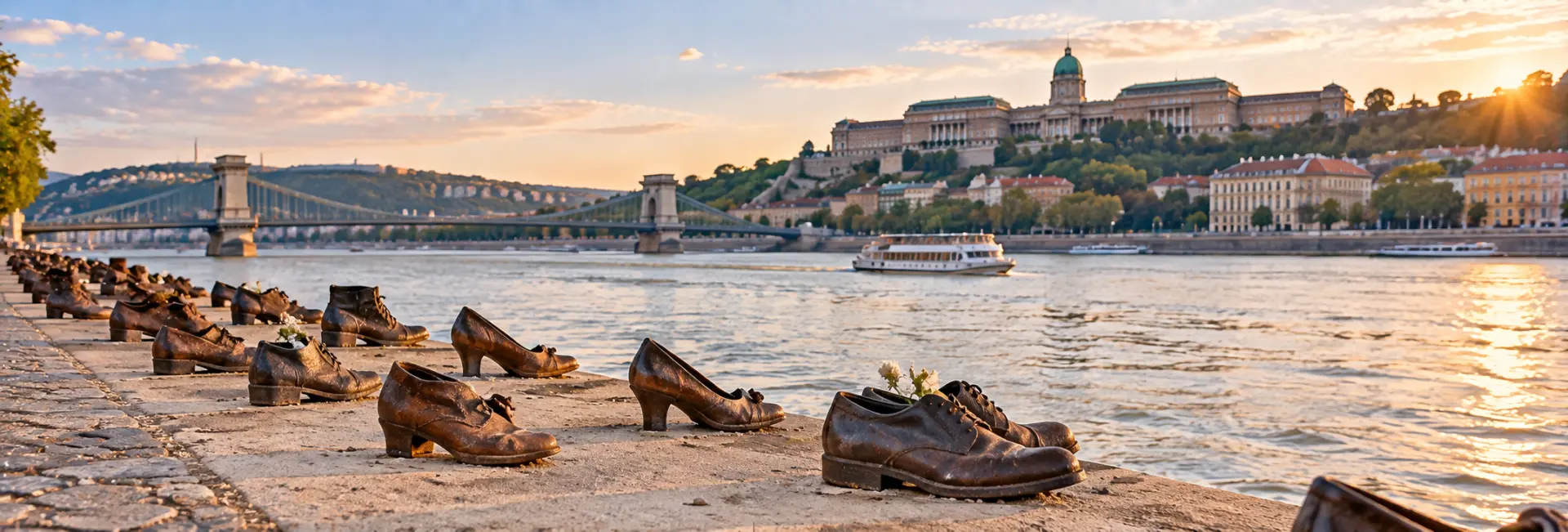
Shoes on the Danube Bank is a small, quiet memorial on the Pest embankment, a short walk south of the Hungarian Parliament Building. Sixty pairs of cast-iron shoes, sized and styled to look like ordinary 1940s footwear, sit at the water's edge facing the river, left behind as if their owners had simply stepped out of them.
There is no admission fee, no gate, and no building to visit; the memorial exists only as this row of shoes and a short inscription. It marks the site where, during the winter of 1944–45, Arrow Cross militiamen forced Jewish men, women, and children to remove their shoes before shooting them into the freezing Danube, a method of killing chosen in part because the river carried the bodies away and the shoes themselves held resale value in wartime Budapest.
History
The Arrow Cross Takes Power
On 15 October 1944, with the Soviet army closing in from the east, Nazi Germany backed a coup that removed Hungary's regent, Miklós Horthy, who had been seeking a separate peace with the Allies, and installed Ferenc Szálasi and his fascist Arrow Cross Party in power. For the roughly three and a half months until Budapest's liberation in February 1945, the Arrow Cross carried out an intense campaign of violence against the city's remaining Jewish population, who by then numbered around 200,000 after earlier waves of deportation had already devastated Jewish communities elsewhere in Hungary.
Budapest's Jews had largely been spared the mass deportations to Auschwitz that swept through Hungary's countryside earlier in 1944, in part because of the capital's size and the presence of international observers, but the Arrow Cross takeover ended that relative safety. The new regime moved quickly to confine the city's Jewish population into a sealed ghetto in the 7th district and a separate area of buildings placed under the nominal protection of neutral legations, even as its militiamen carried out killings independent of any formal deportation order.
Killings Along the River
Arrow Cross militiamen roamed Budapest's streets during these months, dragging Jewish residents from their homes, from the city's sealed ghetto, and from the international protected houses set up by neutral diplomats, and marching them to the Danube embankment. Victims were often bound together in small groups so that the weight of one body falling into the river would pull the others in with it, and they were routinely ordered to remove their shoes beforehand, since footwear was a scarce and valuable commodity that the killers could resell or reuse. Estimates of the death toll from these riverbank killings vary considerably between sources, with figures commonly ranging from roughly 3,500 up toward 10,000 or more, reflecting how difficult it has been to establish an exact count for killings that were often unrecorded and left no bodies to identify.
Wallenberg and the Protected Houses
These months also saw the height of efforts by neutral diplomats, most famously Swedish diplomat Raoul Wallenberg, who issued protective passports and established safe houses that sheltered tens of thousands of Budapest's Jews from deportation and violence. Diplomats from Switzerland, Portugal, Spain, and the Vatican ran similar rescue efforts alongside Wallenberg, together helping account for why a substantial Jewish population still remained in the city by the time of its liberation, unlike in much of the rest of German-occupied Europe.
Even so, the protected houses and the sealed Jewish ghetto in the city's 7th district could not fully shield residents from Arrow Cross raids, and the killings at the Danube continued until Soviet forces finally secured the city in February 1945. The events remain among the most extensively documented episodes of the Holocaust in Hungary, drawing on postwar trial records, survivor testimony, and the accounts of the diplomats and aid workers who tried to intervene.
Design & Symbolism
The memorial was conceived by film director Can Togay and realized by sculptor Gyula Pauer, and it was unveiled on 16 April 2005, the 60th anniversary year of the events it commemorates. Sixty pairs of shoes, cast in iron and modeled closely on genuine 1940s footwear, are fixed directly to the stone of the embankment: men's lace-up shoes and boots, women's heels, and small children's shoes among them, deliberately left in a range of styles and sizes.
The variety of the shoes is itself part of the memorial's design, a reminder that the killings made no distinction between men, women, the elderly, or children. Rather than a single sculptural figure or abstract monument, the empty footwear asks visitors to imagine the people who once stood in them, an approach that has made the memorial one of the most quietly affecting Holocaust monuments in Europe despite its modest physical scale.
A short inscription cast in iron nearby reads, in Hungarian, English, and Hebrew: "To the memory of the victims shot into the Danube by Arrow Cross militiamen in 1944–45."
Pauer, who had trained as a sculptor of the human figure, deliberately left the shoes empty rather than adding any figurative representation of the victims themselves, a choice that keeps the focus on absence rather than on any single depiction of suffering. The shoes are bolted directly into the embankment stone so that they cannot be removed, anchoring the memorial permanently to the exact stretch of riverbank where the killings are understood to have taken place.
Recognition & Status
The memorial sits along Budapest's Danube embankment, part of the UNESCO World Heritage Site covering the river's banks together with the Buda Castle Quarter and Andrássy Avenue, though the shoes themselves are a 21st-century addition rather than part of the historic listing itself. In 2017, Architectural Digest ranked the memorial among the most compelling public sculptures in the world, citing the emotional weight it carries despite its restrained, understated design.
The memorial has no dedicated management, ticket office, or set opening hours, since it is simply installed along a public riverside walkway that remains open at all times. It functions today both as a stop on general sightseeing routes along the Danube and as a specific destination for visitors researching Hungary's Holocaust history, often visited together with the nearby Hungarian Parliament Building and the Dohány Street Synagogue's memorials across the river.
The site is also used for formal commemorations, including ceremonies held around Hungary's Holocaust Remembrance Day each April, when officials, survivors' descendants, and members of the public gather to lay flowers and stones along the embankment. Outside of these occasions, the memorial remains an unstaffed, everyday part of the city's riverside, visited quietly by individuals rather than through any organized site management.
Visiting Etiquette & Tips
As a memorial to a mass atrocity rather than a conventional tourist attraction, Shoes on the Danube Bank calls for a measure of quiet respect. Visitors are generally asked to keep voices low and to avoid treating the shoes as a photo prop, and stepping into the shoes or posing playfully with them is widely considered inappropriate at what remains, for many, a solemn gravesite in all but name.
- Read up on the history beforehand if possible, since the on-site inscription is brief and does not explain the broader context
- Visit quietly and be mindful of others who may be there to reflect or pay respects to victims connected to their own family history
- The site is unguarded and freely accessible at all hours, so there is no need to plan around opening times
- Flowers, stones, or candles are sometimes left at the memorial by visitors; these should be left undisturbed
- Combine the visit with the nearby Hungarian Parliament Building or a walk along the Danube promenade toward the Chain Bridge
Because the memorial sits directly on a public walkway with no barrier, it is easy to come across unexpectedly while walking the riverside, and pausing for even a few minutes is generally considered a meaningful way to acknowledge the history of the site, even without a full understanding of the events beforehand.
Best Time to Visit
Because it is a small, open-air site along a public walkway, Shoes on the Danube Bank can be visited at any hour, though early morning or early evening generally offer the quietest conditions and softer light for those who want a more reflective, less crowded experience. Midday, especially in summer, tends to bring the largest number of passing tour groups and river cruise passengers.
The memorial is equally accessible in any season, though a clear day makes for a more comfortable stop along the exposed riverside promenade, and evenings bring the added atmosphere of the illuminated Parliament Building just a short walk to the north.
Nearby Attractions
- The Hungarian Parliament Building, a short walk north along the Danube promenade
- Kossuth Lajos tér, the square in front of Parliament and the nearest metro station to the memorial
- The Danube Promenade itself, part of Budapest's UNESCO-listed riverside stretching toward the Chain Bridge
- The Dohány Street Synagogue and its own Holocaust memorials, a short distance away in the historic Jewish Quarter
- The House of Terror Museum, documenting both the fascist and communist periods of 20th-century Hungarian history
FAQs about visiting Shoes on the Danube Bank
What is the meaning behind the Shoes on the Danube Bank? +
The sixty iron shoes represent the men, women, and children who were ordered to remove their footwear before being shot into the Danube by Arrow Cross militiamen during the winter of 1944–45.
Is Shoes on the Danube Bank free to visit? +
Yes, it is an open-air public memorial with no admission fee, gate, or fixed opening hours.
Who created the memorial? +
It was conceived by film director Can Togay and created by sculptor Gyula Pauer, and it was unveiled on 16 April 2005.
How many people were killed at this site? +
Estimates vary by source, with figures commonly ranging from roughly 3,500 to over 10,000 victims killed along the Danube during the Arrow Cross regime's rule between October 1944 and February 1945.
How long does a visit take? +
Most visitors spend just 10 to 15 minutes at the memorial itself, though many pair it with a longer walk along the Danube promenade or a visit to the nearby Parliament Building.
Is it appropriate to take photos at the memorial? +
Photography is common and generally accepted, but visitors are asked to behave respectfully, keep noise to a minimum, and avoid posing playfully with the shoes.
What else should I visit nearby to learn more about this history? +
The Dohány Street Synagogue's Holocaust memorials and the House of Terror Museum both provide further context on this period of Hungarian history.