Table of Contents
Overview
The Victoria and Albert Museum, known to almost everyone as the V&A, is widely regarded as the world's leading museum of art, design, and performance. Set across a sprawling Victorian building in South Kensington, London, it holds a permanent collection of millions of objects spanning 5,000 years of human creativity, from ancient sculpture to contemporary fashion.
What sets the V&A apart is the sheer range of what it covers under one roof: fashion, jewellery, furniture, ceramics, photography, theatre, and design from cultures across the globe. With free general admission and 145 galleries to wander, it rewards both a quick focused visit and a full day of exploration.
History
Origins in the Great Exhibition
The museum's story begins with the Great Exhibition of 1851, the world's first international showcase of design, art, and manufacturing, held in Hyde Park's Crystal Palace. Prince Albert, one of the driving forces behind the Exhibition, believed its profits should fund a cultural and educational district in South Kensington devoted to art, science, and design.
The museum opened in May 1852 as the Museum of Manufactures at Marlborough House, with a founding collection drawn largely from objects displayed at the Exhibition. Its early mission was to raise the standard of British design and manufacturing by making excellent examples of craftsmanship available for public study.
Move to South Kensington and a New Name
The growing collection soon outgrew its temporary home and moved to Somerset House before settling on its current Exhibition Road and Cromwell Road site in 1857. For more than four decades it was known as the South Kensington Museum.
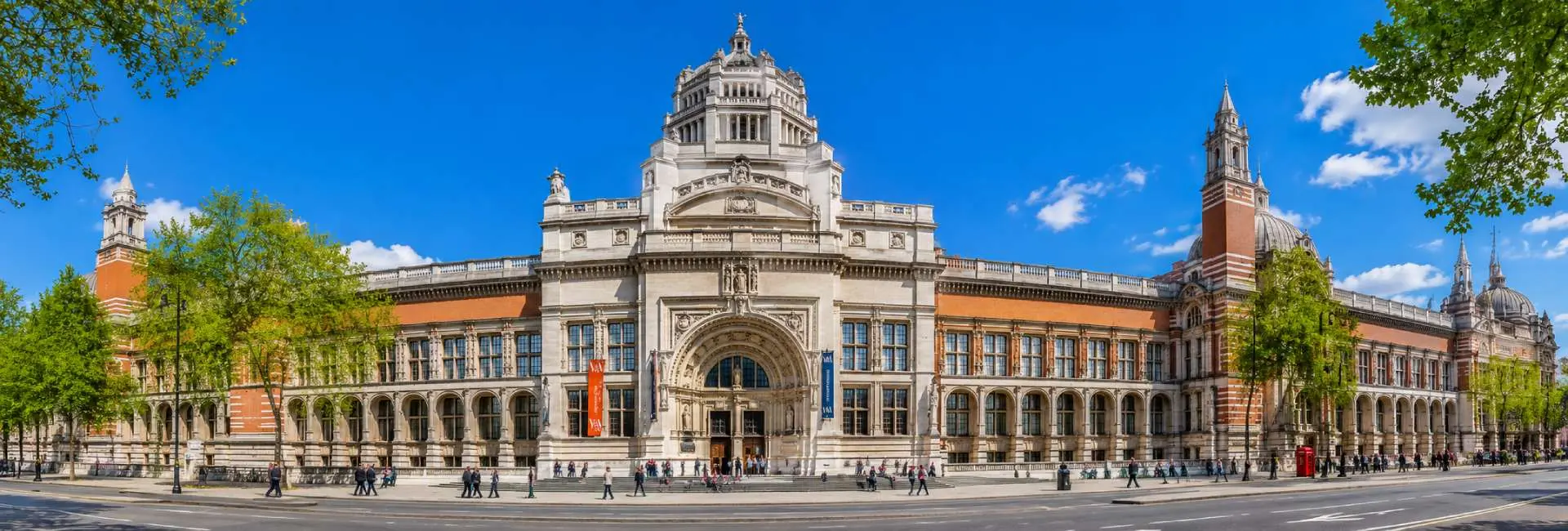
In May 1899, Queen Victoria laid the foundation stone for a grand new building designed by architect Aston Webb, and the museum was renamed the Victoria and Albert Museum in honor of the Queen and her late husband. It was, notably, one of Queen Victoria's last public appearances.
Through the 20th Century
During the Second World War, the majority of the collection was evacuated to safekeeping outside London, and parts of the museum served other purposes, including as a school for evacuated children. The collection was largely reunited with the building by the late 1940s, and the museum's Britain Can Make It exhibition in 1946 drew huge crowds eager for optimism after the war.
Architecture & Design
A Grand Victorian Landmark
The V&A's main building is itself a work of design, with its red-brick and terracotta facade, ornate ironwork, and the distinctive mosaic-tiled entrance hall. Aston Webb's early-20th-century frontage on Cromwell Road remains one of the most recognizable museum exteriors in London.
Interiors Worth Visiting for Their Own Sake
- The Cast Courts, opened in the 1870s, hold monumental plaster casts of European masterpieces, including a full-scale replica of Michelangelo's David.
- The Morris, Gamble, and Poynter Rooms, the museum's original refreshment rooms, are celebrated examples of Victorian decorative design in their own right.
- The museum's courtyard garden offers a rare open-air pause among the galleries, particularly popular in warmer months.
Collections & Highlights
Fashion
The V&A's fashion collection is considered one of the largest and most comprehensive in the world, spanning several centuries of dress. It ranges from historic garments to contemporary couture by designers such as Vivienne Westwood, Alexander McQueen, and Stella McCartney.
Sculpture and the Cast Courts
The museum holds one of the largest collections of post-classical sculpture anywhere, and its Italian Renaissance sculpture holdings are the most significant outside Italy. The towering Cast Courts remain one of the most photographed spaces in the building.
Jewellery and Metalwork
The Jewellery Gallery displays thousands of pieces spanning roughly 3,000 years, from ancient gold ornaments to modern designer pieces, arranged in dramatically lit cases across two floors.
Ceramics, Glass, and Beyond
- One of the world's most important ceramics collections, including Italian Renaissance maiolica and East Asian porcelain.
- The Raphael Cartoons, full-size designs created for Sistine Chapel tapestries.
- The National Art Library, housing over 750,000 books, prints, and drawings related to fine and decorative art.
- A rotating photography collection, showcased in the museum's dedicated Photography Centre.
Ways to Experience It
General admission to the permanent collection is free, and visitors are welcome to explore independently at their own pace across the museum's 145 galleries. Free introductory tours run daily and are a good way to get oriented before branching off into personal interests.
- Self-guided visits using the museum's gallery trails, designed around themes such as fashion, sculpture, or world cultures.
- Paid, ticketed special exhibitions, which rotate regularly and often require advance booking.
- Friday Lates, with the museum open until 10pm and extended evening programming.
- Family-friendly activities and trails aimed at younger visitors during school holidays.
Best Time to Visit
The museum opens daily at 10am, and arriving close to opening or after mid-afternoon tends to mean noticeably thinner crowds. Fridays offer extended hours until 10pm, giving visitors a quieter, atmospheric alternative to a daytime visit, though some galleries close earlier than the main building on these evenings.
Weekends and school holidays are the busiest periods, particularly for popular ticketed exhibitions, which can sell out well in advance. Weekday mornings outside of school holiday periods are generally the calmest time to explore the permanent galleries.
Visitor Tips
- General admission is free and does not require booking; only special exhibitions typically need a paid, timed ticket.
- The museum is large, with seven miles of galleries across multiple floors, so it's worth picking two or three areas of interest rather than trying to see everything in one visit.
- Wheelchairs are available to borrow, entrances on Cromwell Road and Exhibition Road are step-free, and accessible toilets and hearing loops are available throughout.
- South Kensington Underground station itself is not step-free; travelers needing step-free access should use a nearby step-free station instead.
- Some galleries close temporarily for redevelopment from time to time, so it's worth checking the museum's current gallery closures before visiting if a specific collection is a priority.
- The historic Morris, Gamble, and Poynter refreshment rooms are worth a stop for their decor alone, in addition to the museum's garden café.
Nearby Attractions
The V&A sits within London's "Museum Quarter" in South Kensington, within easy walking distance of some of the city's other major cultural institutions, making it simple to combine with a broader museum day.
- The Natural History Museum, just a short walk away, known for its dinosaur skeletons and dramatic entrance hall.
- The Science Museum, neighboring the V&A, covering the history of science, technology, and space exploration.
- The Royal Albert Hall, a short walk north, for those looking to pair a museum visit with an evening performance.
- Hyde Park and Kensington Gardens, offering a green space to unwind after a day of gallery-hopping.
Frequently Asked Questions
What is the Victoria and Albert Museum known for? +
The V&A is known as the world's leading museum of art and design, with especially renowned collections of fashion, sculpture, jewellery, and ceramics spanning 5,000 years of human creativity.
Is admission to the V&A free? +
Yes, general admission to the permanent collection is free and requires no booking. Only special, temporary exhibitions typically carry a separate ticket price.
How much time should I plan for a visit? +
Most visitors spend 2 to 4 hours exploring, though the museum is large enough that a full day is easily possible if you want to see multiple collections in depth.
What are the must-see highlights? +
Popular highlights include the Cast Courts with their full-scale plaster casts, the Jewellery Gallery, the Fashion Galleries, and the Raphael Cartoons, though the right highlights depend on personal interests.
Do I need to book tickets in advance? +
No advance booking is needed for general admission. Advance booking is recommended only for popular ticketed special exhibitions, which can sell out on weekends and during school holidays.
Is the V&A suitable for children and families? +
Yes, the museum runs family-friendly trails and activities, particularly during school holidays, and its Young V&A site in Bethnal Green is designed specifically for children and families.
Is the museum accessible for visitors with disabilities? +
Yes, the museum has step-free entrances on Cromwell Road and Exhibition Road, lifts to all floors, borrowable wheelchairs, accessible toilets, and hearing loops, though South Kensington tube station itself is not step-free.
What's the best time to visit to avoid crowds? +
Weekday mornings near opening time or later afternoons tend to be quietest, while weekends, school holidays, and popular exhibition periods draw the largest crowds.
What else is nearby that I can combine with my visit? +
The Natural History Museum and Science Museum are both a short walk away in the same South Kensington museum quarter, making it easy to plan a full day around multiple museums.