
Table of Contents
Overview
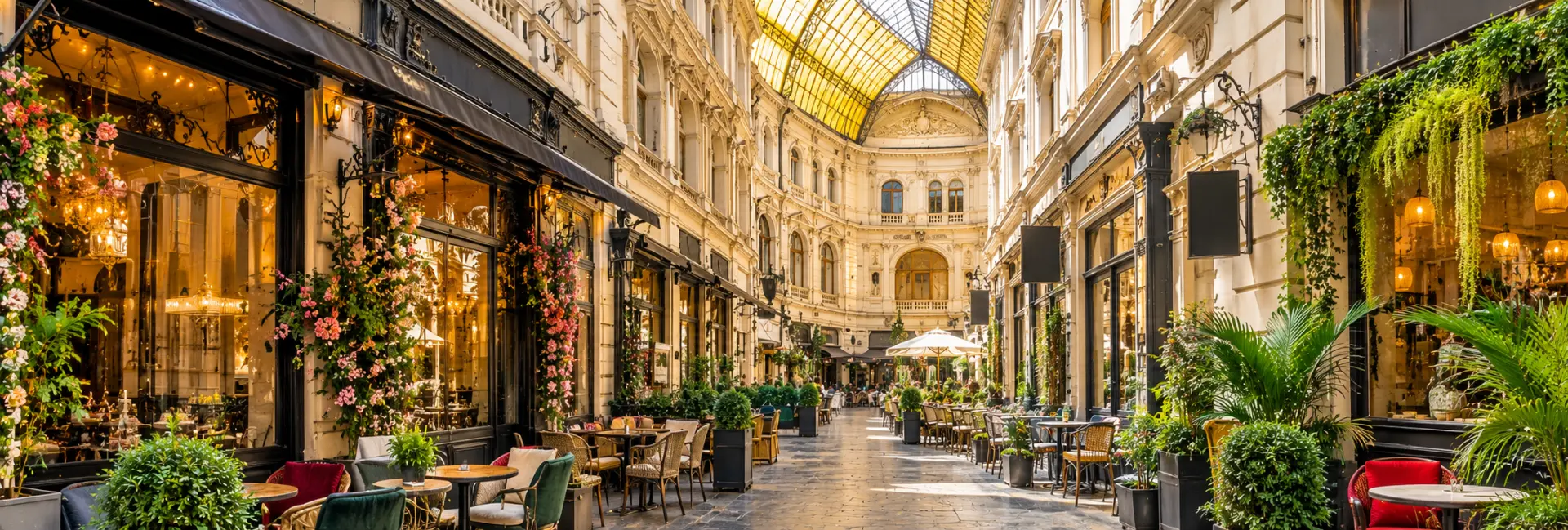
The Macca-Vilacrosse Passage, known in Romanian as Pasajul Macca-Vilacrosse, is a covered arcade in the heart of Bucharest's Old Town. It links Calea Victoriei, the city's grand historic avenue, with the streets around the National Bank of Romania and the Lipscani district. Its most recognizable feature is the yellow glass roof, which fills the narrow lanes below with a warm, golden light.
The passage was built in 1891 and is often described as one of the city's first shopping arcades. Its unusual fork shape, with two branches that run around a central block, makes it unlike the straight arcades found in many other European cities.
Today it is a place to linger rather than a sight to tick off. Visitors come to admire the roof, sit down for a coffee or a meal, take photographs and step out of the rain or midday sun without leaving the street. Entry is free, and the passage is simply part of the city's public space.
History
The inn that came before
The site was once occupied by the Câmpineanu Inn, a busy stop near the crossing of two of the old city's main routes. Later the inn was bought by Petros Seraphim, who gave it to two of his daughters as dowries. One daughter, Polixena, married Xavier Vilacrosse, a Catalan-born architect who served as Chief Architect of Bucharest in the 1840s. The inn took his name. The other daughter, Anastasia, married Mihalache Macca, who built luxury shops on his share of the property.
A passage to ease the congestion
By the late 1880s the city center was crowded, and the authorities decided to buy up the land and create a Western-style passage to relieve the pressure. The project was entrusted to architect Felix Xenopol, and the passage opened in 1891. The two branches were named after the former owners, one for Vilacrosse and the other for Macca, which is why the combined name is still in use today.
Why the passage forks
The fork shape is not an artistic choice. The owner of the Pesht Hotel, which stood in the middle of the site, refused to sell, so Xenopol had to design around it. The result was two wings that wrap around the hotel, a happy accident that gives the passage its character.
Stock exchange, jewelers and revival
The arcade was more than a place to shop. It hosted the first Stock Exchange of Bucharest, before a larger purpose-built home was constructed for the exchange. During the communist period, from 1950 to 1990, it was renamed Pasajul Bijuteria, or the Jewelry Store Passage, and was home to some of the city's largest jewelers. The original name came back after 1990, and in recent decades the passage has reinvented itself as a hub for cafés, restaurants and nightlife.
Architecture & Design
The passage follows the model of the glass-roofed arcades that spread across European cities in the 19th century. Visitors often compare it to Paris arcades or Milan's grand galleria, although Macca-Vilacrosse is far smaller and more intimate. Its two narrow lanes are lined with two-story buildings, with shops at street level and rooms to rent on the upper floor.
The yellow glass roof
The roof is the star feature. Panels of yellow glass span the lanes, letting daylight in while giving shelter from rain. The color casts a soft, honey-toned glow on the stonework and the terraces below, and it is especially photogenic on bright days. Many visitors say the passage is at its best in the morning, when the light is diffuse and the lanes are quiet.
Decorative details
The facades are richly finished, including ornamental stucco work, and the entrance on Strada Eugeniu Carada is marked by a monumental gateway with a wrought-iron door. Restoration work in recent years has helped bring out the details of the walls and ceiling, so it pays to look up and around as you walk through.
Layout and entrances
The passage has three entrances: two open onto Calea Victoriei, where the branches split, and the third faces the National Bank side on Strada Eugeniu Carada, where the two branches meet. This makes it a handy shortcut between the avenue and the Old Town.
Inside the Passage
The passage is short, and you can walk its length in a few minutes. Its charm lies in the details, which reward a slower pace.
- The two branches: one called Vilacrosse and the other Macca, each with its own row of terraces and doorways. Walking both gives a feel for the fork-like layout.
- The glass canopy: the roof creates a continuous covered space, so terraces stay usable in light rain.
- The Carada gateway: the monumental entrance on the National Bank side is one of the passage's most photographed spots.
- The upper floors: the first-floor rooms were originally built to be rented out, a reminder that the passage was designed as a mixed-use building and not only a shopping street. A small boutique inn named after the passage still carries on the lodging tradition.
- Street-level life: shopfronts, terraces and doorways mingle in a compact space, giving the arcade a lively, slightly bohemian feel.
Cafés, Restaurants & Nightlife
The passage's lanes are now filled with places to eat and drink. You will find cafés, bistros, restaurants and wine bars, and many have outdoor tables arranged directly under the glass roof. Several cafés are known for serving hookah, or shisha, a tradition that Bucharest inherited from its Ottoman past.
The atmosphere changes through the day. In the morning and early afternoon it is relaxed and good for coffee, while in the evening the terraces fill up, music drifts out of the bars and the passage becomes one of the Old Town's social hubs.
Menus and opening hours vary from venue to venue and change often, so treat any recommendation as a starting point and take a quick look at what is open before you sit down. If you want to eat, it is worth comparing a few places along both branches, as prices and quality can differ.
Ways to Experience It
A quick walk-through
If you are short on time, simply stroll through from Calea Victoriei to Strada Eugeniu Carada. It takes only a few minutes and is a pleasant way to move between the avenue and the Old Town.
A coffee or meal under glass
The best way to experience the passage is to stay for a while. Choose a terrace, order a coffee or a meal and watch the light shift on the glass as the day goes on.
Photography
The yellow glass, the curved lanes and the gateway make for striking architectural and street photos. Go early for the emptiest views and the softest light.
Part of a walking route
The passage fits naturally into a walk along Calea Victoriei and through the Old Town. Many visitors combine it with the surrounding historic streets and nearby landmarks.
Best Time to Visit
For photos and quiet, aim for the morning, when the passage is calm and the roof glows without crowds. Midday is good for lunch, and the covered lanes offer welcome shade in summer and shelter from rain or cold winds in other seasons.
In the evening the atmosphere is livelier. Terraces fill with diners and drinkers, and the arcade becomes a social space. If you like energy and noise, that is the time to come; if you prefer calm, choose an earlier hour.
The passage is a pedestrian space that can be walked through at any time of day or night, but individual venues keep their own hours, so check what is open if you plan to eat or drink.
Visitor Tips
- It is free to walk through: there is no ticket for the passage itself, and you only pay if you order at a café or restaurant.
- Allow 20 to 30 minutes for a stroll and photos: add more time if you plan to sit down for a drink or meal.
- Getting there: the passage is in central Bucharest, a short walk from Piața Universității and the Universitate metro station, and it is easily reached on foot from the Old Town.
- Check venue hours and prices: opening times, menus and prices vary and can change, so look before you commit to a place.
- Mind the smoke: hookah is popular in several venues, so if you are sensitive to smoke, ask for a table away from smokers.
- Keep an eye on your belongings: as in any busy central area, be aware of your bag and phone, especially in the evening.
- Accessibility: crowded terraces can make the narrow lanes tricky to navigate, so allow extra time if you use a wheelchair or stroller, and check ahead if you need step-free access to a particular venue.
Nearby Attractions
The passage sits in one of the most walkable parts of the capital, so it is easy to pair with other sights.
- Calea Victoriei: Bucharest's famous historic avenue, lined with palaces, shops and landmarks. The passage opens directly onto it.
- National Bank of Romania: the imposing bank building stands at the far end of the passage and is a striking sight in its own right.
- Lipscani and the Old Town: the historic merchants' quarter is right next door, with narrow streets, bars and restaurants.
- Manuc's Inn (Hanul lui Manuc): one of the oldest and best-preserved inns in the capital, a short walk away in the Old Town.
- Romanian Athenaeum: the city's famous concert hall is a longer walk up Calea Victoriei and is one of Bucharest's most recognizable buildings.
FAQs about visiting the Macca-Vilacrosse Passage
What is the Macca-Vilacrosse Passage? +
It is a covered arcade built in 1891 in central Bucharest, known for its fork shape and yellow glass roof. Today it is lined with cafés, restaurants and bars.
Why is the passage shaped like a fork? +
The owner of the Pesht Hotel, which stood in the middle of the planned site, refused to sell. The architect designed two branches that wrap around the hotel instead.
Is it free to visit? +
Yes, walking through the passage costs nothing. You only pay if you order food or drinks at one of the venues.
How long should I spend there? +
A walk-through takes just a few minutes, and most visitors spend 20 to 30 minutes looking around and taking photos. Plan on an hour or more if you stop for a meal.
When is the best time to go? +
Mornings are the quietest and best for photography, while evenings are livelier. The roof also makes it a good choice on rainy days.
How do I get there? +
The passage is in the Old Town, a short walk from Piața Universității and the Universitate metro station. Its entrances are on Calea Victoriei and on Strada Eugeniu Carada.
Is it a good place to eat and drink? +
Yes, it is packed with cafés, restaurants and wine bars, many with terraces under the glass roof. Menus and hours vary, so check before you sit down.
What else is nearby? +
You can walk to Calea Victoriei, the National Bank of Romania, the Lipscani Old Town and Manuc's Inn within minutes. The Romanian Athenaeum is a longer walk along Calea Victoriei.
