
Table of Contents
Overview
The Romanian National Opera in Bucharest, known locally as Opera Națională București or ONB, is the capital's leading stage for opera and ballet. It is the oldest of Romania's four national opera and ballet companies, and its home is a mid-century theatre on Bulevardul Mihail Kogălniceanu, close to the Cotroceni district.
The company has been performing in this building since early 1954, and the house seats just under a thousand people. That size gives it a more intimate feel than many of the world's grand opera houses, which is one reason first-time opera-goers often find it welcoming.
For visitors, the opera house offers two experiences in one. It is a landmark building worth seeing from the outside and a working theatre where a full evening of music, drama or dance is the best way to see what it is all about.
History of the Opera
From early Italian seasons to a national company
Opera arrived in Bucharest in the 19th century. In 1843 the city inaugurated its first Italian theatre with Bellini's Norma, and touring troupes and students of the Philharmonic School brought works by Donizetti and Rossini to local audiences. Over the following decades, Romanian musicians began to push for a company of their own.
The first Romanian opera company
A government regulation in 1877 provided for an opera company under the umbrella of the National Theatre. On 8 May 1885 the Romanian Opera Company gave its first performance, led by composer, conductor and teacher George Stephănescu, who is remembered as the founder of the national opera tradition. The early years were precarious, and the company relied on the efforts of artists and supporters to keep going.
An independent institution in 1921
In 1921 the company became a fully independent institution, with funding that moved back and forth between state support and private backers. Its first production under the new status was Wagner's Lohengrin, conducted by George Enescu, the towering figure of Romanian music. That link with Enescu remains a point of pride for the house.
A new home in the 1950s
The present building went up in 1953 to serve as a venue for the international festivals held in Bucharest that summer. The Romanian Opera inaugurated it on 9 January 1954 with Tchaikovsky's The Queen of Spades, and the first ballet performance, Delibes' Coppélia, followed the next evening. In 2021 the company marked 100 years since becoming an institution with a new staging of Lohengrin, the same work that had launched its independent life.
Architecture & Design
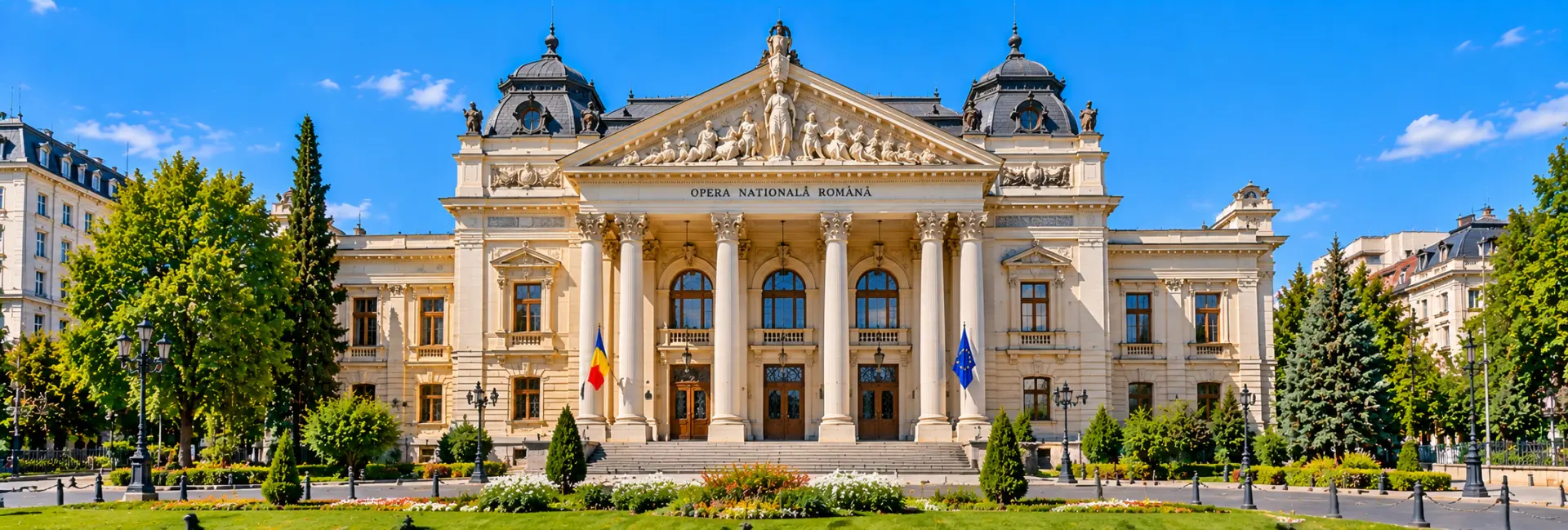
The opera house was designed by architects Octav Doicescu and Paraschiva Iubu, and was finished in 1953. Doicescu is also known for other projects in the capital, including the Mioriţa Fountain. Visitors often describe the building as loosely neoclassical, with a calm, formal exterior that suits a national cultural institution.
At the front, a flight of broad, shallow steps leads up to the entrance, and the facade is lit in the colors of the Romanian flag in the evening. The setting creates a sense of occasion even before you step inside, which is part of the appeal of dressing up for a night at the opera.
The auditorium
Inside, the main hall is richly decorated and seats 952 people. The scale is modest compared with some of Europe's largest opera houses, and that is part of its charm: audiences can feel close to the action rather than watching from a distance.
In front of the building
The area in front of the opera house is dotted with tributes to the people who shaped Romanian music. A statue of George Enescu stands near the entrance, and the founding figure of the national opera, George Stephănescu, is honored with a bust.
Recognition / Status
The opera house is a listed historic monument and appears in Romania's national register of historic monuments. It belongs to the state and operates as a national institution under the Ministry of Culture.
Its status as a national company also gives it a wider cultural role. It carries the flag for Romanian opera, ballet and music education, and it has been a regular venue for guest performances, gala concerts and festival productions that attract celebrated singers and conductors from Romania and abroad.
Names associated with special programs at the house in recent decades include sopranos Angela Gheorghiu and Anita Hartig, mezzo-soprano Ruxandra Donose and bass-baritone Erwin Schrott. Their appearances show how the opera has maintained a place on the international circuit despite being based in a mid-sized national theatre.
The company also serves as a showcase for Romanian composers. The country has a rich but little-known operatic heritage, and a night at ONB is one of the few chances visitors have to hear it live. It is a meaningful way to experience Romania's cultural identity in addition to seeing the city's sights.
What to See Inside
The main auditorium
For most visitors, the highlight is the auditorium itself, where the rich decoration and the framed stage combine into a classic opera-house atmosphere. Arrive a little early to take it all in before the lights go down.
Foyers and public spaces
The foyers become a social hub before the show and during intermission. They are a good place to soak up the pre-performance atmosphere and see how locals dress for the occasion.
The Opera Museum
The National Opera House Museum, founded in 1964, is located on the second floor of the building. It holds photographs, programs, posters, stage costumes, letters and documents tracing the history of Romanian opera, along with busts of major musicians and performers. Access is generally tied to performance times, so plan to visit before the show or during an interval rather than turning up on a quiet afternoon.
Ways to Experience It
Attending an opera
The repertoire has included well-loved works such as Puccini's La Bohème, Gounod's Faust, Tchaikovsky's The Queen of Spades and Wagner's Lohengrin, alongside Romanian works such as Enescu's Oedipe. The mix means a visit can be a first taste of the classics or a chance to hear music rarely staged elsewhere.
Watching a ballet
The house is a home for ballet as well as opera, and the company staged its first ballet, Coppélia, only a day after opening the building. Ballet evenings are a good choice if you are less comfortable with sung performances in another language.
Concerts, galas and festivals
Outside the regular season, the opera hosts anniversary galas, concerts and special events. The Bucharest Opera Festival has brought major international voices to the stage, including a Gounod Faust opening night in June 2025 with well-known guest soloists.
Planning a full evening
An evening at the opera can easily become the centerpiece of a night out. Many visitors arrive early for a light dinner nearby, take their seats well before curtain time, and use the intermission to stretch their legs in the foyers. Afterward, the walk back through the neighborhood is a relaxed way to unwind, and the illuminated facade makes a worthwhile last photo of the night.
Seeing the building only
If you cannot attend a show, the exterior and the monuments out front are worth a short stop, especially in the evening when the facade is illuminated.
Best Time to Visit
The best time to visit is simply when a production you want to see is on. The performance schedule changes regularly, so check what is playing and book early for popular titles and gala nights.
Evenings are the classic choice because the building looks its best after dark and the atmosphere in the foyers is livelier. Weekend performances can be busier, while midweek shows tend to be calmer.
Special programs and festivals can fall outside the main season, as the June festival edition shows, so it is worth checking the schedule for your dates. If you want to combine the show with some time outdoors, late spring and early autumn are comfortable months for a walk in the neighborhood before or after the performance.
Visitor Tips
- Buy tickets in advance: performances can be booked through the opera's official website, and the box office handles in-person sales. Opening hours for the box office have varied, so confirm before you go.
- Check the show details: look at the language of the performance, whether surtitles are provided and how long the evening runs, including intermissions.
- Dress for the occasion: many guests dress smartly, although you will see a range of styles. Smart casual is a safe choice.
- Pick your seat with care: the house is relatively compact, so most seats offer a good view, but compare the seating plan and prices on the booking page to match your budget and comfort.
- Arrive early: being there 30 to 45 minutes before the start gives you time to collect tickets, explore the foyers and visit the museum.
- Getting there: the Eroilor metro station is the closest, and the boulevard is also well served by public transport. Taxis and ride-hailing are easy to find after the show.
- Accessibility: contact the opera ahead of your visit if you need step-free access or other assistance.
Nearby Attractions
The opera house is on the western edge of the city center, so it is easy to combine with a wider day out.
- Cotroceni district: a quiet, green residential area next to the opera, home to Cotroceni Palace, which houses the National Cotroceni Museum.
- Cișmigiu Gardens: the oldest public park in central Bucharest, a pleasant spot for a stroll before an evening show.
- Bucharest Botanical Garden: a large and peaceful green space a short ride away, ideal for a slower afternoon.
- Palace of Parliament: one of the largest administrative buildings in the world, reachable on foot or by a short ride from the opera.
- Old Town: the lively historic center, with restaurants and cafés where you can have dinner before or after the performance.
FAQs about visiting the Romanian National Opera in Bucharest
What is the Romanian National Opera famous for? +
It is the oldest of Romania's national opera and ballet companies and performs in a listed mid-century theatre that opened in 1954. Its repertoire covers classic opera and ballet as well as Romanian works.
Can I visit the opera house without seeing a show? +
You can admire the building from outside at any time, but access to the interior is usually linked to performances. The small opera museum is also generally open around show times, so check with the opera before planning a daytime visit.
How do I buy tickets? +
Tickets are sold through the opera's official website and at the box office. Popular titles and gala evenings can sell out, so it is wise to book ahead and check the current schedule and prices.
How long does a performance last? +
Most opera and ballet evenings run for about two to three hours, including at least one intermission, though longer works such as Wagner can take considerably more. The listing for each show states the expected duration.
What should I wear? +
There is no need for formal evening wear, but many guests dress smartly for an evening out. Smart casual clothes will let you feel comfortable in the main hall.
How do I get to the Romanian National Opera? +
The nearest metro station is Eroilor, and the opera sits on the boulevard a short walk away. Buses, taxis and ride-hailing services also serve the area.
Is the opera suitable for first-time visitors or children? +
Yes. Ballet and shorter, well-known operas are a gentle introduction, and the intimate size of the house helps. Check each production's listing for the recommended age and running time.
What else can I do nearby? +
You can stroll through Cișmigiu Gardens, explore the Cotroceni district or head to the Botanical Garden. The Old Town is a short ride away for dinner and nightlife.
