
Table of Contents
Overview
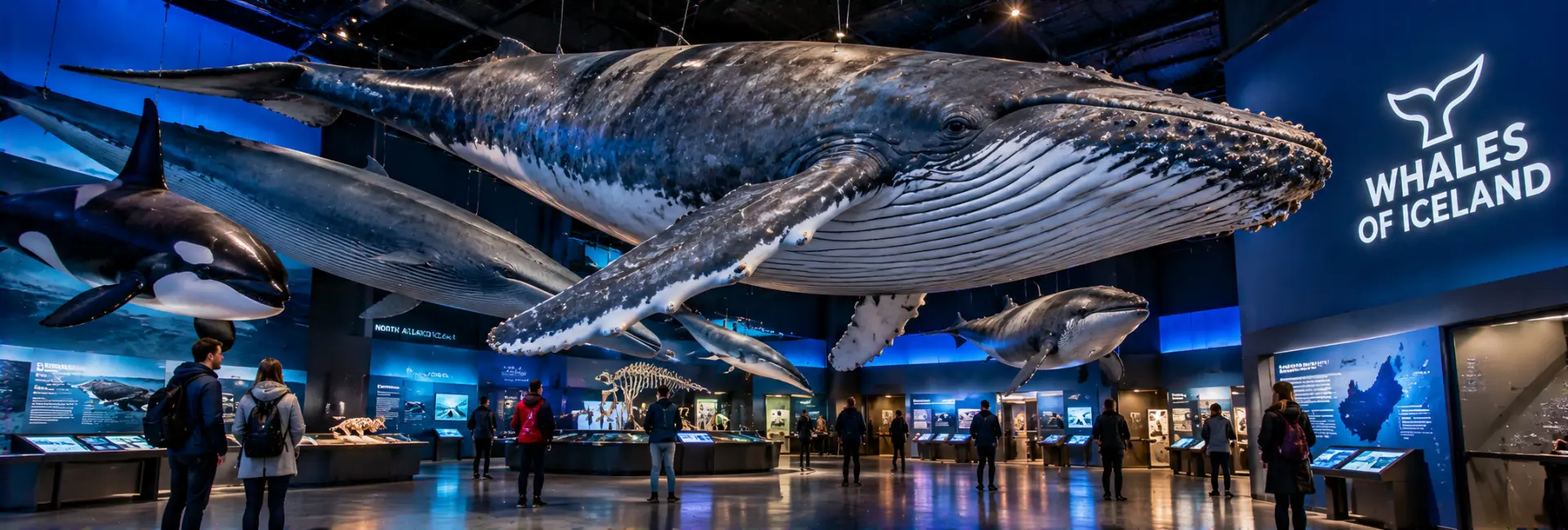
Whales of Iceland is a museum on Reykjavik's harbour front where 23 full-size whale, dolphin and porpoise models share one large, dimly lit hall. Every species recorded in Icelandic waters is represented, so you can compare a harbour porpoise with a blue whale in a few steps instead of trying to picture the numbers on a page.
The setting is deliberately atmospheric. Soft blue lighting and recorded ocean sounds give the space the feel of a seabed, and the models are made from a soft material that visitors are welcome to touch. The museum describes itself as the largest of its kind in Europe, and it works equally well as a family outing and as a serious first introduction to marine mammals.
Beyond the models, the museum adds an audio guide, documentary films, interactive stations, a café and a gift shop. Together they make it an easy way to fill a rainy half-day in the Icelandic capital.
History of the Museum
Origins and Opening
The museum was created by Icelandic entrepreneur Hörður Bender and opened to the public in February 2015, following roughly two years of preparation. The idea was simple: many visitors come to Iceland hoping to see whales but never spot one at sea, and even those who do rarely grasp how large and varied these animals really are.
Building the Models
The team began with detailed blueprints drawn from close study of the species found around Iceland. Specialist craftspeople in China then built each model to order, and the whales arrived in Reykjavik in August 2014. The biggest pieces were too large for a shipping container or the museum doorway, so they travelled in sections and were assembled on site before being painted by hand.
Growth Since Opening
The exhibition has kept expanding since its first season. An interactive minke whale anatomy installation, designed by the studio Gagarin, was added in January 2015. In November 2015 the museum joined the Marine Research Institute of Iceland on a trip to Eyjafjörður in the north, where three humpback whales were fitted with tracking tags. A free app followed in early 2016, and a dedicated film theatre was added later.
In 2018 and 2019 the museum also joined local whale-watching companies and other businesses in hosting Whale Day events, aimed at building appreciation for the animals among residents and visitors alike.
Design & Craftsmanship
What sets the hall apart is how individual the models feel. Rather than showing a generic version of each species, the makers painted each whale to match a real animal seen in the wild. The scars on the sperm whale record the kind of deep-water encounters that real animals survive, and the tail pattern on the humpback copies the markings that scientists use to tell one humpback from another.
Scale is the other big achievement. All 23 models are built at true size, and many hang overhead, so you often walk beneath them and look up at their bellies and flukes. The largest animals dominate the space, while the dolphins and porpoises sit at a human scale that makes the contrast easy to take in.
Lighting and sound do much of the storytelling. The hall is kept dark with a deep blue glow, and whale song and ambient sea sounds play in the background. Combined with the soft, squishy texture of the models, the effect is closer to wading through a quiet ocean than to walking through a traditional museum gallery.
Collections & Exhibits
The collection covers all 23 species the museum has identified in Icelandic waters, from the smallest porpoise to the largest animal that has ever lived. It is easiest to understand as three groups.
Porpoises and Dolphins
The harbour porpoise, about 1.5 metres long, is the smallest marine mammal in Iceland. Alongside it are five dolphins: the white-beaked, Atlantic white-sided, short-beaked common, common bottlenose and striped dolphin. Their information panels cover speed, social behaviour, lifespan and typical group sizes.
Toothed Whales
This group includes the beluga, narwhal, orca and long-finned pilot whale, along with four beaked whales: northern bottlenose, Cuvier's, Blainville's and Sowerby's. Beaked whales are some of the least familiar animals in the hall, and the museum uses them to show how deep and secretive ocean life can be. The sperm whale, the biggest of the toothed whales, rounds out the group.
Baleen Whales
Eight giants make up the baleen section: the bowhead, North Atlantic right, gray, humpback, blue, minke, sei and fin whales. These filter-feeders strain small prey from the water rather than hunting with teeth, and the size jump from the minke to the blue whale is one of the most striking comparisons in the whole museum.
Must-See Highlights
With 23 models to explore, it helps to know which ones tend to stop visitors in their tracks.
- Blue whale: the centrepiece model, at roughly 25 metres, represents the largest animal known to have existed. Standing beneath it is the clearest way to appreciate its size.
- Sperm whale: a heavily scarred, deep-diving hunter. Only older or young males are usually found around Iceland, which makes this model a fitting local portrait.
- North Atlantic right whale: a critically endangered species whose name reportedly came from whalers who saw it as the right whale to hunt. The model carries a sobering conservation message.
- Narwhal: the Arctic species with the spiralling tusk that inspired unicorn legends, usually measuring two to three metres on males.
- Bowhead whale: possibly the longest-lived mammal on Earth, with estimates stretching past a century.
- Fin whale: among the fastest large whales, and the animal that gives the museum's film theatre its name.
- Orca: a highly social species whose pods are often led by an older female.
Interactive Exhibits & Conservation
Hands-On Stations
Scattered between the models are touch-screen and multi-user installations that go deeper than the information panels. One explores the anatomy of the minke whale, letting groups of visitors peel back layers to see how the body works. Another follows the real migration routes of whales tracked by satellite, using data gathered in cooperation with Iceland's Marine Research Institute.
The Fin Whale Theatre
A large screen in the Fin Whale Theatre shows documentary films several times a day, and they are included in the ticket. Past screenings have included a nature film narrated by Sir David Attenborough about whale intelligence and a documentary on how industrial and military ocean noise affects marine life. Screening times can change when lectures or events are scheduled, so it is worth checking on the day.
A Conservation Message
The theatre also hosts an exhibit on the threats whales face and the solutions that could help, developed with the International Fund for Animal Welfare and local scientists. Education and protection are central to the museum's mission, and visitors are invited to sign a petition against commercial whaling. The museum also reports that it runs on renewable energy, recycles its waste and stocks locally made products in its shop.
Ways to Experience It
Self-Guided with the Audio Guide
The audio guide is free and runs on your own smartphone, so you scan a code at the front desk and listen as you walk. It is narrated by marine biologists and tour guides, is available in 17 languages, and takes around 30 minutes. Bring your own headphones for the best experience.
Live Guided Tours
A guided tour with a member of staff is offered twice daily, at 11:00 and 15:00, for ticket holders at no extra charge. It lasts about 30 minutes and covers the differences between baleen and toothed whales, with real teeth and baleen plates to examine up close. Check the official site for the current schedule before you plan around it.
Groups, Schools and Private Visits
Groups of 15 or more can book a private tour outside the standard times. The museum welcomes preschool groups free of charge and offers reduced rates and guided visits for other student groups, which makes it a popular school trip.
Combine It with a Real Whale Watch
The museum partners with whale-watching operators, and the harbour where tours depart is a short walk away. Many visitors pair the two, using the museum to learn what to look for before heading out on the water.
Best Time to Visit
Because the whole exhibition is indoors, Whales of Iceland works in every season. The museum is open daily throughout the year, including public holidays, which makes it a reliable fallback when wind, rain or snow rule out outdoor plans.
By Season
In summer the long daylight hours leave plenty of time to pair a morning or afternoon at the museum with a boat trip or a harbour stroll. In winter the museum is a warm, atmospheric break from short days, and it is often quieter than at the height of the tourist season.
By Time of Day
Tour groups and families tend to cluster around the middle of the day and around the scheduled guided tours. If you prefer a calmer hall for photographs and for reading the panels, arriving soon after opening or later in the afternoon is usually a safer bet.
Visitor Tips
A little planning helps you get more from the visit.
- Allow enough time: most people spend one to two hours, more if they watch a full film or join a guided tour.
- Confirm the practical details: opening hours, ticket prices, family and multi-visit passes, and film times can change, so check the official website before you go.
- Buy tickets ahead if you can: booking online can save time at the desk, particularly on busy days.
- Bring headphones: they make the free audio guide far more enjoyable, especially in the darker, echoing hall.
- Touch with care: the models are made to be handled, but gentle contact keeps them looking good for every visitor.
- Plan for low light: the hall is dim by design, so photos work best with a steady hand or a phone with a good night mode.
- Take a break: the Big Little Whale Café serves coffee and baked goods beneath the models, and the gift shop stocks books, souvenirs and locally made items.
- Accessibility: the museum describes itself as an accessible attraction, and the details are published on its website for anyone with specific needs.
- Getting there: city bus 14 and the hop-on hop-off sightseeing bus stop outside, and free visitor parking is available on site.
Nearby Attractions
The museum sits in Grandi, a former fishing district on Reykjavik's old harbour that has become one of the city's liveliest corners. Fishermen once repaired their nets and landed their catches here, and the area now has well-regarded restaurants, small shops selling Icelandic design and a few supermarkets. The walk from the city centre takes about 15 minutes along the waterfront.
What to Pair with Your Visit
- Old Harbour: departure point for whale-watching, puffin and other boat tours, only a short stroll from the museum.
- Saga Museum: an immersive look at Iceland's Viking-era history, located in the same district.
- Marshall House: a converted harbour building that now houses contemporary art exhibitions.
- Grandi restaurants and cafés: a convenient place to eat after the museum, with seafood and casual options close by.
FAQs about visiting Whales of Iceland
What is Whales of Iceland? +
It is a museum in Reykjavik's Grandi harbour district featuring 23 life-size models of the whale, dolphin and porpoise species found in Icelandic waters, along with films, interactive displays and an audio guide.
Where is Whales of Iceland located? +
The museum is at Fiskislóð 23-25 in Reykjavik, about a 15-minute walk from the city centre along the Old Harbour waterfront.
How long does a visit take? +
Most visitors spend between one and two hours, depending on whether they follow the full audio guide, watch a documentary or join one of the daily guided tours.
Are the whales real? +
No, they are hand-painted life-size models, each based on a real animal in the wild. They are soft to the touch, and the museum itself describes them as squishy.
Is it suitable for children? +
Yes, the museum is designed for all ages, and the touchable models, dim underwater atmosphere and interactive stations are especially popular with kids. Very young children have historically been admitted free, but check the official site for current pricing.
Is there an audio guide, and is it free? +
Yes, the audio guide is free and runs on your own smartphone via a code at the front desk. It is available in 17 languages, so bring headphones for the best experience.
How do I get there? +
City bus 14 and the hop-on hop-off sightseeing bus both stop outside the museum, and free visitor parking is available on site. Walking from the city centre takes about 15 minutes.
Can I see real whales on the same trip? +
Yes, whale-watching tours depart from the Old Harbour, a short walk away, and the museum works with local operators. Many visitors visit the museum first to learn about the species they might see at sea.
