Table of Contents
Overview
Piazza del Popolo is one of Rome's grandest public squares, sitting at the northern edge of the historic center where the ancient Via Flaminia once entered the city. Laid out as a broad, symmetrical oval, it has served for centuries as the first dramatic glimpse of Rome for travelers and pilgrims arriving from the north.
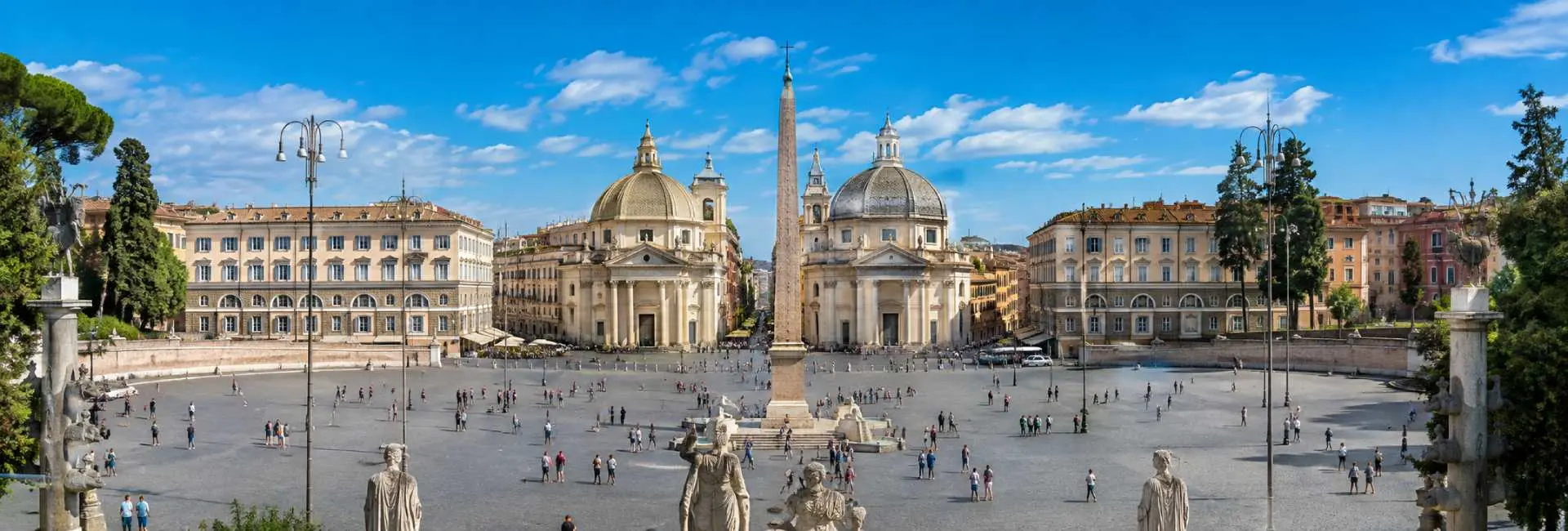
The square brings together more than two thousand years of history in one open space: an Egyptian obelisk far older than Rome itself, a pair of near-identical Baroque churches, a Renaissance basilica, and neoclassical fountains, all arranged around a single sweeping ellipse.
History
Medieval and Renaissance Origins
The square takes its name not from "popolo," the Italian word for "people," but most likely from the Latin populus, meaning poplar tree, after the trees that once grew on the site. In the 15th century, Pope Sixtus IV commissioned the Basilica di Santa Maria del Popolo, rebuilding it over an existing 11th-century chapel and giving the square its earliest architectural anchor.
The Baroque Transformation
The piazza gained much of its theatrical character in the 17th century. In 1589, Pope Sixtus V had a long-buried Egyptian obelisk re-erected at the center of the square. Several decades later, in the 1660s, architect Carlo Rainaldi began work on the twin churches that would frame the entrance to Via del Corso, a project later completed by Carlo Fontana with input from Gian Lorenzo Bernini.
The Modern Oval
The piazza's current form dates to the early 19th century, when architect Giuseppe Valadier redesigned the square between 1811 and 1822, sweeping away older, cramped structures in favor of the elegant ellipse visitors see today, complete with curving exedras and ramps linking up to the Pincio terrace above. Notably, the piazza also has a darker past: it was used as a site of public executions as recently as 1826.
The Flaminio Obelisk
At the center of the piazza stands the Flaminio Obelisk, one of Rome's oldest and tallest ancient monuments. Carved from red granite in Egypt roughly 3,000 years ago, it originally stood at a temple in Heliopolis before Emperor Augustus had it brought to Rome around 10 BC and installed at the Circus Maximus.
Over the centuries the obelisk toppled and was buried, only to be rediscovered broken into pieces in the 16th century. Pope Sixtus V ordered it restored and moved to Piazza del Popolo, where it was re-erected in 1589. It rises roughly 24 metres on its own, with a cross on top bringing its total height to well over 30 metres, making it one of the tallest obelisks in the city.
- Originally quarried and carved in ancient Egypt, long before it ever reached Rome
- First brought to Rome by Emperor Augustus after his Egyptian campaign
- Re-erected in its current spot in 1589 under Pope Sixtus V
- Ringed by four stone lions and a fountain added in the 19th century
The Twin Churches
At the southern end of the piazza, two Baroque churches, Santa Maria dei Miracoli and Santa Maria in Montesanto, frame the entrances to three streets that fan out into the city: Via del Corso, Via del Babuino, and Via di Ripetta. Designed to look like mirror images of each other, they form one of Rome's most photographed architectural set pieces.
The illusion of perfect symmetry is a clever piece of design rather than a coincidence. Because the two churches sit on differently shaped plots, squeezed between streets that already existed, architect Carlo Rainaldi gave one church an oval dome and the other a round one, angling both facades slightly inward so that, from the piazza, they appear identical.
- Santa Maria in Montesanto sits on the eastern plot with an oval floor plan
- Santa Maria dei Miracoli sits on the narrower western plot with a circular floor plan
- Both were begun by Carlo Rainaldi in the 1660s and completed later by Carlo Fontana
Porta del Popolo and the Fountains
On the northern side of the square stands Porta del Popolo, the monumental gateway that once marked the entrance to Rome through the ancient Aurelian Walls. The gate was built in 1561 under Pope Pius IV and later redecorated on its inner face by Bernini to mark the arrival of Sweden's Queen Christina in Rome.
The piazza is also anchored by a set of neoclassical fountains added during Valadier's 19th-century redesign. To the north, the Fountain of Neptune shows the god of the sea flanked by tritons, while to the south, the Fountain of the Goddess Roma features Roma enthroned above Romulus and Remus suckling from the she-wolf, a nod to the city's founding legend.
Basilica di Santa Maria del Popolo
Tucked beside Porta del Popolo, the Basilica di Santa Maria del Popolo is often overshadowed by its flashier neighbors, but it holds some of the piazza's finest art. Rebuilt in the 15th century over an earlier medieval chapel, it's considered one of Rome's great early Renaissance churches.
Inside, the Cerasi Chapel houses two paintings by Caravaggio, while the Chigi Chapel, designed in part by Raphael, is known for its striking mosaics. For visitors who want to go beyond the piazza's open-air landmarks, the basilica offers a quieter, art-filled counterpoint.
Best Time to Visit
Piazza del Popolo is at its most atmospheric in the early morning or the late afternoon, when the crowds thin out and the light catches the pale travertine fountains and church facades. Midday in summer can feel exposed and busy, since the square offers little shade.
- Early morning: quiet streets, softer light, easier photos of the obelisk and twin churches
- Late afternoon into evening: golden light and a livelier, more social atmosphere
- Spring and autumn: comfortable temperatures without peak summer crowds
Visitor Tips
The piazza is free and open at all hours, making it easy to fit into a longer walk through central Rome rather than a dedicated stop on its own.
- Climb up to the Pincio terrace, just above the square, for a panoramic view over the piazza and the domes of Rome
- Check opening hours for the Basilica di Santa Maria del Popolo before visiting, since access to the Caravaggio paintings depends on the church's schedule
- The square sits at the start of Via del Corso, one of Rome's main shopping streets, so it pairs naturally with a stroll south into the center
- Benches and steps around the fountains make it a good rest stop between other sightseeing
Nearby Attractions
Piazza del Popolo works well as a starting or ending point for exploring central Rome, with several major sights within easy walking distance.
- Pincio Terrace and the Villa Borghese gardens, just above the square
- Via del Corso, Via del Babuino, and Via di Ripetta, the three streets radiating south from the piazza
- The Spanish Steps, a short walk along Via del Babuino
- The Mausoleum of Augustus, a short walk south along Via di Ripetta
FAQs about Piazza del Popolo
What is Piazza del Popolo known for? +
It's known for its grand oval design, the ancient Egyptian obelisk at its center, and the twin Baroque churches that frame the entrance to Via del Corso.
How old is the obelisk in Piazza del Popolo? +
The Flaminio Obelisk was carved in Egypt roughly 3,000 years ago and has stood in its current spot in the piazza since 1589.
Is Piazza del Popolo free to visit? +
Yes, the piazza is a public square that's free and open at all times; only some buildings around it, like certain church chapels, may have their own visiting hours.
How much time should I spend at Piazza del Popolo? +
Most visitors spend 20 to 40 minutes taking in the square itself, longer if they also visit the Basilica di Santa Maria del Popolo or climb up to the Pincio terrace.
Are the two churches on the piazza actually identical? +
They look identical from the square thanks to matching facades, but their floor plans differ, with one built on an oval plan and the other on a circular one to fit their differently shaped plots.
Is Piazza del Popolo suitable for visiting with kids or limited mobility? +
The square itself is flat, open, and easy to navigate with a stroller or wheelchair, though the ramps and steps up to the Pincio terrace involve more effort.
What's a good way to combine a visit with other sights? +
Pair it with a walk down Via del Corso toward central Rome, a stop at the Spanish Steps, or a climb up to the Pincio terrace and Villa Borghese gardens for a wider view of the city.
Do I need tickets to enter Piazza del Popolo? +
No tickets are needed for the square itself; only specific sites nearby, such as museum spaces or certain chapels, may require separate admission.