
Table of Contents
Overview
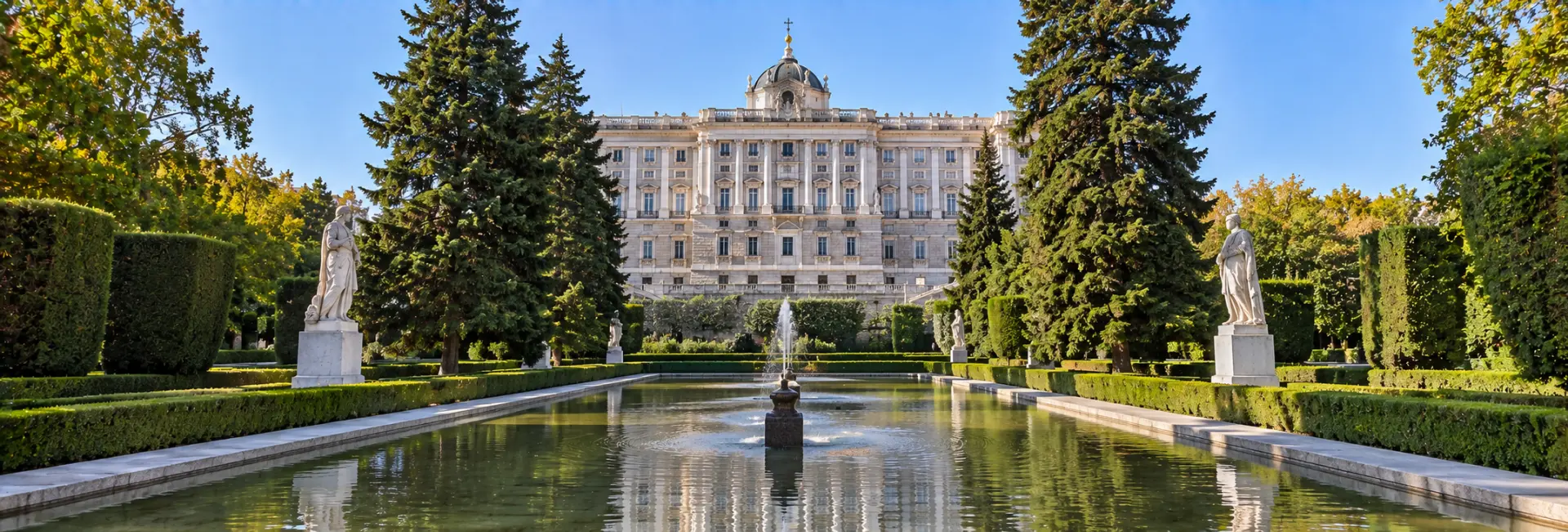
Tucked along the north side of the Royal Palace, the Sabatini Gardens are one of those spots that a lot of visitors stumble into almost by accident, usually right after touring the palace itself, and end up lingering in far longer than planned. Clipped hedges cut into tidy geometric shapes, a long reflecting pool, and rows of marble statues give the place a formal, almost theatrical feel, especially with the palace's grey stone facade rising up behind it.
The gardens only opened to the public in 1978, which makes them relatively young compared to most of what's around them in this part of Madrid. Before that, the same ground had spent nearly two centuries as the site of the royal stables. These days it's a quiet, free place to rest your feet, and a genuinely good spot to watch the sun go down over the city.
History
A Garden That Was Never Built, at First
Back when the Royal Palace was going up in the 18th century, the architects working on the project, first Filippo Juvarra and Giovanni Battista Sacchetti, then later Francesco Sabatini, drew up plans for formal gardens on the palace's north side. Those plans never got built. Instead, the space was handed over to something far less glamorous: the royal stables, which housed the horses and carriages of the royal court for close to two hundred years.
From Stables to Public Garden
The gardens as they exist now were conceived after 1931, once the Second Spanish Republic had been proclaimed, and were laid out gradually over the following decades. It wasn't until 1978 that King Juan Carlos I finally opened the finished gardens to the public, giving Madrid a proper green space right beside the palace after nearly two centuries of the site being off-limits and put to a much more practical use.
A Name Borrowed From an Architect Who Never Built Them
Oddly enough, Francesco Sabatini himself never designed the gardens that carry his name. He'd designed the stables that once occupied the spot, along with other parts of the palace complex, and when the space was finally turned into a garden, it was named in his honor as a nod to his broader role as one of the palace's key architects rather than because he drew up this particular layout.
Architecture & Design
The layout is strictly geometric, which is part of what makes it feel so different from Madrid's more sprawling, informal parks. Paths cut the space into neat quadrants, hedges are trimmed into sharp lines and shapes, and everything is arranged with a kind of symmetry that rewards walking straight down the middle rather than wandering off to the side.
At the center sits a long rectangular pool, with a smaller round fountain featuring triton figures where the garden's two main paths cross. Around the edges and scattered through the hedges are white marble statues of former Spanish kings, originally carved to decorate the cornice of the Royal Palace itself and never installed there. Conifers line the perimeter, adding a bit of height and shade against the otherwise flat, manicured layout.
- Covers roughly 2.5 hectares on the palace's north side
- Divided into three terraced levels
- Central rectangular pool flanked by fountains and marble statues
- Round fountain with triton figures at the intersection of the main paths
- Statues of Spanish monarchs originally intended for the palace cornice
Because the whole design faces the palace's rear facade, a lot of the visual interest comes from that pairing, the stiff geometry of the garden set against the heavier stone architecture looming just beyond it.
Cultural Significance & Traditions
Statues Meant for the Palace, Displayed in the Garden
The marble kings scattered throughout the gardens have a slightly strange backstory. They were carved as part of a larger series meant to line the roofline of the Royal Palace, but the project was scaled back and most of the statues were never installed there. Rather than let the work go to waste, many ended up placed around Madrid instead, including here in the gardens that now bear Sabatini's name, giving visitors an up-close look at pieces that were originally meant to be seen from the street below, far overhead.
A Stage for Summer Culture
Each summer, the gardens become one of the venues for "Los Veranos de la Villa," Madrid's long-running season of outdoor cultural events. Concerts, flamenco performances, and other live shows fill the space on warm evenings, turning what's normally a quiet garden into one of the city's more atmospheric open-air venues for a few months at a time.
Part of the Royal Palace's Story
Even though they're open to anyone, free of charge, the gardens are still very much tied to the palace next door and its long history. Walking through them after a palace tour rounds out the visit nicely, connecting the formal grandeur of the building with the more approachable, everyday version of royal life the outdoor space represents.
What to See There
The garden itself is the main attraction, but a few specific features are worth slowing down for as you walk through.
- The central pool and its reflection of the Royal Palace's north facade, especially striking near sunset
- The round fountain with triton figures marking the crossing point of the main paths
- The marble statues of Spanish kings tucked among the hedges
- The tiered terraces, which give a slightly different vantage point of the layout depending on where you're standing
Since the gardens sit right against the palace, it's easy to combine a visit here with touring the palace's interior or wandering over to the Plaza de Oriente just on the other side, making this a natural stop rather than a separate destination in its own right.
Ways to Experience It
Most people treat the gardens as a place to slow down rather than a checklist item, and that's really the best way to approach them.
- Walk the full length of the central pool for the classic view back toward the palace
- Find a bench along one of the terraces and just sit for a while, especially useful after a long palace tour
- Time a visit for late afternoon to catch the light hitting the palace facade as the sun goes down
- Check the summer schedule for "Los Veranos de la Villa" if you're visiting between June and September, since outdoor concerts and flamenco shows are sometimes staged here
There's no real "wrong" way to see the gardens, given how compact and walkable the whole space is, but going slow tends to pay off more than rushing through on the way to somewhere else.
Best Time to Visit
Late afternoon into early evening is when the gardens really shine, since the low sun lights up the palace's stone facade and the whole place tends to be less crowded than during midday palace-tour hours. The gardens stay open every day of the year, with slightly longer hours in the warmer months.
Spring and autumn bring the most comfortable weather for lingering on a bench or walking the full loop, while summer afternoons in Madrid can get quite hot, even with the shade from the perimeter trees. If flamenco or live music is part of the draw, aim for a summer evening when "Los Veranos de la Villa" events are running.
Visitor Tips
- Entry is completely free, and the gardens are open every day of the year
- Winter hours run roughly 9am to 9pm, extending to around 10pm in the summer months, though it's worth double-checking current times before visiting
- Pets aren't allowed inside, so plan accordingly if you're traveling with one
- The nearest metro stop is Ópera, served by Lines 2 and 5, with Príncipe Pío also within walking distance
- Pair a visit with the Royal Palace tour, since the two sit right next to each other and most visitors end up doing both in one trip
Nearby Attractions
Sitting right beside the Royal Palace, the gardens make an easy addition to a walk through this part of central Madrid.
- Royal Palace of Madrid, immediately adjacent
- Plaza de Oriente, just around the corner from the palace's main facade
- Plaza de España, a short walk north
- Teatro Real, Madrid's opera house, close by
- Cerralbo Museum, a nearby 19th-century mansion turned museum
FAQs about visiting the Sabatini Gardens
What are the Sabatini Gardens? +
They're a neoclassical garden on the north side of Madrid's Royal Palace, known for their geometric hedges, a central pool, and marble statues of former Spanish kings.
How old are the gardens? +
The site itself has a long history, but the gardens as they exist today weren't opened to the public until 1978, after being laid out gradually starting in the 1930s.
Is there an entry fee? +
No, the gardens are free to enter and open every day of the year.
Why are they called the Sabatini Gardens if Sabatini didn't design them? +
They're named after Francesco Sabatini, the architect who designed the royal stables that once stood on the same site and worked on other parts of the Royal Palace, even though he wasn't the one who laid out this particular garden.
Can I bring my dog? +
No, pets aren't permitted inside the gardens.
How do I get there? +
The Ópera metro station, on Lines 2 and 5, is the closest stop, and it's an easy walk from Plaza de España or the Royal Palace itself.
What's the best time of day to visit? +
Late afternoon or early evening, when the light hits the palace facade and the gardens tend to be quieter than during peak palace-tour hours.
Are there events held here? +
Yes, during the summer the gardens host performances as part of "Los Veranos de la Villa," Madrid's outdoor cultural festival, including flamenco and live music.
How much time should I set aside? +
Most visitors spend 20 to 40 minutes here, though it's easy to stay longer if you find a bench and just take in the view of the palace.
Is it worth visiting if I've already toured the Royal Palace? +
Definitely. The gardens sit right next to the palace, so it makes sense to combine both into a single visit rather than treating them as separate trips.
