
Table of Contents
Overview
On the eastern edge of Riga, in the Mežciems district, stands the largest antique vehicle museum in the Baltic states. Its three floors hold more than 100 cars, motorcycles and bicycles, arranged as a story about engineering, politics and everyday life in Latvia and far beyond it.
What sets the Riga Motor Museum apart from a typical car collection is its mix of Western luxury, Latvian-built rarities and a remarkable group of official limousines once used by Soviet leaders. Few museums outside Russia can show you an armoured car from Stalin's fleet, and fewer still can show you a Rolls-Royce that Leonid Brezhnev wrote off at the wheel.
The exhibition is designed to be enjoyed by more than just petrolheads. Multimedia displays, hands-on stations and a play area for children mean that families, school groups and curious travellers all find something to engage with. It is a good choice for a rainy day, and a worthwhile reason to head beyond the Old Town.
History of the Museum
Born from a Rescue
The museum's roots lie in the passion of Latvian vintage-car enthusiasts. It was founded in 1989 on the initiative of the Antique Automobile Club of Latvia, and its origins are closely tied to a single dramatic save. In the 1970s, the club's president, Viktors Kulbergs, learned that the wrecked remains of a 1938 Auto Union racing car were about to be scrapped, and he stepped in to rescue them.
That car became the symbolic heart of the collection, and the club's efforts to preserve it grew into a much broader mission to protect the country's motoring heritage at a time when old vehicles were routinely melted down.
From Club Project to State Museum
The institution became a state museum in 1992 and now operates as a state agency under Latvia's Ministry of Transport. Over the years it joined several professional museum and transport-heritage organisations, reflecting its growing reputation.
Closure and Reinvention
In 2013 the museum closed for a major reconstruction, and the vehicles were relocated to a temporary home in Rāmava while the work was carried out. The renovated museum reopened to the public on 2 July 2016, with larger exhibition space, landscaped surroundings, improved access for all visitors and a thoroughly modernised, interactive display.
Architecture & Building
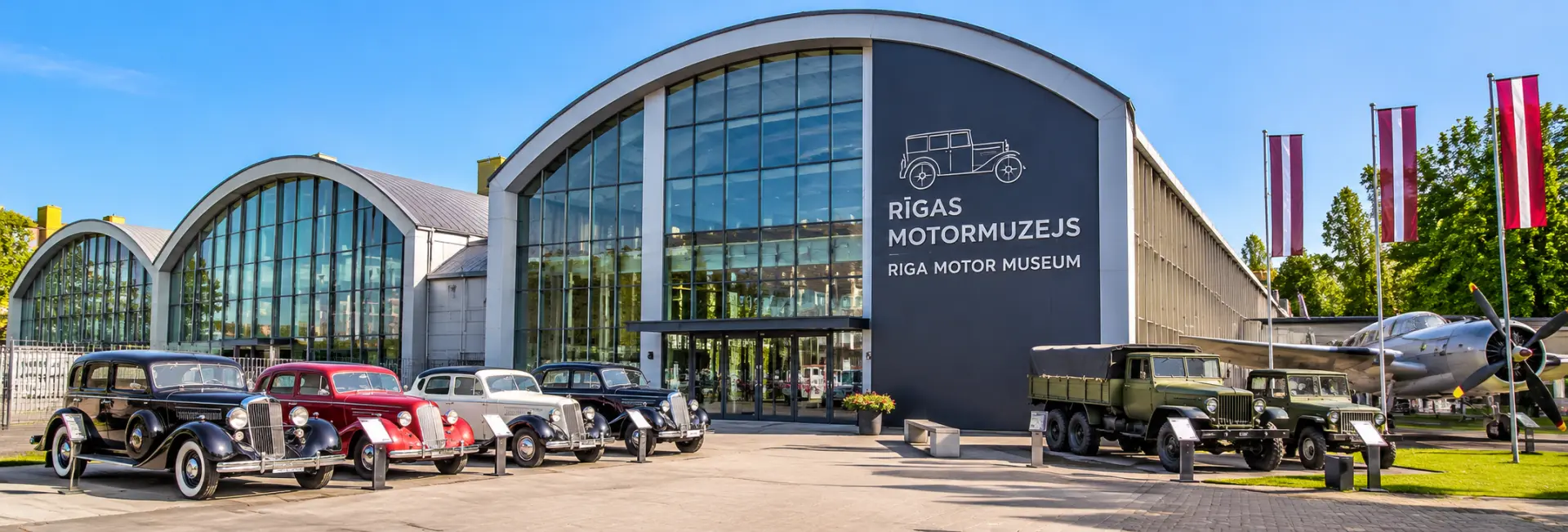
The museum occupies a purpose-built structure designed by architect Viktors Valgums and opened in the final years of the Soviet era. Its bold, angular front is often compared to the radiator grille of a luxury saloon, a fitting visual joke for a building dedicated to cars.
The 2016 reconstruction kept the structure but transformed the experience inside. Exhibition space now covers more than 4,000 square metres across three floors, giving large vehicles room to breathe and allowing visitors to walk around each car rather than squeeze past it.
The interior blends historic machinery with modern design. Lighting, projections, audio and video clips are used to set each vehicle in context, while landscaped grounds, free on-site parking, a café and a souvenir shop make the site comfortable for a full visit.
Collections & Exhibits
The displays are organised chronologically and by theme, so you can follow the story of the automobile from its earliest days to the late 20th century. Most information and audio commentary is available in Latvian, Russian and English. The collection is divided into roughly a dozen themed areas, including:
- The long road to the car: an introduction to transport history, including a replica of the world's first patented motorcar, the Benz Patent Motorwagen
- The birth of the automotive industry, including the surprising part played by a Latvian engineer
- Cars of the 1920s, from the first decade of the independent Latvian Republic
- Luxury and sports cars of the 1930s, many of them German
- The Kremlin Collection of official Soviet limousines
- The Soviet car industry and its everyday vehicles
- Motorsport, headed by an Auto Union Grand Prix car, alongside rare Soviet-built racers
- Cult cars from the second half of the 20th century
- Latvian manufacturing of cars, motorcycles and bicycles, plus a display of locally made radios
- Trucks, military machinery and special-purpose vehicles
- A hall for temporary exhibitions
Beyond the headline cars you will find a strong selection of motorcycles, including pre-war BMW machines and military models, as well as a sizeable bicycle collection. Latvia's own industrial story features too, from early Russo-Baltic cars built in Riga to Ford-Vairogs vehicles assembled locally and the RAF minibuses that were produced in Riga for much of the Eastern Bloc.
Must-See Highlights
The Kremlin Collection
This is the museum's best-known attraction. It gathers large official cars used by Soviet dignitaries, a category of vehicle almost never displayed in Western museums. The star is an armoured ZIS-115 limousine from Stalin's era, presented with a figure of the dictator seated in the back.
Just as famous is the Rolls-Royce Silver Shadow that Leonid Brezhnev crashed in 1980. The car was never repaired and is displayed in its wrecked state, complete with a model of the Soviet leader behind the wheel. Nearby, visitors can also pose by a ZIS parade car as if taking the salute.
The Auto Union Racing Car
The museum's founding story is told through its Auto Union Type C/D Grand Prix car from 1938. The gleaming car on show is an authentic replica, as the surviving original is held elsewhere, but it honours the rescue that launched the collection and shows off the extraordinary engineering of 1930s Silver Arrows racing.
The 1903 Krastin
One of the most surprising exhibits celebrates Augusts Krastiņš, a Latvian-born inventor who built cars in the United States in the early 1900s. His company's factory burned down in 1904, and very few of his vehicles were ever made. The Riga museum owns the only Krastin known to survive, a rare piece of Latvian diaspora history.
The Soviet BMW 326
Among the 1930s luxury cars, a BMW 326 stands out for the opposite reason: it is not pristine. After decades in the USSR, with no access to original parts, it was repaired using improvised components until only its badges were left as genuine BMW pieces. It is displayed beside a standard example so the differences are easy to see.
Presidential and Early Latvian Cars
Look for the 1930 Cadillac Fleetwood used by Latvian leader Kārlis Ulmanis, as well as a surviving Russo-Baltic car from Riga's early motor-industry days. Together they show how the city once stood among the Russian Empire's leading industrial centres.
Ways to Experience It
Most visitors explore on their own, following the chronological flow of the floors and stopping at the displays that catch their interest. Exhibits are supported by video, audio and interactive features, so there is plenty to engage with even if you do not know much about cars.
For deeper context, the museum offers guided tours of its collection. These can bring individual vehicles to life with stories about the people who drove them, and they are especially valuable in the Kremlin Collection, where politics and engineering overlap.
Families will appreciate the children's play and learning zone, and photographers will enjoy the well-lit displays and the staged scenes around the Soviet limousines. The on-site café makes it easy to turn a visit into a half-day outing, and the temporary exhibition hall means there is sometimes something new to see on return visits.
Best Time to Visit
Because the museum is indoors, it works in any season. It is especially useful on cold, wet or very hot days when outdoor sightseeing is less appealing, and it makes a good counterpoint to a day spent walking around the Old Town.
Weekday mornings usually offer the quietest conditions, giving you space to study the exhibits and take photos without crowds. Weekends and school holidays tend to be busier, particularly around the interactive displays.
Plan to spend at least a couple of hours, and longer if you are a dedicated car enthusiast or are visiting with children who want to try every activity. Since opening hours and days can change, particularly around public holidays and the Midsummer and winter festive periods, it is wise to confirm current times with the museum before you travel.
Visitor Tips
The museum lies outside the historic centre, so a little planning makes the trip smoother. Free parking is available on site, and public buses from central Riga serve the area, with the journey taking roughly half an hour or more depending on the route.
- Check the museum's official website for current opening days, hours and ticket prices before you go, as these can change.
- Ticket pricing generally includes reduced rates for children, students and seniors, plus family options, so ask about the best fit for your group.
- Allow two hours as a minimum for a satisfying visit.
- Check the bus timetable for your return journey in advance so you are not left waiting after you leave.
- A taxi or ride-hailing service is a convenient alternative if you are short on time or travelling as a group.
- Look out for the Kremlin Collection first if time is limited, since it is the most distinctive part of the museum.
- Bring children along: interactive elements and a dedicated play area keep younger visitors entertained.
FAQs about visiting the Riga Motor Museum
What is the Riga Motor Museum known for? +
It is the largest antique vehicle museum in the Baltics, with more than 100 cars, motorcycles and bicycles. It is especially famous for the Kremlin Collection of Soviet leaders' limousines, including Stalin's armoured ZIS and Brezhnev's wrecked Rolls-Royce.
Where is the museum located? +
It is in the Mežciems district on the eastern side of Riga, on Sergeja Eizenšteina iela. It lies outside the Old Town, so you will need a bus, taxi or car to reach it.
How do I get there from central Riga? +
Bus 5 from the central station area stops near the museum, and the ride takes about 30 to 40 minutes. A taxi or ride-hailing trip is faster, and free parking is available if you drive.
How much time should I spend at the museum? +
Plan on at least two hours. Car enthusiasts and families who want to try the interactive displays often stay longer.
Is it suitable for children? +
Yes. The exhibition includes interactive elements and a play and learning zone for younger visitors, so it works well as a family outing.
How much do tickets cost and when is it open? +
Admission is paid, with lower rates usually offered for children, students, seniors and families. Opening days and hours can change around holidays, so check the museum's official website for current prices and times.
Is there a café or parking on site? +
Yes, the museum has a café and a souvenir shop, and parking at the museum is free of charge.
Are the exhibits explained in English? +
Yes. Most descriptions and audio are available in Latvian, Russian and English, and guided tours of the collection are also available.
