
Table of Contents
Overview
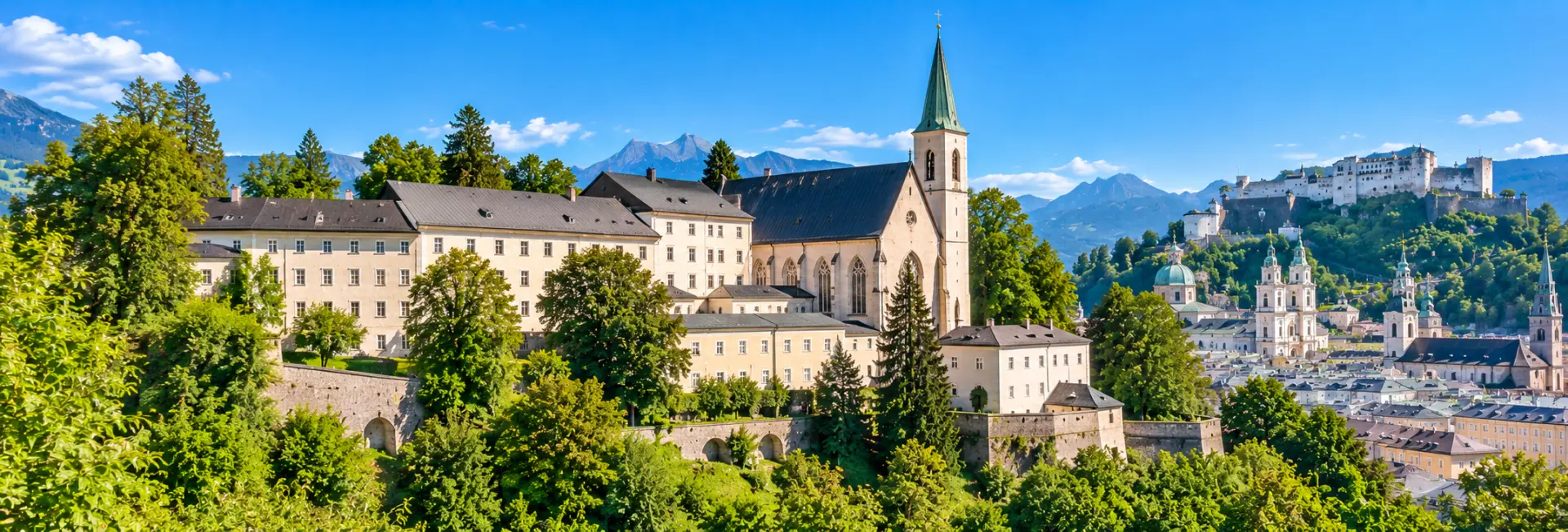
Stift Nonnberg is a Benedictine convent set on a rocky spur at the eastern foot of the Festungsberg, just above Salzburg's Old Town. It dates back to the early eighth century and is widely regarded as the oldest convent in the German-speaking world that has been in continuous use. A community of nuns still lives and prays here today.
Most visitors come for one of two reasons. Some want to step into a church that has stood in some form for over a thousand years, with Romanesque wall paintings, a carved Gothic altar and an unusual crypt. Others arrive because this is where Maria Kutschera, the real woman behind the von Trapp story, spent her time as a novice before the events that inspired The Sound of Music. Both reasons are good ones.
It helps to know what you can and cannot see. The abbey itself is a private enclosure and is closed to the public. What is open is the abbey church, its entrance porch and the small cemetery, all reached by a short, steep climb from the streets below. Plan on roughly an hour, a little longer if you want to catch the nuns at prayer.
History
A Founding Shrouded in Uncertainty
Nobody can say exactly when the convent began. Sources place its founding somewhere between about 711 and 715, and tradition credits Saint Rupert, the missionary bishop associated with the earliest days of Christian Salzburg, with starting it. The first abbess was Erentrudis, a relative of Rupert who is usually described as his niece, though some accounts call her his sister.
Erentrudis remained central to the abbey's identity long after her death. In 1624 she was given the title of Mother of Salzburg, and her tomb is still one of the main reasons pilgrims come. In 987 the convent became independent of its founding house, which marked the start of its life as a self-governing community.
The Romanesque Church
Around the year 1000, Emperor Henry II had a Romanesque basilica built here. It was consecrated to the Virgin Mary in 1009, which makes it the second oldest church in Salzburg dedicated to Mary. Parts of this early church survive in fragments, notably in the portal and in the wall paintings from the twelfth century.
Fire and Rebuilding
A major fire in 1423 destroyed most of the convent buildings. The community rebuilt in the fifteenth century in the late Gothic style, and that rebuilt church is what visitors walk into now. The nuns kept what the flames had spared, so the older and newer layers sit side by side.
Recognition
The abbey is a protected monument and forms part of the Historic Centre of the City of Salzburg, which UNESCO added to its World Heritage List in 1996. Austria also put the abbey on a commemorative coin issued on 5 April 2006, a sign of how much weight the site carries nationally.
Architecture & Design
The church is a late Gothic basilica, and the rebuilding after 1423 shaped its character more than any other period. The proportions feel intimate rather than grand, which suits a space built for a small, cloistered community. Stonework, vaulting and carved detail reward a slow look rather than a quick walk-through.
The Portal and Entrance Porch
Before you reach the nave, pause at the main entrance. A sculpted Romanesque tympanum survived the fire and still crowns the doorway, showing the Virgin Mary alongside John the Baptist and Saint Erentrudis. Beyond it, the entrance hall under the nuns' gallery, known as the Paradise, holds some of the oldest paintings in the building.
The Crypt
The crypt is one of the abbey's most distinctive spaces and is often described as unique in Salzburg. Slender free-standing columns carry a net-like ribbed vault, and the Michelin guide counts eighteen columns in total. The effect is of a small forest of stone, quite unlike the heavier crypts found in many other Austrian churches.
A Mix of Eras
Because the complex grew over many centuries, it carries Romanesque, Gothic and later Baroque touches. This layering is part of the appeal. Rather than a single polished style, you see how a living community adapted its home over about a thousand years.
Notable Features Inside the Church
The High Altar
The centrepiece of the church is its carved late Gothic winged altarpiece, dating from the early sixteenth century and built around a statue of Mary. The altar can be lit up, and doing so brings out the gilding and the fine carving far better than daylight alone.
The Romanesque Frescoes
Many people consider the wall paintings the abbey's greatest treasure. They date from around the middle of the twelfth century and are tucked beneath the nuns' choir in the Paradise area. They are fragile, faded and easy to overlook, so take your time. The lighting here can be switched on to help you see the details.
Saint John's Chapel
A smaller side chapel holds an altarpiece from 1498. It is quieter than the main nave and a good place to appreciate the craftsmanship of the late fifteenth century without the distraction of the larger altar.
The Tomb of Saint Erentrudis
The abbey's founding abbess rests in the eastern part of the church, in the crypt and apse area. The spot remains a place of prayer rather than a museum display, so visitors are expected to be quiet and respectful.
Treasures Held by the Convent
- A crucifix from the old Salzburg cathedral, dated to about 1300
- Smaller works of art and murals kept within the convent and church
- The cemetery beside the church, open to visitors during the same hours
Nonnberg and The Sound of Music
The Real Maria
Maria Augusta Kutschera entered Nonnberg Abbey in 1924 as a postulant, intending to become a nun. In 1926 she was sent out of the convent to tutor one of the seven children of the widowed naval officer Georg von Trapp. She had not taken her vows, so she was a novice and teacher rather than a nun, a detail the film glosses over.
When the captain proposed, a frightened Maria went back to Nonnberg for advice. The abbess, Virgilia Lütz, counselled her to accept. The couple married in the abbey church on 26 November 1927.
Film Versus Reality
The 1965 musical film moved the wedding to the church in Mondsee, and its abbey interiors were staged away from the real convent, so what you see on screen is not what you will see here. The nuns who live at Nonnberg have never been actors in the story. They continue a daily rhythm of prayer that long predates the film.
What Fans Can Expect
Sound of Music tours usually include a stop at the abbey. Fans can stand in the church where the real wedding took place, but there are no film sets, props or exhibitions. Treat it as a working place of worship that happens to have a famous chapter in its past.
Visiting Etiquette & Tips
Etiquette
- Dress modestly, with shoulders and knees covered, as in any active church
- Keep your voice low and phones silent
- Do not enter during services; the church is closed to sightseers while they take place
- Respect the enclosure: the convent buildings are private
- Look for any signs about photography and follow them
Reaching the Abbey
There are two main routes on foot. One climbs the Nonnberg stairs from Kaigasse in the Old Town. The other follows a narrow lane up from the Nonntal district. Both are steep and uneven in places, which can be difficult for visitors with limited mobility. Roadworks have occasionally closed the lower part of Nonnberggasse, so check the latest access notes before you set out.
Tickets and Hours
Entry to the church is generally free. It is typically open from early morning until dusk, with shorter hours in the colder months, but exact times can change. Confirm the current schedule with the official abbey site or the Salzburg tourist office before you visit, particularly since ongoing renovation work on the choir chapel has limited prayer times to some degree in recent years.
Hearing the Nuns Sing
The sisters sing Gregorian chant at 6:45 am each morning, with a later start on Sundays and holidays, and also in the evening. You can listen from the church. If you would like to attend Vespers, contact the abbey by email no later than the day before.
Best Time to Visit
Time of Day
Early morning is the most atmospheric time. The chant at 6:45 am is the highlight for many people, and the church is calm before the day's tour groups arrive. Later in the day, tours tend to stop here, so mid-morning and early afternoon can be busier at the gate.
Seasons
- Spring and early summer: mild weather for the climb, long daylight and green views from the forecourt
- Late summer: the longest opening hours, though also the busiest tourist period
- Autumn: soft light over the city rooftops and fewer crowds
- Winter: cold, short days and earlier closing at dusk, but the church feels especially quiet and candle-lit
The forecourt in front of the church offers a good view across Salzburg, so a clear day adds to the visit.
Nearby Attractions
Nonnberg sits in the middle of Salzburg's historic core, so it is easy to combine with other sights on foot.
- Hohensalzburg Fortress: directly above the abbey and reachable by funicular, with sweeping views over the city and the Alps
- St. Peter's Abbey and Cemetery: another ancient Benedictine foundation, just a short walk away
- Salzburg Cathedral and Kapitelplatz: the Baroque heart of the Old Town, close to the base of the Nonnberg stairs
- Residenzplatz: a grand square surrounded by the former prince-archbishops' palace buildings
- Mozart's Birthplace on Getreidegasse: a popular stop within a few minutes' walk of the rest
A sensible plan is to start at the abbey early, then walk down through the Old Town or take the funicular up to the fortress.
FAQs about visiting Stift Nonnberg
What is Stift Nonnberg? +
It is a Benedictine convent in Salzburg, founded in the early eighth century and regarded as the oldest continuously active convent in the German-speaking world. The nuns still live in the enclosure, and the abbey church is open to visitors.
Can I go inside the abbey? +
The convent buildings are private, but you can enter the abbey church, its entrance porch and the cemetery. Visits are not possible while services are under way.
Is it free to visit? +
Entry to the church is generally free, though small donations are appreciated. It is worth checking the official site for any changes before you go.
Is this the convent from The Sound of Music? +
Yes, it is the real abbey where Maria Kutschera was a novice and where she married Georg von Trapp in 1927. The film moved the wedding to Mondsee and staged its abbey scenes elsewhere, so the building will look different from what you remember.
Can I hear the nuns sing? +
You can. They sing Gregorian chant in the church at 6:45 am each morning, a little later on Sundays and holidays, and again in the evening. For Vespers, you should email the abbey ahead of time.
How long should I spend there? +
About an hour is enough for the church, the Paradise frescoes and the cemetery. Add time if you want to attend the chant or enjoy the view from the forecourt.
How do I get there? +
It is a short but steep walk from the Old Town via the Nonnberg stairs from Kaigasse, or from Nonntal via a narrow lane. The funicular to Hohensalzburg Fortress is also nearby.
Is it suitable for visitors with limited mobility? +
The approach is steep and uneven, so it can be difficult. Anyone with mobility needs should plan the route carefully and check current access conditions.
