Table of Contents
Overview
Torres de Quart is one of only two surviving gates from Valencia's medieval city wall, a pair of massive round towers that once guarded the western approach to the old city. Built in the 15th century, it's a rare and vivid piece of the city's fortified past, still bearing visible scars from a siege fought at its base centuries after it was built.
Unlike many restored monuments that look pristine and untouched, Torres de Quart wears its history openly: the plasterwork on its outer face is pitted with cannonball and musket marks from the early 19th century, a reminder that this gate once stood on the front line of the city's defence rather than serving a purely ceremonial role.
History
A Gate Modelled on Naples
Construction of Torres de Quart began in 1441 on the site of an earlier, simpler gate, and continued in stages over the following decades under a succession of master builders, including Francesc Baldomar, Jaume Perez, Pere Compte and Pere Bonfill. Its design deliberately echoed the towers of the Castel Nuovo in Naples, a connection that was no coincidence: both projects were commissioned under Alfonso the Magnanimous, king of the combined Crown of Aragon and Naples, as a display of his power across both territories.
The Western Gate to Castile
Positioned on the road toward the town of Quart de Poblet and, beyond it, the Kingdom of Castile, the gate controlled traffic entering Valencia from the west, one of four principal gateways into the medieval city alongside Serranos, El Mar and San Vicente. For a time it was also known locally as the Torres de la Cal, after a rule requiring lime brought into the city to pass through this gate specifically.
Prison and Battle Scars
In 1623, the city council converted the towers into a women's prison, a use that continued for generations before the building became a military prison in the 19th century, a role it kept until the early 1930s. During the Peninsular War, French forces besieging Valencia in 1808 bombarded the gate directly, leaving the pockmarked plasterwork still visible on its outer face today.
Recognition & Status
Torres de Quart was declared a Bien de Interes Cultural with the category of Monument in 1963, formally recognising it as one of Valencia's most significant surviving historic structures. Together with Torres de Serranos, it stands as one of only two gates to survive the demolition of the city's medieval walls in the 19th century.
- Declared a Bien de Interes Cultural (Monument) in 1963
- One of only two surviving gates from Valencia's medieval city wall
- Modelled on the Castel Nuovo gate in Naples, commissioned by Alfonso the Magnanimous
Architecture & Design
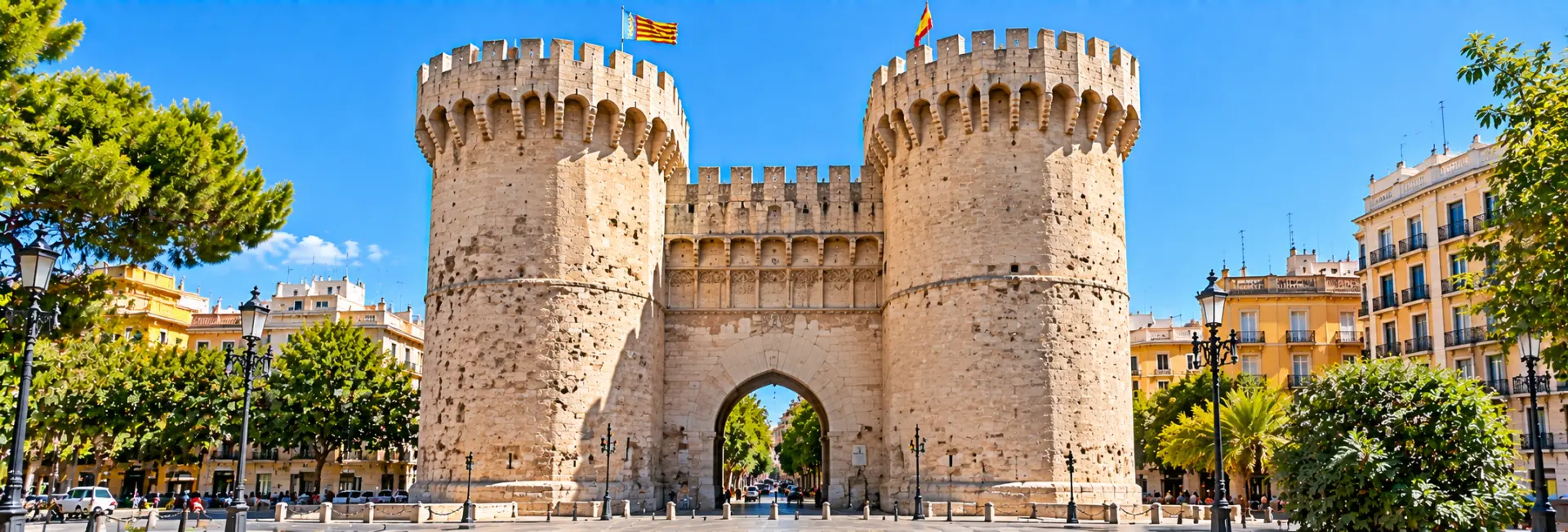
The gate consists of three main parts: two massive cylindrical towers built on splayed, sloping bases, and a rectangular central section holding the semicircular stone archway that forms the actual passage into the city. The towers rise around 34 metres, their thick, rounded walls designed to deflect and absorb the impact of artillery far better than a flat surface would.
As with Valencia's other surviving gate, the design contrasts a heavily fortified exterior with a more open interior face, where flat walls and windows overlook the city rather than presenting solid defensive mass. A spiral staircase connects the different levels inside, leading up through pointed barrel vaults to a crenellated walkway near the top.
Key Areas & What to See There
The Twin Towers
The two cylindrical towers form the bulk of the structure, their curved outer walls still marked by the pitted plaster left behind after the 1808 bombardment, a detail visitors can examine up close from the base of the building.
The Central Archway
Between the towers, a stone archway forms the actual gateway, framed by the same defensive stonework that made the whole structure such an effective barrier during sieges.
The Rooftop Walkway
At the top of the towers, an open, crenellated walkway offers panoramic views over Valencia's old town and the green strip of the former riverbed below, reached via the internal spiral staircases.
Cultural Significance
Torres de Quart carries a heavier, more martial history than some of Valencia's other landmarks, having served as both a women's prison and a military prison across more than three centuries. Its role during the 1808 siege, when Valencia successfully resisted a Napoleonic assault at its walls, has made it a lasting symbol of the city's resistance during the Peninsular War.
In a quieter twist, the pockmarked surface left by that bombardment has since become an unlikely nesting site for a colony of parakeets, who have made their homes in the cavities left by cannon fire, a small piece of urban wildlife folded into the building's violent history.
Ways to Experience It
A visit typically involves climbing through the towers' internal chambers and staircases to reach the rooftop walkway, taking in the Gothic vaulting and the battle scars along the way.
- Self-guided climb through the towers to the rooftop walkway
- Close-up viewing of the cannonball and musket damage on the outer walls
- Panoramic views over the old town and the former Turia riverbed from the top
Best Time to Visit
Because the climb involves open-air stairs and a rooftop walkway, access depends on daylight and can be limited during rain, fog or strong wind, so checking conditions before visiting is worthwhile. Earlier in the day tends to mean fewer visitors on the stairs and clearer light for photographing the damaged facade.
The gate sits close to a busy road junction, so visiting outside peak traffic hours can also make for a calmer experience at street level before heading inside.
Visitor Tips
- Wear comfortable shoes, since the visit involves climbing stone stairs with no lift access
- Entry is free on Sundays and public holidays, so those days tend to draw more visitors
- Visits are closed in wet or windy weather for safety, so it's worth checking ahead if the forecast looks poor
- Take a moment at street level to look closely at the pitted plasterwork before heading inside
Nearby Attractions
Torres de Quart marks the western edge of Valencia's old town, within easy walking distance of several other historic sights.
- Museo de Prehistoria and IVAM contemporary art museum, both close by
- Barrio del Carmen: the old town's atmospheric artistic quarter, right at the gate's doorstep
- Torres de Serranos: Valencia's other surviving medieval gate, a walk across the old town
FAQs about visiting Torres de Quart
What was Torres de Quart originally used for? +
It was built as a fortified gate controlling access to Valencia from the west, later serving as a women's prison and then a military prison for several centuries.
Why does Torres de Quart look damaged? +
The outer walls still bear cannonball and musket marks from a French siege during the Peninsular War in 1808, left unrepaired as a visible piece of the city's history.
Can you climb to the top of Torres de Quart? +
Yes, an internal staircase leads up through the towers to a rooftop walkway with panoramic views over Valencia's old town.
Is Torres de Quart free to visit? +
There's a small entry fee on most days, with free admission on Sundays and public holidays.
How much time should I set aside for a visit? +
Most visitors spend around forty-five minutes to an hour, including the climb and time to take in the views.
Is the climb suitable for everyone? +
The towers are reached by stone stairs with no lift, so the climb may not suit visitors with mobility limitations.
What's nearby worth visiting after Torres de Quart? +
The Barrio del Carmen sits right at the gate's doorstep, and the Museo de Prehistoria and IVAM contemporary art museum are both a short walk away.