
Table of Contents
Overview
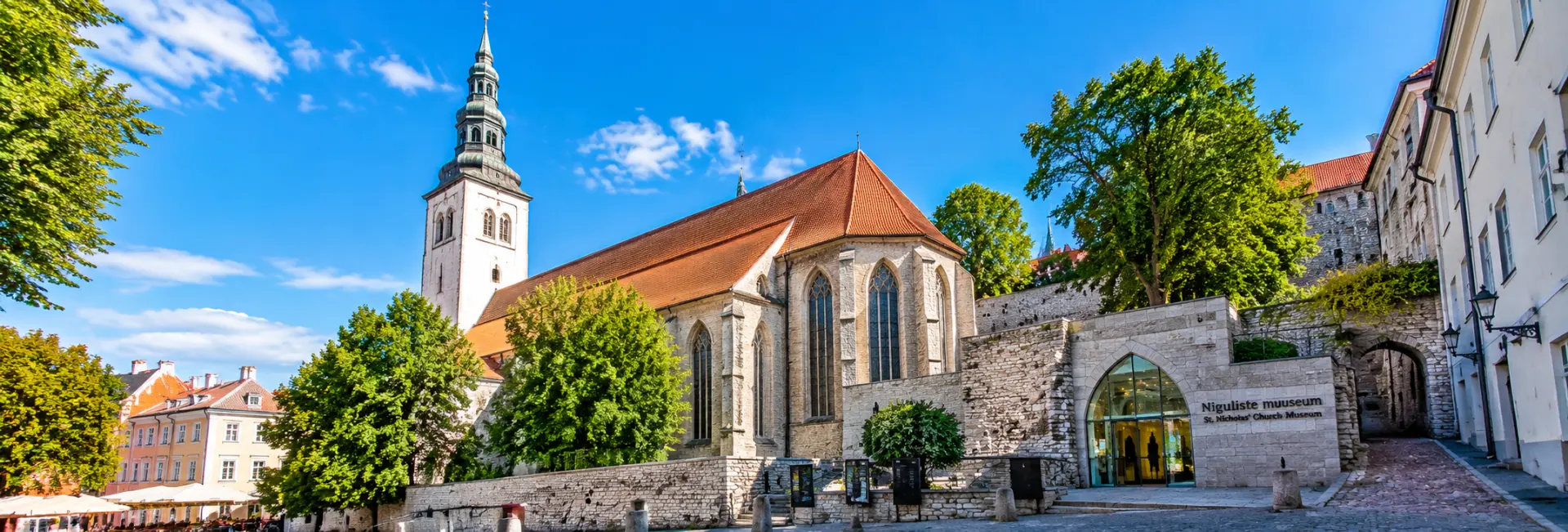
St. Nicholas' Church, known in Estonian as Niguliste kirik, stands on a small rise at the foot of Toompea Hill in the heart of Tallinn's Old Town. Its tall green spire is one of the most recognisable shapes on the city skyline, and the building itself is among the oldest in the capital. Today it no longer serves as a regular place of worship but houses the Niguliste Museum, a branch of the Art Museum of Estonia.
Inside, the church holds the country's most important collection of medieval and early modern church art. Carved altarpieces, painted panels, guild silver, ornate gravestones and a monumental candelabrum are displayed in the very space they were made for, which gives the visit a rare sense of place.
The star attraction is the fragment of Bernt Notke's Dance of Death, the best-known medieval artwork in Estonia. Add a glass lift up the tower and a viewing platform above the red roofs, and you have one of the most rewarding stops in Tallinn for history, art and architecture lovers.
History of the Church
A Merchants' Church
The church was founded and built roughly between 1230 and 1275 by Westphalian merchants who had come to Tallinn from Gotland. It was dedicated to St. Nicholas, the patron saint of merchants and sailors, which suited a trading town on the Baltic. In its early years the town was not yet fortified, so the building was designed to double as a refuge, with strong bars for the entrances, loopholes and hiding places.
Growth and Wealth
As Tallinn prospered within the Hanseatic trading network, the church grew along with it. Major rebuilding between about 1405 and 1420 gave it the late Gothic appearance it has today. The tower was raised in 1515, and in the late 17th century it received the Baroque spire that remains its crowning feature. Over the centuries wealthy families, guilds and brotherhoods filled the church with altars, epitaphs and silverware.
The church became Lutheran in the 16th century and, unlike many of Tallinn's churches, came through the Reformation without major damage to its medieval art.
Destruction and Rebirth
On 9 March 1944, Soviet bombing of Tallinn set the church on fire, destroying roofs and most of the interior. Fortunately, most of the artworks had been moved to safety in time. Reconstruction began in the 1950s, and in October 1982 a fire again burned out the tower. After long restoration work, the building reopened in 1984 as a museum and concert hall.
Architecture and Tower
From the outside, Niguliste looks like a fortress as much as a church, with thick walls and a strong, broad body. Inside, a tall central nave, a polygonal choir and a series of side chapels reflect the building's long history of expansion and rebuilding. The sparse, restored interior lets the artworks stand out against pale walls and high vaults.
The Baroque Spire
The tower is the church's signature. Its slender Baroque spire, with airy galleries added in stages over several centuries, now reaches about 105 metres. It is visible from many corners of the Old Town and from the harbour, and it plays a major role in the city's skyline.
Chapels and Details
Several chapels along the nave once belonged to guilds and families, and the Chapel of St. Anthony houses the Dance of Death. Look for carved details, tomb slabs set into the floor and the way the museum has placed objects near the positions they once occupied. On the first floor of the tower, a small display presents historic church bells.
Collections and Exhibits
The permanent exhibition holds the most remarkable body of medieval and early modern church art in Estonia. Most of the works came from this very church or from other Tallinn churches, and many are shown close to where they once stood.
Altarpieces and Sculpture
The core of the collection is made up of late medieval altarpieces and wooden sculpture. The high altar retable, created in the workshop of the Lübeck master Hermen Rode and delivered in 1481, is one of the largest and best-preserved retables of its kind from northern Germany. Three Netherlandish altarpieces, including one linked to the workshop of Adriaen Isenbrandt and one made for the Brotherhood of Blackheads, add a Flemish accent.
The Silver Chamber
A dedicated chamber displays the most valuable part of the Art Museum of Estonia's precious metals collection. The pieces, dating from the 16th to the 20th centuries, belonged to Tallinn's churches, guilds and the Brotherhood of Blackheads, an association of unmarried merchants and shipowners.
Candelabra, Gravestones and Epitaphs
- A four-metre-high seven-armed candelabrum, cast in Lübeck and donated to the church in 1519, is the oldest and rarest of the museum's lighting pieces.
- More than a hundred gravestones and fragments, most from the 14th to 17th centuries, record the merchants and townspeople who were buried here.
- Epitaphs and coats of arms from the 16th and 17th centuries show how families displayed status and piety.
Temporary exhibitions are held in some areas and change regularly, so check what is on during your visit.
The Dance of Death
Tucked into the Chapel of St. Anthony, the Dance of Death is the most famous work in the museum and the best-known medieval artwork in Estonia. It is attributed to Bernt Notke, one of the leading artists in northern Europe in the late Middle Ages, and was probably made in the late 15th century.
What You See
Only a fragment survives, about seven and a half metres long, and it shows a procession of figures led by Death. A preacher in a pulpit introduces the scene, followed by a skeleton playing the bagpipes and another carrying a coffin. After them come a pope, an emperor, an empress, a cardinal and a king, each taken by a figure of Death against an autumn landscape. Below, a band of verse in Low German records the dialogue between Death and each mortal.
Why It Matters
The dance of death was a popular medieval theme that reminded everyone, rich or poor, that death spares no one. Notke painted a longer version for St. Mary's Church in Lübeck, but that work was destroyed in 1942. The Tallinn painting is therefore the only surviving medieval Dance of Death painted on canvas, which is part of what makes it so valuable.
Its original location and its complete length remain uncertain, and its first written mention comes from 1603. That mystery adds to its power, and it is well worth spending extra time in front of it.
Tower Views and Organ Music
The Glass Lift and Viewing Platform
A glass lift carries visitors up inside the tower to a viewing platform with a 360-degree panorama. From here you look over the red-tiled roofs, steep medieval streets and church spires of the UNESCO-listed Old Town, with the harbour beyond. The platform is accessible by wheelchair, and the lift saves you the climb.
Organ Half-Hours
The church is known for its fine acoustics, and the museum holds organ concerts every Saturday and Sunday at 4 pm. Hearing classical and contemporary music in the Gothic nave is a very different experience from a quiet walk through the galleries.
Audio Guides and Tours
Audio guides are available at the ticket counter, and short guided tours of the Dance of Death and other treasures run at selected times. Audio descriptions for blind and visually impaired visitors are also provided for the church's architecture and its most valuable works.
Best Time to Visit
Niguliste is open year-round and is generally calmer than the busiest Old Town sights. Weekday mornings shortly after opening are the most peaceful time to see the Dance of Death and the altarpieces without crowds.
Late afternoon is lovely for the tower platform, when softer light falls across the rooftops. If you want music, plan your visit for a Saturday or Sunday so that you can stay for the 4 pm organ half-hour.
In summer, the museum is busier because cruise passengers and day visitors fill the Old Town, while winter brings quieter galleries and a cosy atmosphere. Because the museum is indoors, it works well on rainy or very cold days.
Visitor Tips
- Opening hours depend on the season, and the museum is normally closed on Mondays outside the main summer months. It also closes or shortens hours on some public holidays, so confirm times on the official website before you go.
- Tickets include adult, concession, student and family options, and joint tickets covering other branches of the Art Museum of Estonia are available. Prices and offers change, so check the current rates.
- Allow about an hour and a half for the permanent exhibition, plus extra time for the tower and any temporary exhibition.
- The exhibition halls are wheelchair-friendly, and the lift and viewing platform are accessible. Hearing loops and sign-language tablet guides are available, and you can contact the museum in advance for special needs.
- Audio guides can be borrowed at the ticket counter, and they include both regular commentary and audio descriptions.
- The church is cool inside, so take a light layer even in summer.
- Check photography rules on arrival, as some areas or exhibitions may have restrictions.
Nearby Attractions
The museum sits on Harjumägi, only a few minutes' walk along Harju Street from both Town Hall Square and Freedom Square. Many bus, tram and trolleybus lines stop at Vabaduse Väljak, which makes it easy to reach from the rest of the city.
From Toompea Hill, you can come down to the church by the stairs of Lühike Jalg, the "Short Leg" street, which is one of the most atmospheric routes in the Old Town. Nearby you can visit Town Hall Square, the Great Guild Hall, a stretch of the medieval city walls and the sights of Toompea, including the domed Alexander Nevsky Cathedral. Together they make a rich half day or full day of walking in the UNESCO-listed historic centre.
FAQs about visiting St. Nicholas' Church and Niguliste Museum
What is St. Nicholas' Church in Tallinn used for today? +
It is no longer a regular church but the Niguliste Museum, a branch of the Art Museum of Estonia. It displays medieval church art and also hosts concerts.
What is the Dance of Death at Niguliste? +
It is a fragment of a late 15th-century painting by Bernt Notke showing Death leading figures such as a pope, emperor and king. It is the best-known medieval artwork in Estonia and the only surviving medieval Dance of Death painted on canvas.
How long does a visit take? +
Plan on about an hour and a half for the exhibition. Add time if you want to go up the tower, join a tour or attend an organ concert.
Is there a viewing platform? +
Yes. A glass lift takes you up the tower to a platform with 360-degree views over Tallinn's Old Town. The platform is wheelchair accessible.
When are the organ concerts? +
The museum holds organ half-hours on Saturdays and Sundays at 4 pm. Check the official site for any changes or special concerts.
How much does it cost and when is it open? +
Opening hours and ticket prices vary by season and can change, and the museum is closed on some holidays. Confirm the current details on the official website, and look for family, discount and joint tickets.
Is the museum accessible for wheelchair users and visitors with disabilities? +
The exhibition halls are wheelchair-friendly, and the lift and viewing platform are accessible. Audio descriptions, hearing loops and sign-language tablet guides are also provided, and you can contact the museum ahead for support.
How do I get there? +
It is a short walk from Town Hall Square or Freedom Square along Harju Street. Many bus, tram and trolleybus lines stop at Vabaduse Väljak nearby.
What else is close by? +
Town Hall Square, Toompea Hill, the Great Guild Hall and the Old Town walls are all within a short walk.
