
Table of Contents
Overview
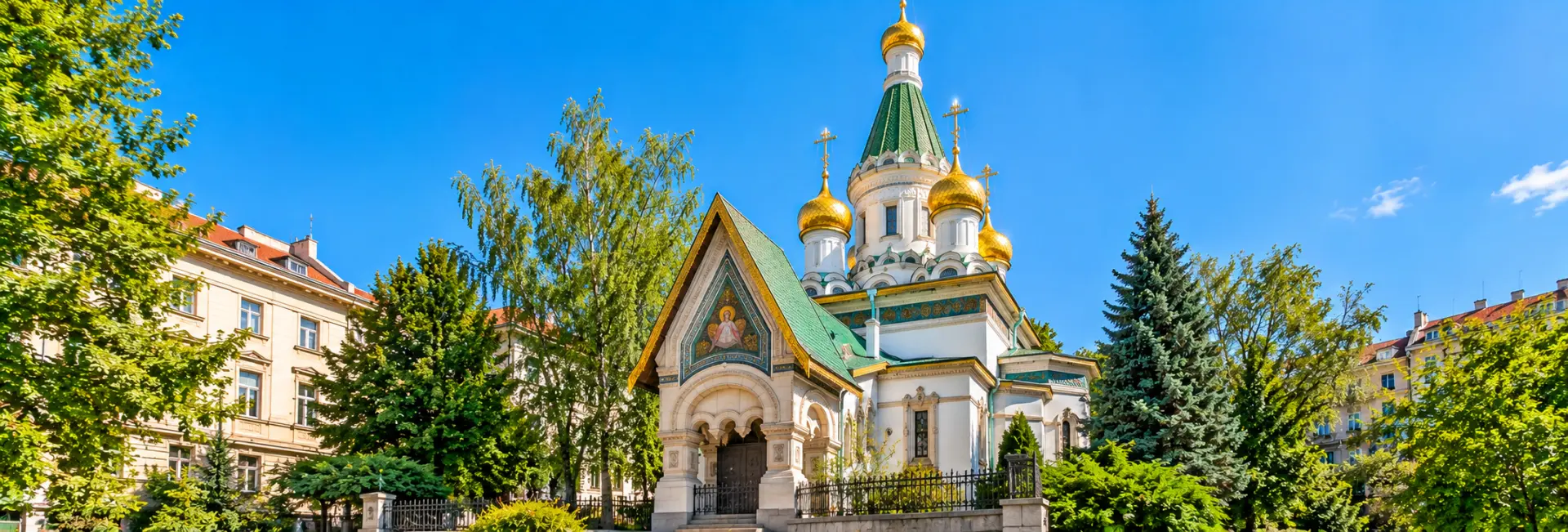
Set back among the trees on Tsar Osvoboditel Boulevard, the Russian Church is one of those buildings that makes people slow down mid-stride. Its official name is the Church of St Nicholas the Miracle-Maker, but hardly anyone in Sofia uses it. To locals it is simply the Russian Church, a small and richly decorated Orthodox temple with a green roof and five gilded domes that look lifted straight out of old Moscow.
It was built in the early twentieth century for the Russian embassy and the Russian community living in the Bulgarian capital, and the design reflects that origin. Brightly glazed tiles, steep gables and a cluster of golden cupolas set it apart from the more restrained buildings around it.
The church attracts two kinds of visitors. Some come for the architecture and the photographs. Others come for the crypt below the main floor, where St Seraphim of Sofia is buried and where people of all backgrounds leave handwritten notes asking for help. Most leave surprised by how much is packed into such a compact building.
History
A Site With Layers of History
The ground beneath the Russian Church was not empty before the twentieth century. A mosque known as the Saray Mosque once stood here, and it was pulled down in 1882, a few years after Bulgaria was freed from Ottoman rule. The plot later went to Russia's diplomatic mission, and the church was built beside the embassy.
Diplomatic churches of that era were traditionally dedicated to the patron saint of the reigning emperor. Russia's ruler at the time was Nicholas II, so the new building was named for St Nicholas, the fourth-century bishop of Myra who is among the most widely loved saints in the Orthodox world.
Construction and Consecration
Building began in 1907 to a design by the Russian architect Mikhail Preobrazhensky. On site, the work was overseen by the architect A. Smirnov, who was also building the Alexander Nevsky Cathedral a short walk away. Construction and decoration stretched across several years, and the church was consecrated in 1914.
Exile, War and the Communist Years
The Russian Revolution of 1917 changed who the church served. Russians who fled the revolution and the civil war settled in Bulgaria in large numbers, and the church became a gathering point for them. Archbishop Seraphim, himself an exile, led the Russian Orthodox communities in Bulgaria from 1921 until his death in 1950.
The church stayed open throughout the communist period, although accounts describe the state security service keeping a close eye on its clergy and worshippers. Today it operates as a representation church, known as a metochion, of the Russian Orthodox Church in Sofia.
Closure and Reopening in 2023
In September 2023, Bulgaria's national security agency expelled three clergymen connected to the church, citing security concerns, while Russian officials strongly objected. The church closed for several weeks, and questions about who owned the building and who should appoint its clergy were raised publicly. Services resumed in November 2023 under a new rector named by the Russian Church. Because the church's status has touched on diplomacy as well as faith, it is sensible to confirm access shortly before you go.
Architecture & Exterior Design
Russian Revival in the Balkans
The Russian Church is a textbook example of the Russian Revival style, which looked back to the churches of seventeenth-century Muscovy for its inspiration. That period is known for ornament, colorful tilework and layered rooflines, and Preobrazhensky brought all of it to Sofia on a modest scale. He designed Orthodox churches in other European cities as well, including Tallinn and Florence, so he knew how to make a small building feel grand.
Domes, Roof and Bells
Five domes crown the building, each coated in gold. The central one rises to roughly 19 meters and anchors the whole composition. Below them, a roof of green glazed tiles gives the church its fairy-tale silhouette, especially when low sun hits the gold against a clear sky.
The bells came as a gift from Emperor Nicholas II, a detail that ties the church directly to the imperial court that sponsored it.
Tilework and Entrances
The multicolored tiles on the facade were produced by G. Kislichev, and they are the first thing most visitors photograph. Above the entrance facing the boulevard, a mosaic shows St Nicholas, while the side that opens toward the neighboring park carries an image of Alexander Nevsky. The layout is slightly unusual, because visitors step in from the side rather than through the back of the nave, as in many Orthodox churches.
Inside the Church
Murals and Icons
The interior is small, warm and densely painted. The murals were created by a team of Russian artists led by Vasily Perminov, who also decorated the Alexander Nevsky Cathedral. Years of burning candles have given the paintings a deep, aged tone that suits the quiet atmosphere.
Among the icons is a mosaic image of St Nicholas that copies an icon from the Stavronikita Monastery on Mount Athos. Candle stands sit in front of the main icons, and visitors often light one as they pass.
A Working Place of Worship
It helps to remember that this is a living church rather than a museum. Services are held regularly, with a choir at the back of the nave, and worshippers may be praying or lighting candles at any hour the doors are open. Moving slowly, speaking softly and keeping out of the way of people in prayer goes a long way here.
Because the space is so tight, the church can feel crowded with only a few dozen people inside. That closeness is part of its charm, and it explains why many first-time visitors describe the experience as intimate rather than monumental.
The Crypt & St Seraphim of Sofia
Who Was Archbishop Seraphim?
Seraphim Sobolev was born in 1881 and became a bishop of the Russian Orthodox Church. After the revolution he left Crimea for Constantinople in 1920, and in 1921 he settled in Bulgaria, where he stayed for the rest of his life. He led the Russian Orthodox communities there until he died on 26 February 1950, and he is remembered for his sermons and theological writing, including a hymn composed in honor of St John of Rila.
When he died, the little church could not hold everyone who wanted to say goodbye. He was buried in the crypt beneath the main floor, and the place has drawn visitors ever since.
The Tomb and the Tradition of Notes
The crypt is reached by stairs from the church. Inside, a simple marble tomb topped with a large cross stands among murals and fresh flowers. The ceiling carries a fresco of the Mother of God known as the Sign, and a painting of the Trinity and an icon of Seraphim complete the space.
In the anteroom, a wooden table is set aside for writing. Visitors jot down a wish or a request on a slip of paper, then leave it near the tomb. People ask for health, for work, for help with family worries, and students are known to come before major exams. Believers say many prayers have been answered, and whatever your own view, it is moving to see so many strangers quietly taking part.
Official Recognition
Bulgarians venerated Seraphim for decades before any formal declaration. The Russian Orthodox Church canonized him on 3 February 2016, and the glorification took place on 26 February 2016 at the Alexander Nevsky Cathedral in Sofia. Bulgaria's Patriarch Neofit led the service with a Russian delegation, making it a rare occasion shared by both churches. His feast day is 26 February, and it is marked each year at the Russian Church.
Visiting Etiquette & Tips
A visit here rewards a little preparation, mostly because the church is small and always in use. These points cover the essentials.
- Dress modestly. Cover your shoulders and knees, and remove hats before stepping in.
- Keep your voice low and avoid walking between worshippers and the icons they are facing.
- Entry is generally without a ticket, and donations toward candles are welcome.
- Photography inside is often limited, so look for signs or ask before raising a camera. Never photograph people who are praying.
- If you want to leave a note in the crypt, bring a pen and a small piece of paper in case none is available.
- Opening hours and service times can change, so check the church's official website or the notice at the door before you travel.
- The crypt is below the main floor, so visitors with limited mobility should ask on site about access.
If you only want to see the exterior, the pavement along the boulevard and the small garden around the entrance give you good angles on the domes and tilework without disturbing anyone inside.
Best Time to Visit
Season by Season
Spring and early autumn are the most comfortable seasons, with mild weather for lingering outside and plenty of soft light on the gold domes. Summer afternoons can be hot and busy with tour groups, though the leafy setting offers some shade. In winter the green roof and gilded domes look striking against a gray or snowy sky, and the candlelit interior feels especially warm.
Time of Day and Special Dates
Early morning is usually the calmest time, both for exterior photographs and for a quieter moment in the crypt. The crypt tends to fill up before exam periods, when many students come to pray, so weekday mornings during the school year are worth avoiding if you want space to yourself. Major church holidays and the feast of St Seraphim on 26 February bring larger crowds and longer services, which can be a rewarding experience if you go in the right spirit.
Nearby Attractions
The church sits in the middle of Sofia's most walkable stretch, so it pairs easily with several other stops.
- Alexander Nevsky Cathedral: the grand Bulgarian Orthodox cathedral is only a few minutes away on foot and makes a striking contrast in scale.
- Ivan Vazov National Theatre and the City Garden: a pleasant place for a break among flower beds and benches.
- Sofia University: its historic main building stands along the same boulevard.
- Alexander Battenberg Square: a short stroll away, with government buildings and museums nearby.
- Tsar Osvoboditel Boulevard: the street is paved with yellow bricks, which makes the walk itself part of the sightseeing.
A relaxed circuit from the Russian Church to the cathedral and back through the City Garden fits comfortably into a half day.
FAQs about visiting the Russian Church in Sofia
Why is it called the Russian Church? +
It was built for the Russian embassy and the Russian community in Sofia, and it has stayed linked to the Russian Orthodox Church ever since. Its formal name is the Church of St Nicholas the Miracle-Maker.
Is there an entrance fee? +
Visitors generally enter without a ticket. Small donations for candles are welcome, but it is worth confirming on arrival.
Can I visit the crypt of St Seraphim? +
Yes, when the church is open to visitors. The crypt is below the main floor and is a place of quiet prayer, so move slowly and keep conversation to a minimum.
What should I wear? +
Dress modestly with covered shoulders and knees, and take off hats inside. This is an active place of worship, so respectful clothing is expected.
Can I take photos inside? +
Photography is often restricted inside, so check for signs or ask a staff member first. The exterior and the garden are much easier to photograph freely.
How long should I spend there? +
Plan on about 20 to 30 minutes for the interior and crypt, and a little longer if you want to take photographs outside or combine it with a walk to the nearby cathedral.
How do I get there? +
It is in the city center on Tsar Osvoboditel Boulevard, a short walk from the Sofia University metro station. Most visitors simply stroll over while exploring the central sights.
Is the church open to visitors right now? +
It is an active church, so opening hours and service times can change, and access has been affected by events in the past. Check the church's official website or the notice at the door before you go.
