Table of Contents
Overview
Tucked into a quiet corner of Seville's old town, Palacio de las Dueñas is one of the few grand family homes in the city that has never stopped being exactly that: a home. Built at the end of the 15th century, the palace blends Gothic, Mudéjar, and Renaissance details into a single sprawling residence organized around a series of sun-drenched courtyards and gardens. For more than four hundred years it has belonged to the House of Alba, one of Spain's oldest and most storied noble families, and parts of it are still used by the family today.
What makes Las Dueñas stand apart from Seville's other historic houses is its air of lived-in intimacy. Rather than a roped-off museum, it feels like walking through someone's actual family home, filled with generations of art, furniture, and personal keepsakes rather than curated period rooms. The palace opened its doors to the public only in 2016, so for most of its history it remained largely hidden from view, known mainly to the aristocrats, artists, and writers who were invited inside.
History
Origins and the Pineda Family
Palacio de las Dueñas takes its name from a Cistercian convent, the Monasterio de Santa María de las Dueñas, which once stood immediately next door. The convent dated back to the 13th century and stood until the mid-19th century, when religious property across Spain was seized and sold off by the state; the convent buildings were later demolished, but the palace kept its name.
The house itself was built in the closing decades of the 15th century by the Pineda family, minor nobility who held the title of Lords of Casabermeja. In 1496 the property passed to Catalina de Ribera, the widow of a former royal governor of Andalusia. A popular legend claims the Pinedas were forced to sell the house to raise ransom money after a family member was captured during the wars against the last Muslim kingdom of Granada; historians who have examined the original sale documents have since questioned that story, noting the timeline does not quite line up with the accepted version of events.
From the Riberas to the House of Alba
Catalina de Ribera's descendants expanded and remodeled the house over the following century, adding much of the Renaissance detailing that survives today. In the early 17th century, the Ribera line married into the House of Alba, and the palace has remained in that family's hands ever since, formally becoming Alba property in 1612. Like many noble houses, it saw cycles of splendor and neglect: after Spain's 19th-century church and land reforms upended the fortunes of many aristocratic families, sections of the palace were rented out as apartments to help cover its upkeep.
From Private Home to Public Museum
The palace was formally recognized as a Spanish national monument in 1931 in acknowledgment of its historical, architectural, and artistic value. During the Spanish Civil War it briefly served as a makeshift hospital for the wounded. In the 20th century it became closely associated with Cayetana Fitz-James Stuart, the 18th Duchess of Alba, who treated it as her favorite residence among the family's many properties and continued restoring its gardens. Following her death in 2014, her son and heir opened the palace to paying visitors for the first time in 2016, turning a private family seat into one of Seville's most visited historic houses.
Architecture & Notable Rooms
Courtyards and Facades
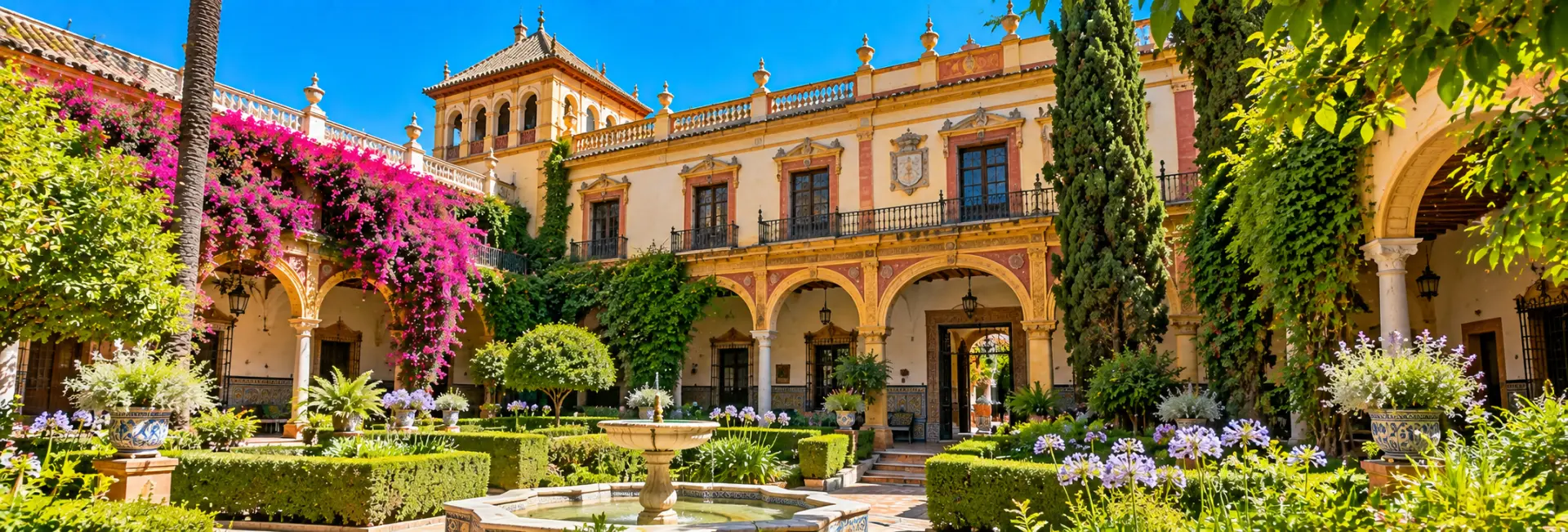
The palace is entered through a restrained neoclassical gate bearing the coat of arms of the House of Alba, which opens onto the first of several gardens rather than straight into the building itself. Beyond it lies the Patio Principal, the main courtyard and the architectural heart of the house. Slender white marble columns support a gallery of intricately carved arches, many following the mixtilinear, horseshoe-influenced lines typical of Seville's Mudéjar tradition, while a central fountain is ringed with glazed tiles produced by local craftsmen in the 16th century. Painted friezes and coats of arms decorate the upper galleries, and a broad interior staircase leads from the courtyard up to the family's private reception rooms.
Interior Halls and Collections
Because the Alba family still uses part of the building, only the ground floor and select rooms are open to visitors, but even that portion holds well over a thousand individual works of art. Paintings, sculptures, tapestries, ceramics, and antique furniture accumulated by successive generations fill the halls, alongside more personal items such as a collection of decorative posters advertising Seville's Feria de Abril spring fair, some over a century old. A small chapel opens off the west side of the courtyard through a Gothic doorway; inside is a 15th-century panel attributed to the Florentine painter Neri di Bicci, one of the older works in the family's collection. A hidden doorway once connected the chapel directly to a neighboring parish church, allowing the family to slip in and attend Mass without stepping onto the public street.
Grounds & Gardens
Gardens make up a surprisingly large share of the property, and for many visitors they are the main draw rather than a supporting act to the architecture. The first garden encountered past the entrance gate is planted with orange and palm trees and clipped myrtle hedges, laid out in the early 20th century under the direction of the 15th Duke of Alba, an enthusiastic amateur horticulturist. Later gardens carry the citrus theme further, with rows of orange trees whose blossom scents the courtyards each spring, along with tiled paths, wall fountains, and climbing bougainvillea.
- Several distinct garden "rooms" rather than one continuous lawn, each with its own planting and mood
- Mature specimen trees, including old fig and citrus trees original to earlier centuries of the property
- Traditional Sevillian tile work used for benches, fountains, and garden paths throughout
- Quiet corners with shaded seating, popular for resting partway through a visit
Royal and Cultural Ties
Birthplace of Antonio Machado
Las Dueñas has a long history of housing tenants alongside the noble family that owned it, and its most famous lodger was the poet Antonio Machado, one of the leading voices of Spanish literature's Generation of '98. Machado was born inside the palace in 1875, when his family rented an apartment within the complex, and he lived there until he was about nine years old. A plaque inside commemorates his birth, and the palace is sometimes included on literary walking routes through the city for that reason alone.
The Duchess of Alba's Home
In more recent memory, the palace is inseparable from Cayetana Fitz-James Stuart, the 18th Duchess of Alba, one of Spain's best-known aristocrats until her death in 2014. She chose Las Dueñas over the family's other residences as her home in Seville and was married there in 2011. Over the decades the house welcomed a long list of visitors from European royalty to figures from arts and letters, and its rooms are still furnished with photographs, gifts, and mementos from those relationships rather than generic period pieces, which is part of what gives the interior its distinctly personal feel.
Ways to Experience It
Most visits are self-guided, using the audio guide included with every ticket, which walks visitors through the gardens, courtyard, chapel, and open interior rooms at their own pace.
- Standard admission with an audio guide in several languages, the most common way to visit
- Guided group tours on certain days for visitors who prefer a live narration over headphones
- Evening or theatrical visits offered on select dates, focused on the gardens after dark
- Private group and school visits available by advance arrangement directly with the palace
Best Time to Visit
Spring is generally considered the best season, when the orange trees are in blossom and the gardens are at their fullest, though this is also when Seville is busiest with visitors for Holy Week and the Feria de Abril. Autumn offers a similar mix of mild weather and blooming gardens with noticeably smaller crowds.
Within the day, arriving close to opening time tends to mean a quieter visit and softer light for photographs in the courtyards, since tour groups typically build up through the late morning and midday hours. Seville's summer heat can make an outdoor-heavy visit like this one uncomfortable in the early afternoon, so a morning or early evening visit is worth planning around between June and September.
Visitor Tips
Because the palace remains a working family home in part, opening hours and ticket policies can change with little notice, so it is worth checking the official website shortly before a visit rather than relying on older guides.
- Book tickets online in advance, especially in spring, since same-day tickets can sell out
- Free entry slots are sometimes offered on Monday afternoons but must be reserved ahead of time
- Allow at least an hour, and closer to two if lingering in the gardens or chapel
- Photography is generally permitted in the courtyards and gardens; check current rules for interior rooms
- The ground floor and main courtyards are step-free, though some interior thresholds and garden paths are uneven
Nearby Attractions
Las Dueñas sits well inside Seville's historic core, within easy walking distance of several other major sights, making it easy to combine with a wider day of sightseeing.
- Casa de Pilatos, another aristocratic palace known for its tilework, a short walk away
- Seville Cathedral and the Giralda tower, the city's largest landmark complex
- The Real Alcázar, the royal palace and gardens still used by the Spanish crown
- Metropol Parasol, the large modern wooden structure and public square in La Encarnación
FAQs about visiting Palacio de las Dueñas
What is Palacio de las Dueñas known for? +
It's known as the historic Seville home of the House of Alba, blending Gothic, Mudéjar, and Renaissance architecture with lush citrus gardens, and as the birthplace of poet Antonio Machado.
How much time should I set aside for a visit? +
Around one hour covers the main courtyard, chapel, and open rooms, though many visitors spend closer to two hours if they linger in the gardens.
Is Palacio de las Dueñas free to visit? +
Standard admission carries a charge, though limited free slots have historically been offered on Monday afternoons with advance booking; check the official site for current pricing and availability.
Do I need to book tickets in advance? +
It's strongly recommended, particularly in spring and around Holy Week, since walk-up tickets can sell out on busy days.
How do I get to Palacio de las Dueñas? +
It sits in Seville's historic center on Calle Dueñas, within comfortable walking distance of the Cathedral, the Alcázar, and Casa de Pilatos, so most visitors simply walk in from elsewhere in the old town.
Is the palace suitable for young children or visitors with mobility needs? +
Children are welcome, and the courtyards and ground-floor rooms are generally step-free, though some garden paths and older interior thresholds are uneven, so strollers and wheelchairs may need a little extra care.
What's the best time of year to visit? +
Spring and autumn are the most rewarding, when the orange and citrus trees are in bloom and temperatures are mild; summer visits are best scheduled for morning or early evening to avoid the midday heat.
Can I combine it with other sights in the same day? +
Yes, its central location makes it easy to pair with Casa de Pilatos, the Cathedral and Giralda, or the Real Alcázar, all within a short walk.