
Table of Contents
Overview
Cărturești Carusel is one of the most photographed interiors in Bucharest and a favorite stop for anyone exploring the Old Town. Set in a restored historic building at Strada Lipscani 55, it is a bookshop that doubles as a cultural space, with a gallery, a multimedia area and a bistro under one roof.
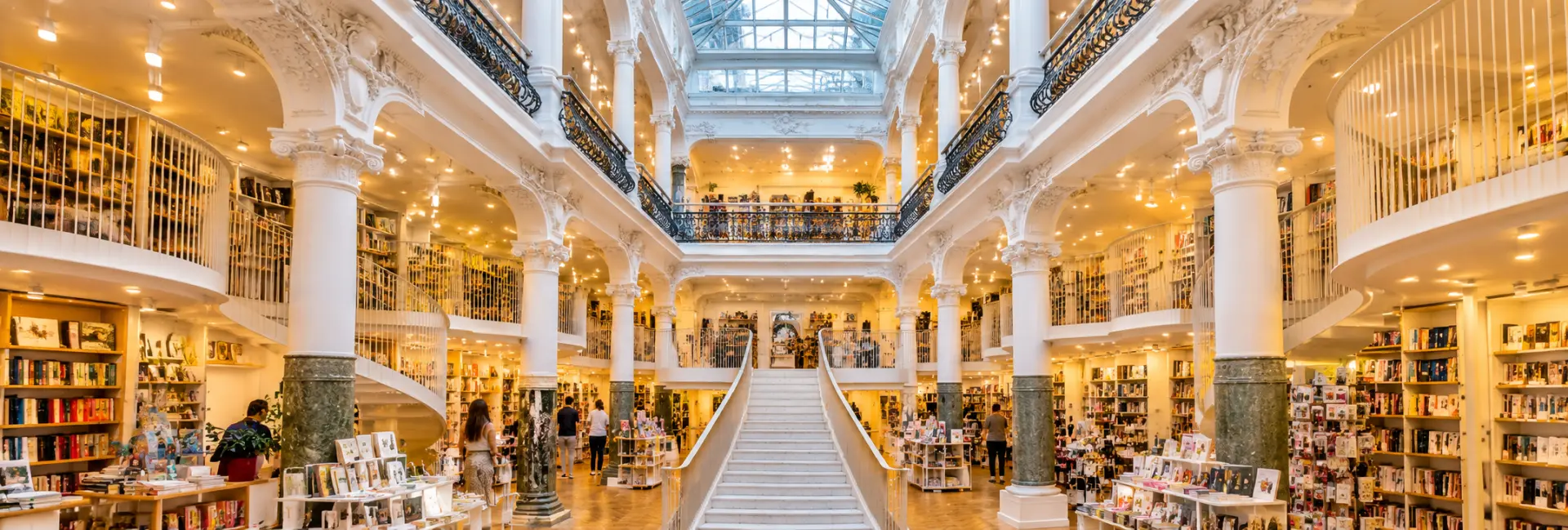
The name translates as "Carousel of Light", and it fits. A large skylight pours daylight down through an open central atrium, while curving white balconies wrap around the walls on every level. Together they create a sense of movement, as if the building were gently turning.
Cărturești is the largest bookshop chain in Romania, and Carusel is its best-known branch. The brand name is a playful nod to the Romanian word for a scholar, cărturar, and this shop is the chain's flagship statement about what a bookshop can be: part library, part gallery, part meeting place.
Visitors come for the books, but also for the atmosphere. Whether you buy something, climb to the top for a coffee or simply wander and look up, it is one of the easiest and most rewarding stops on a walk through the historic center.
History of the Building
A banking house
The building is a 19th-century structure that took on its famous role in the early 20th century. In 1903 the banker Nicolas Chrissoveloni bought it to house his family's bank, and for several decades it served as the Chrissoveloni Bank. The family had roots in Galați, and the Lipscani branch became their first headquarters in the capital. Part of the street-facing side held the teller windows, while the family lived in the back.
Nationalization and neglect
The bank was closed by the communist authorities in 1948. The building was then used as a men's clothing store and later as a department store known as Familia. After the fall of the old regime it was left empty and slowly deteriorated, a victim of the long legal and bureaucratic tangles that followed the restitution of nationalized property.
The heirs return
A descendant of the banking family, Jean Chrissoveloni, fought to recover the property and eventually succeeded. Restoring it was a major task. The work was reported to take years and many thousands of working hours, and it involved strengthening the structure and rehabilitating its historic features.
A symbol of the Old Town's revival
The timing of the reopening matters. The Old Town had spent decades as a neglected zone before reviving as the city's main leisure district, and a large, ambitious cultural project in a once-derelict building signaled a new kind of use for the area, one based on reading, art and design rather than only nightlife. Local listings describe it as a monument building, a reminder that the shop's value lies as much in the architecture as in what is on its shelves.
Opening as a bookshop
The renovated building was leased to the Cărturești bookshop chain, and the doors opened in 2015 after about a quarter of a century of closure. It quickly became one of the best-known buildings in the Old Town and a symbol of the district's revival.
Architecture & Design
The shop's appeal lies in how old and new fit together. The building's elaborate Corinthian columns and historic details were kept, while new elements were added to open up the interior and let light flow through it.
The central skylight
The restoration and expansion included adding a new level at the top with a very large central skylight. This opening is the heart of the design, filling the space with daylight and giving it the luminous quality that inspired the name.
Curving mezzanines
The interior is arranged over six levels, including the basement. Mezzanines wrap around three sides of the building, and their sinuous white balustrades weave between the old columns. Curving staircases link the floors, and the overall effect recalls a carousel in motion. The architects behind the interior concept, Square One, aimed to reduce color so that the play of light and shadow would take center stage.
The street and the setting
From the outside, the building blends into Strada Lipscani's historic streetscape, so the scale of the interior comes as a surprise. You step in from a narrow, busy street and find yourself under a tall, bright atrium, a contrast that is part of the experience.
Materials and details
Bright white surfaces, tall shelves and ornamental railings create a calm backdrop for the books. In the bistro, wooden chairs and slim copper pendant lights, made by Roma artisans, add warmth to the top floor.
What to See Inside
The shop covers about 1,000 square meters across its six levels and carries more than 10,000 titles, along with music, films, gifts and design items. Each level has its own character, so it is worth exploring the building floor by floor.
- The ground floor and atrium: the main entrance level, where the open space and the view up to the skylight make a strong first impression.
- The first-floor gallery: a space for exhibitions of contemporary Romanian art, adding a cultural layer beyond shopping.
- The upper mezzanines: curving balconies lined with shelves, offering views back down into the atrium.
- The basement multimedia area: a space for music, film and other media, as well as cultural events.
- Bistro Carusel on the top floor: a café and light-meal spot with a calm atmosphere and a full view over the interior, a good place to rest after browsing.
Ways to Experience It
Browse the shelves
The most natural way to enjoy Carusel is as a bookshop. Many visitors take their time, moving floor by floor around the open atrium and taking in the display tables, which gives the visit a gentle, circular rhythm.
Take a break at the bistro
The top-floor bistro offers coffee, drinks and food, and it is a pleasant place to look down over the whole interior. It stays quieter than many of the cafés in the nightlife-heavy streets around it.
Photography
The building is made for photos, and the shop is known for being relaxed about visitors taking them. The best shots come from looking up toward the skylight or down from the upper balconies. Be considerate of other visitors and of the staff while you shoot.
Gifts, music and design
Along with books, the shop stocks albums, films, souvenirs, gifts and design objects. It is a convenient place to pick up a gift with a Romanian flavor or a memento of the building itself.
Cultural events and exhibitions
Beyond selling books, the venue hosts art in its gallery and cultural events in its multimedia space. Check what is on during your visit for a chance to see something beyond the usual display.
Best Time to Visit
Mornings are the best time to visit if you want space to look around and take photos without crowds. The shop opens at 10:00, and the first hours of the day tend to be the quietest.
Evenings have their own appeal, since the shop stays open into the night and the interior lighting adds atmosphere. Opening times have been reported to be longer on some days of the week, especially on weekends, so check the current schedule before you plan a late visit.
Light also changes the mood. On bright days the skylight floods the atrium and the white balconies glow, while on overcast days the interior feels softer and calmer. Neither is better, so choose based on whether you want dramatic photos or a quiet browse.
Because it is an indoor attraction, Carusel works in any season. It is a good option on a rainy day or when you need a break from the heat or cold while exploring the Old Town on foot.
Visitor Tips
- Check opening hours: the shop is open daily, usually from 10:00 until late evening, but times vary by day and can change, so confirm on the official site.
- Allow about an hour: that is enough to explore the floors and take photos, with extra time for the bistro.
- Getting there: the shop is in the heart of the Old Town on Strada Lipscani, and the nearest metro station is Universitate, a short walk away.
- Look up: some of the best views are of the skylight and balconies overhead, so do not keep your eyes only on the shelves.
- Respect the space: this is a working shop, so be mindful of other customers when taking photos and leave books where you found them.
- Accessibility: the building uses curving staircases between levels, so if you need step-free access, contact the shop before your visit to ask about available options.
- Plan around the crowds: weekends and late afternoons draw more people, so earlier visits are calmer.
Nearby Attractions
Carusel sits in the middle of the Old Town, so it is easy to combine with other sights on foot.
- Macca-Vilacrosse Passage: a fork-shaped, glass-roofed arcade a few steps away, lined with cafés and restaurants.
- Strada Lipscani and the Old Town: the historic merchants' quarter, with courtyards, inns and lively streets all around the bookshop.
- Old Court (Curtea Veche) and Manuc's Inn: two of the district's oldest landmarks, a short walk away.
- Stavropoleos Church: a small, peaceful 18th-century church on a nearby street.
- Calea Victoriei: the city's historic avenue, reached by walking a few minutes west.
FAQs about visiting Cărturești Carusel
What is Cărturești Carusel? +
It is a six-level bookshop in a restored 19th-century building in Bucharest's Old Town. It also houses a gallery, a multimedia space and a bistro.
Why is it called Carusel? +
The name means "carousel", and it was chosen for the way light fills the building and the way the curving balconies seem to circle around the open atrium.
What was the building before it was a bookshop? +
It was the Chrissoveloni Bank, then a men's clothing store and later a department store called Familia. It stood empty for years before reopening as a bookshop in 2015.
Do I have to buy something to go in? +
It is a working bookshop that welcomes visitors to browse. If you want a drink or a meal, you can visit the bistro on the top floor.
Can I take photos? +
Yes, photography is widely reported to be welcome, though you should be considerate of other visitors and follow any signs or staff requests.
How long should I spend there? +
About an hour is enough for most people. Allow longer if you want to browse the books properly or have something at the bistro.
What time is best to visit? +
Early in the day, shortly after opening, is usually the quietest. Weekends and evenings tend to be busier.
How do I get there? +
The shop is on Strada Lipscani in the Old Town. The nearest metro station is Universitate, and most visitors walk in from Calea Victoriei or other parts of the center.
