
Table of Contents
Overview
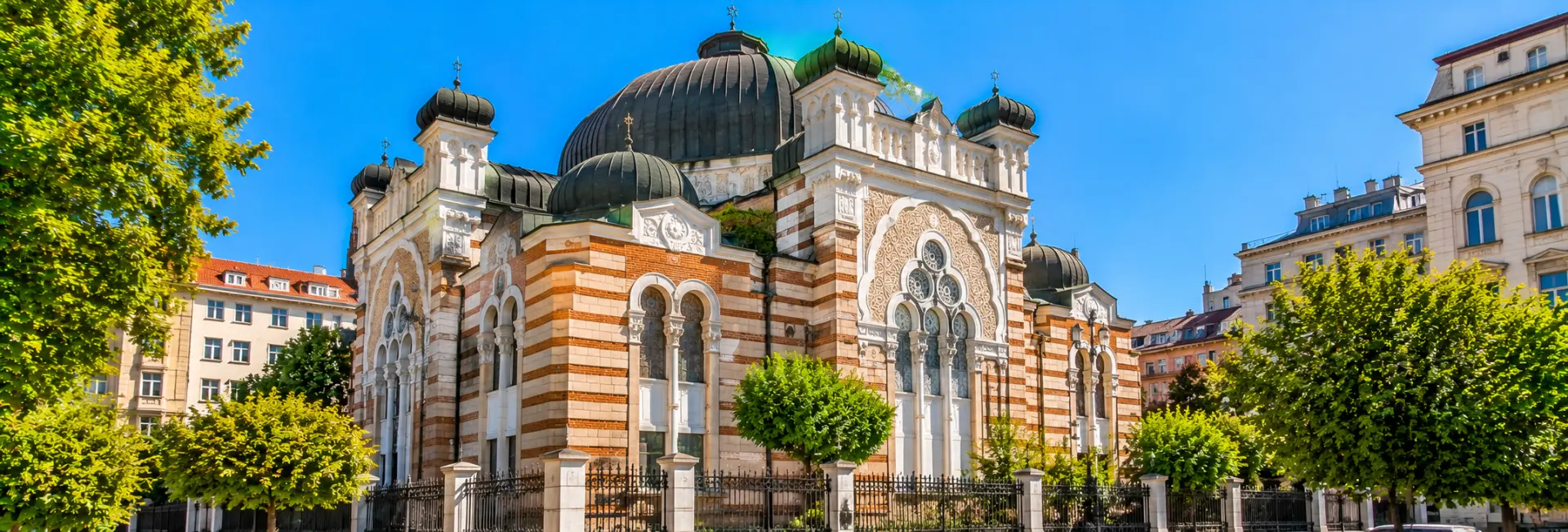
Tucked into a corner of central Sofia, the Sofia Synagogue is one of those buildings that stops you before you even reach the door. Its ornate facade, rows of arches and cluster of small domes make it look far more exotic than the streets around it. It is often described as the largest synagogue in Southeastern Europe, and it ranks among the biggest in the whole continent.
The synagogue opened in 1909 and was built mainly for Sofia's Sephardic Jews, whose ancestors had arrived in the Balkans after being expelled from Spain. It is still a working place of worship today, which gives a visit a very different feel from a museum stop. Services are held here, and the congregation is a fraction of the size the building was designed for.
Part of the synagogue also hosts the Jewish Museum of History, which tells the story of Bulgaria's Jewish communities, including the dramatic events of the Second World War. Together, the architecture, the living congregation and the museum make this one of the most meaningful stops in the capital.
History
Jewish Life in Sofia Before the Synagogue
Jews have lived in the lands around Sofia since Roman times, and a community was established in the city by the early Middle Ages. A major shift came after 1492, when Sephardic Jews expelled from Spain found new homes across the Ottoman Empire, including in Sofia, and gradually became the leading community. For centuries many of them lived in a tightly packed quarter of the old city, which was cleared after Bulgaria became independent and Sofia was rebuilt as a modern capital.
Planning and Construction
By the early twentieth century, the community wanted a large, modern synagogue to replace an older and much smaller one on the same plot. Planning began in 1903 under a community leadership that included the chief rabbi Marcus Ehrenpreis and local figures Ezra Tadjer and Avram Davidjon Levy. Building work started on 13 November 1905.
The synagogue was inaugurated on 9 September 1909, with Tsar Ferdinand I among the guests. It was one of the grandest religious buildings the Bulgarian Jewish community had ever built, and its centenary in 2009 was marked with official celebrations.
War, Damage and Neglect
The synagogue closed only briefly, in 1943 and 1944, when most of Sofia's Jews were expelled from the capital and sent to towns across the country. Allied air raids on Sofia in 1944 then damaged the building. The balcony and several columns in the main hall suffered, and the community's library was destroyed.
Repairs were slow. Under the communist government the building received little serious restoration, and much of the damage lingered for decades. From the mid-1990s, support from Israeli donors began to help, and the building was in need of larger-scale work by the start of the new century.
Restoration
Between 2001 and 2008, the World Monuments Fund led a series of conservation projects here. Crews stabilized the roof, repaired the exterior, restored decorative plaster and key interior features, and fixed drainage so rain no longer ran down the walls. Local organizations added matching funds, and the synagogue was in far better condition when it reached its hundredth birthday.
Architecture & Design
An Austrian Architect and a Viennese Model
The designer was Friedrich Grünanger, an Austrian architect who worked on several important buildings in Bulgaria, including the east wing of the Royal Palace in Sofia, which today houses part of the National Art Gallery. For the synagogue he looked to Vienna, drawing on the Leopoldstädter Tempel, a large synagogue that was destroyed in 1938 and no longer exists. In that sense, the Sofia building preserves a memory of a lost Viennese landmark.
Moorish and Byzantine Styles
The synagogue blends Moorish Revival and Byzantine ideas, with touches of Venetian ornament and the Vienna Secession. Rows of arches, delicate carving and a central dome create a silhouette that is easy to recognize from a distance.
Size and Layout
The scale is impressive. The building reaches about 31 meters at its highest point, with an inner dome rising to roughly 23 meters above the floor. The octagonal prayer hall, spanning around 20 meters, sits beneath the dome and is surrounded by semicircular niches. The interior covers about 659 square meters, and the seating was designed for roughly 1,170 worshippers. A women's gallery runs above the niches, and a vestibule leads visitors into the hall from the entrance.
Inside the Synagogue
The Prayer Hall
Stepping inside, most visitors look up first. The ceiling is painted to suggest the heavens, and light from the stained-glass windows spills across a floor of Venetian mosaic. Columns of Carrara marble support the gallery and frame the central space, while carved stone and woodwork add detail along the walls. In keeping with Jewish tradition, the decoration avoids human figures and relies on geometry, plants and color instead.
The Ark and the Chandelier
At the eastern end, the Holy Ark stands on a raised platform of white marble behind a decorative railing. This is where the Torah scrolls are kept, and it is the focal point of every service. Overhead hangs the great chandelier, which weighs close to two tonnes and is considered the largest in Bulgaria. It is a showpiece that reflects the confidence of the community that commissioned the building.
Acoustics and Atmosphere
The hall is known for its resonant acoustics, a feature that has long made services memorable here. Even when the space is nearly empty, the dome and marble give it a hushed, expansive quality that photographs rarely capture.
Cultural & Religious Significance
A Living Congregation
The synagogue remains the spiritual center of Jewish life in Sofia. It hosts Shabbat services, holiday celebrations and family events such as weddings and coming-of-age ceremonies, and it is one of only two functioning synagogues in Bulgaria. Regular services usually draw a few dozen worshippers, a reflection of how the Jewish population shrank after most Bulgarian Jews emigrated to Israel in the years after the war.
A Symbol of Survival
The building also carries a heavy historical meaning. In 1943, plans to deport Bulgaria's roughly 48,000 Jews were dropped after protests from members of parliament, church leaders and other public figures, which meant the community in the old borders of the country was spared deportation. The story is not simple, though. More than 11,000 Jews from Thrace and Macedonia, territories then under Bulgarian administration, were deported and murdered at Treblinka. Both parts of that history are part of what the synagogue represents today.
The synagogue is also home to the offices of the chief rabbis of Bulgaria and Sofia, which keeps it at the center of the community's religious life.
The Jewish Museum of History
Part of the building holds the Jewish Museum of History, which has been here since 1992 and is run by the Shalom Organization of Jews in Bulgaria. It occupies a small number of rooms, so it is compact, but it covers a lot of ground.
- Daily life, traditions and history of Jewish communities in Bulgaria across the centuries.
- The persecution of Jews during the Second World War, including the expulsion of Jews from Sofia in 1943 and 1944.
- The story of how Bulgaria's Jews were rescued from deportation during the war.
- The mass emigration to Israel in the late 1940s.
Guided tours have been offered in Bulgarian, English and Hebrew by appointment, and there is a small shop for books and souvenirs. If you have only a short time, seeing the prayer hall and spending a few minutes in the museum is a worthwhile combination.
Visiting Etiquette & Tips
Because this is both a landmark and an active synagogue, a few simple habits make the visit smoother and more respectful.
- Dress modestly, with shoulders and knees covered. Men may be asked to cover their heads inside the prayer hall.
- Expect a brief security check at the entrance, and carry photo identification in case it is requested.
- Visiting hours are limited and follow the Jewish calendar, so Saturdays and Jewish holidays are normally not suitable. Confirm the current schedule on the synagogue's official website or by phone before you go.
- Speak quietly, and do not walk through the hall during prayer.
- Ask before taking photographs, because rules can differ inside the hall and in the museum.
- If you want a guided visit to the museum, arrange it in advance rather than turning up on the day.
- Some visitors like to combine the synagogue with a Jewish heritage walk of the city, which usually adds helpful context.
Allow roughly 30 to 45 minutes for the prayer hall and museum together, and a little longer if you want to take your time with the exhibitions.
Best Time to Visit
Time of Year
The synagogue is an indoor stop, so it works in any season. Spring and early autumn are especially pleasant, as the walk through the surrounding streets is comfortable, and the light on the facade is at its best. In winter, the interior can feel quiet and atmospheric, though the building is large and can be cool.
Day and Time
Weekday mornings are the easiest time to visit, since the building is calm and the museum is open for the longest stretch. Avoid Friday evening and Saturday if you simply want to sightsee, as these are times of worship. If you would like to experience the synagogue in use, the major Jewish holidays are meaningful occasions, but you should contact the community first to ask whether visitors are welcome.
Nearby Attractions
The synagogue sits in a lively part of central Sofia, so it is easy to pair with other stops on foot.
- Central Sofia Market Hall: a handsome nineteenth-century market building just around the corner, ideal for local cheese, pastries and snacks.
- Banya Bashi Mosque: one of the few working mosques in the capital, a short walk away on Maria Luisa Boulevard.
- Sofia Public Mineral Baths: a beautiful former bathhouse beside the mosque, whose thermal springs gave the neighborhood its identity.
- Sveta Nedelya Church: a major Orthodox church on the central square, a few minutes away.
- Serdika archaeological complex: Roman ruins under the center of the city, showing how deep Sofia's history goes.
Taken together, the synagogue, the mosque and the nearby churches form a compact route that shows how several faiths have shared this part of the city for centuries.
FAQs about visiting the Sofia Synagogue
Is the Sofia Synagogue open to tourists? +
Yes, visitors are generally welcome during set hours, but it is also an active place of worship. Check the current schedule before you go.
Can I visit on Saturday? +
Usually not for sightseeing, because Saturday is Shabbat and the building is used for services. Weekday mornings are the safest choice.
Is there an admission fee? +
Entry arrangements can change, and a small donation or ticket may apply to the museum. Confirm the current details with the synagogue or its official website.
What should I wear? +
Dress modestly with covered shoulders and knees, and be prepared for men to be asked to cover their heads in the prayer hall.
How long does a visit take? +
About 30 to 45 minutes is enough for the prayer hall and museum, a little more if you join a guided tour.
Can I take photographs? +
Photography is often restricted in parts of the building, so ask at the entrance before you use a camera.
Is the synagogue hard to find? +
Not at all. It stands at the corner of Exarch Yosif and G. Washington streets, close to the Central Sofia Market Hall and a short walk from the Serdika metro station.
Is it suitable for children and visitors with limited mobility? +
Children are welcome if they stay quiet and respectful. The building has steps and a large interior, so visitors with mobility needs should ask staff about the easiest route in.
