Table of Contents
Overview
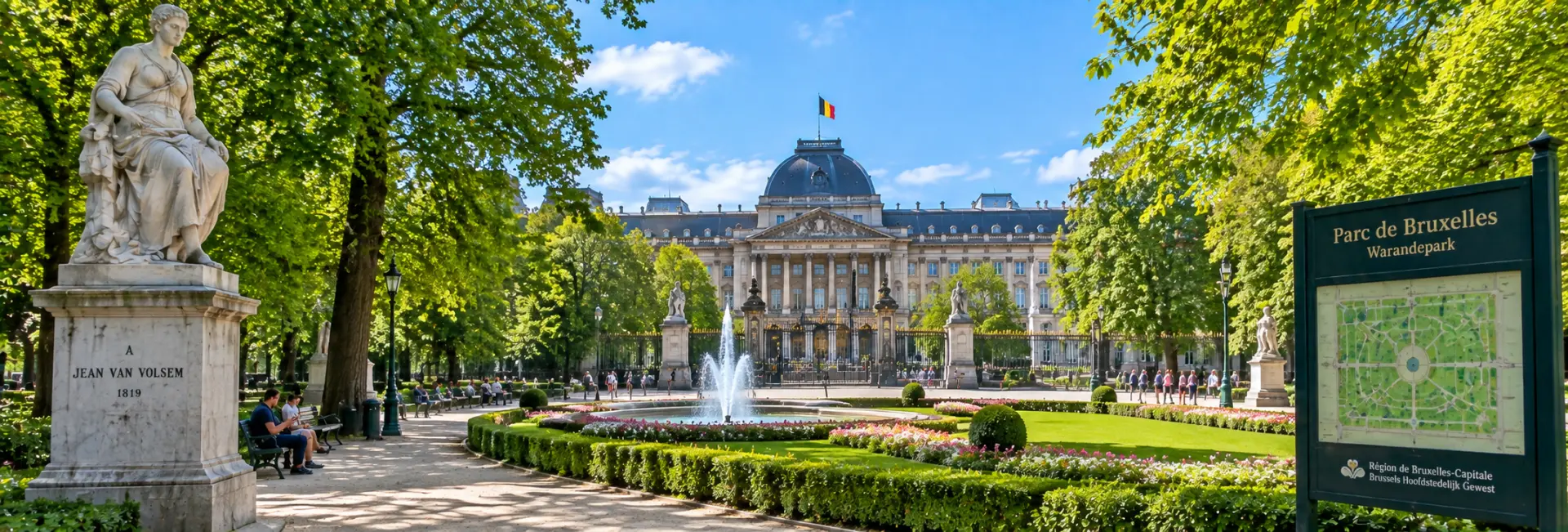
Parc de Bruxelles is the city's oldest and largest central park, a rectangle of clipped lawns and straight gravel avenues sitting squarely between two of Belgium's most important buildings: the Royal Palace and the Palace of the Nation, home to the federal Parliament. Locals often still call it the Royal Park, a nod to its long association with the monarchy that once used the grounds long before it opened to the public.
Unlike the winding, naturalistic parks found elsewhere in Brussels, this one keeps a strict geometric layout dating from the 18th century, giving it a formal, almost ceremonial character that matches the government buildings surrounding it on every side.
History
From Hunting Ground to Public Garden
The park occupies land that once formed part of the grounds of the Coudenberg Palace, used by the Dukes of Brabant as a hunting ground going back to the Middle Ages. After the old palace burned down in the 18th century, the site was reimagined as part of a much larger urban development project for the area.
An 18th-Century Redesign
Between 1776 and 1783, French architect Gilles-Barnabe Guimard and Austrian landscape designer Joachim Zinner laid out the park in its current neoclassical form, tying it into the surrounding development that also produced the Place Royale. The result became the city's first true public park, open to residents rather than reserved for royal or aristocratic use.
A Site of Revolution
In 1830, the park became a battleground during the Belgian Revolution, as fighting between Dutch troops and Belgian revolutionaries spread through its avenues during the uprising that ultimately led to Belgian independence.
Later Additions
In the 1930s, a bunker was built beneath the park, connected by tunnels to the nearby Parliament building, a addition tied to the tense political climate of the period. In the 1960s, an entrance to the underground Parc/Park metro station was added at the park's northwestern corner, and the site was formally classified as a protected heritage area in 1972.
Design & Layout
Covering roughly 13 hectares, the park follows a strict rectangular plan bordered by the Place des Palais, Rue Royale, Rue de la Loi, and Rue Ducale. Straight avenues radiate from a central pond and fountain, with three sightlines from that central point aligned toward the Palace of Justice, the Royal Palace, and the Place du Trone, tying the park's geometry directly to the surrounding city.
A monumental fence designed by architect Tilman-Francois Suys encloses the grounds, while a double row of lime trees lines the park's perimeter, reinforcing its formal, symmetrical character rather than letting it blend into more naturalistic landscaping.
Key Features
- A central pond and fountain, the focal point from which the park's main avenues radiate outward
- Classical statues in the style of Greco-Roman mythology, scattered along the paths and clearings
- The Theatre du Parc, a performance venue built into the park's grounds
- A bandstand used for seasonal concerts and cultural events
- A monumental perimeter fence and gates designed by Tilman-Francois Suys
Cultural Significance
Sitting directly between the Royal Palace and the Belgian Parliament, the park occupies a symbolically central spot in the country's political geography, even though it functions as an everyday public space for walking, jogging, and relaxing. Its role in the 1830 Belgian Revolution ties it directly to the story of Belgian independence, giving an otherwise ordinary garden stroll a layer of historical weight.
Seasonal concerts and cultural events, particularly in spring and summer, continue a long tradition of using the park's open spaces and bandstand for public gatherings, echoing its original purpose as a shared civic space for the city.
Best Time to Visit
Mornings bring joggers and office workers cutting through on their way to nearby government buildings, while afternoons tend to draw a more relaxed, family-friendly crowd. Summer evenings are popular for longer walks as daylight stretches later, and the park's cultural program is most active during the warmer months.
Because the park is largely flat, open, and unshaded in its central areas, visiting earlier in the day during summer helps avoid the strongest midday sun.
Visitor Tips
- Entry is free and the park is generally open daily, though hours can shift around events or maintenance work
- Paths are a level mix of gravel and paved surfaces, making the park comfortable for strollers and wheelchairs
- On-site facilities are limited, so visitors planning a longer stay should plan food and drink stops at cafes around the park's perimeter
- The Parc/Park and Trone metro stations both sit within walking distance, making the park easy to reach from central Brussels
Nearby Attractions
The Royal Palace of Brussels sits directly across from the park's southern edge, while the Palace of the Nation, home to the Belgian federal Parliament, faces it from the north. Mont des Arts and the Magritte Museum are also a short walk away, making the park easy to combine with a broader tour of the surrounding Royal Quarter.
FAQs about visiting Parc de Bruxelles
How old is Parc de Bruxelles? +
The park was laid out between 1776 and 1783, making it the oldest public park in central Brussels.
Is Parc de Bruxelles the same as Brussels Park or the Royal Park? +
Yes, all three names refer to the same park; Royal Park is an older, still commonly used name reflecting its history tied to the monarchy.
Is the park free to visit? +
Yes, entry is free and the gates are generally open daily during normal hours.
What buildings surround the park? +
The Royal Palace sits along its southern edge, while the Palace of the Nation, home to Belgium's federal Parliament, faces it from the north.
Did anything historically significant happen in the park? +
Yes, it was the site of fighting during the 1830 Belgian Revolution, the uprising that led to Belgian independence.
How big is Parc de Bruxelles? +
The rectangular park covers roughly 13 hectares in the heart of the city.
Is the park good for a picnic or a walk? +
Yes, its flat gravel paths and open lawns make it popular for walking, jogging, and relaxing, especially in spring and summer.
How do you get to Parc de Bruxelles? +
The Parc/Park and Trone metro stations both sit within walking distance of the park's edges.