Table of Contents
Overview
MOCAK, short for the Museum of Contemporary Art in Kraków, is one of Poland's most ambitious cultural projects of the 21st century: the first museum built entirely from scratch after the Second World War to be devoted purely to contemporary art. It stands in the Zabłocie district, on part of the grounds once occupied by Oskar Schindler's Emalia enamel factory, a site forever tied to the story told in Schindler's List.
Rather than shy away from that history, MOCAK sits directly beside it, using its charged location as a backdrop for art that grapples with memory, identity, politics, and everyday life. Inside, a constantly rotating program of temporary shows is paired with a growing permanent collection, making it a magnet for anyone curious about where contemporary Polish and international art is headed next. As a member of the International Council of Museums, it has also built a reputation well beyond Kraków, positioning itself alongside established contemporary art institutions elsewhere in Europe.
History
From Factory Grounds to Museum
The idea of building a dedicated contemporary art museum in Kraków had circulated among artists, curators, and city officials for years before it finally took shape. In late 2004, the Municipality of Kraków purchased the land and buildings of the former Schindler's Factory site with the explicit goal of housing a future museum there, following a wider European trend of turning post-industrial sites into homes for contemporary culture. City authorities applied for national funding in 2005, and construction eventually got underway in 2009, financed in part through European Union grants alongside municipal funds. The institution was formally established on 1 February 2010, and after roughly two years of building work it opened its doors to the public on 19 May 2011.
A Deliberate Neighbor
MOCAK occupies the section of the factory complex where Schindler's production halls once stood; those original halls were demolished to make way for the new building, while the separate administrative block next door was preserved and now houses the independently run Oskar Schindler's Enamel Factory museum. The pairing was intentional from the start: rather than competing with its neighbor's wartime history, MOCAK was conceived as a forward-looking counterpoint, built on the same charged ground but focused on how contemporary artists respond to history, memory, and the present. Since opening, the museum has also carried its program beyond Kraków, sending guest exhibitions to venues across Poland and abroad, from Rome's MAXXI to museums in Germany and Lithuania.
Architecture & Building
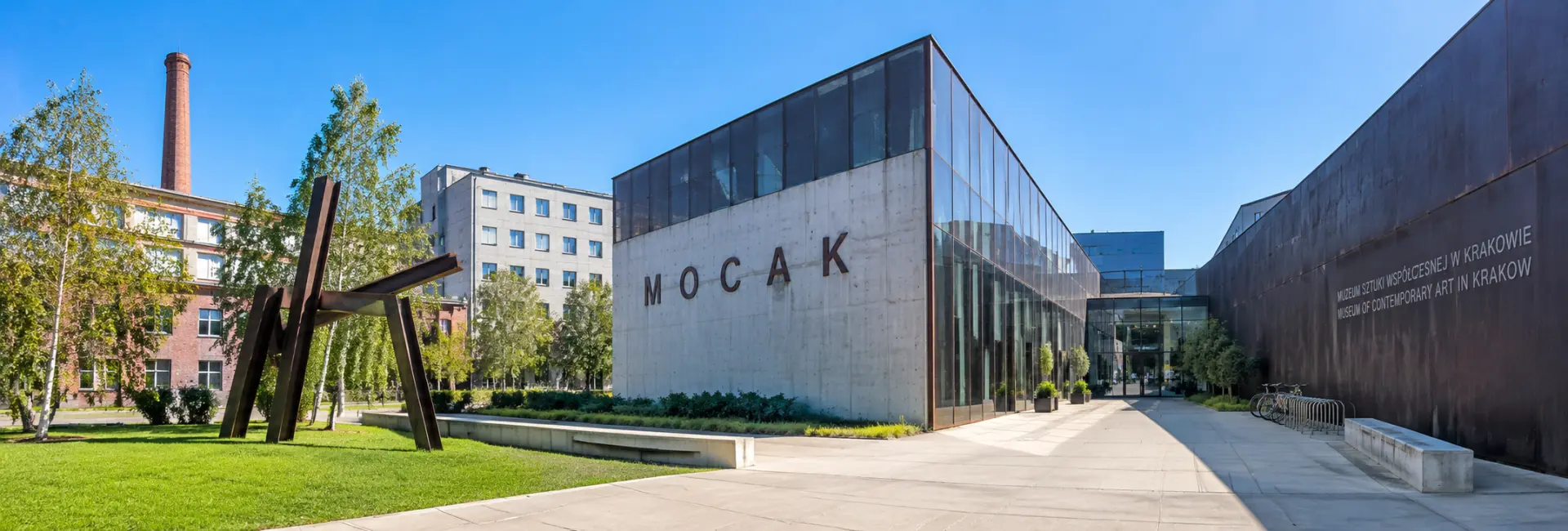
The museum's building was designed by the Italian studio of architect Claudio Nardi, working with Leonardo Maria Proli, and has since picked up multiple architecture awards. Clean lines of glass and concrete sit in deliberate contrast with the site's industrial past; the design nods to the silhouette and roofline of the original factory sheds without imitating them outright, so that the memory of the old Emalia works still lingers in the shape of the new structure. Large expanses of glazing along the exterior let natural light spill into the entrance and circulation areas, while the exhibition halls themselves are kept largely windowless and neutral, giving curators maximum flexibility to reshape the space for each new show.
Across roughly 10,000 square meters of total floor space, about 4,000 square meters are given over to exhibitions, giving MOCAK enough room to run several major shows simultaneously alongside its permanent collection displays. The remaining space houses the library, bookshop, café, administrative offices, and a dedicated conservation laboratory where works entering the collection are cared for and prepared for display. The building is fully step-free, with wide, open galleries designed to accommodate visitors with mobility impairments throughout.
Collection & Exhibits
The MOCAK Collection has grown to more than 5,500 works by several hundred Polish and international artists since the museum's founding. Its guiding idea is to present Polish art from the second half of the 20th century onward alongside comparable international work, letting visitors trace shared concerns and diverging approaches side by side rather than viewing Polish art in isolation. Painting, sculpture, photography, video, and installation all feature heavily, reflecting the wide range of media contemporary artists work in today.
The permanent holdings are organized into thematic groupings that include conceptual art, video, sculpture, and object-based work, and the display of the collection is periodically reshuffled so that repeat visitors encounter new pairings and arguments each time rather than a static hang. Alongside the collection, MOCAK stages an ambitious calendar of temporary exhibitions, including a signature annual "problem exhibition" that takes on a single charged theme, past editions having tackled subjects as varied as history, sport, economics, crime, gender, and medicine through the lens of contemporary art. This mix of a rotating permanent collection and frequently changing temporary shows means the museum rarely looks the same on two separate visits.
Must-See Highlights
- Live Factory 2 – a permanent interactive installation by acclaimed Polish theater director Krystian Lupa, conceived as a nod to Andy Warhol's New York studio and one of the museum's most talked-about spaces.
- The MOCAK Collection galleries – rehung periodically, offering a rolling introduction to major currents in Polish and international art since the 1960s, from conceptualism to video art.
- The annual problem exhibition – MOCAK's flagship themed show, drawing together dozens of artists to explore a single difficult subject each year, with an accompanying multilingual catalogue.
- The Mieczysław Porębski Library – an open, public research library focused on art theory and history, named for the influential Polish art historian and critic.
- The museum's own conservation laboratory and archive, which document artists' working processes and are occasionally opened up to visitors through public programs.
Ways to Experience It
Most visitors move through MOCAK at their own pace, splitting time between the permanent collection galleries and whatever temporary exhibitions happen to be running; the layout makes it easy to focus on just one or two shows rather than attempting everything in a single visit.
- Guided tours in English and other languages can be arranged in advance by phone or email for a deeper look at current exhibitions and the ideas behind them.
- The on-site bookshop stocks an unusually deep selection of contemporary art, photography, design, and film titles, worth browsing even for those short on time, alongside limited-edition artist-made objects and reproductions from the collection.
- The museum café, which keeps its own hours separate from the galleries, is a good stop for a coffee before or after a visit and is open even on the museum's closing day.
- Educational workshops and talks, including sessions for families and young children, run periodically alongside the exhibition program.
- Pair a visit with the neighboring Schindler's Factory museum for a full day that moves between wartime history and contemporary art on the same historic ground.
Best Time to Visit
MOCAK is open Tuesday through Sunday and closed on Mondays, so travelers building a Kraków itinerary should plan around that closure. Weekday mornings tend to be quieter than weekend afternoons, giving more breathing room in front of the larger installations, while Saturdays can draw a steadier stream of local visitors alongside tourists.
Because the program changes throughout the year, checking the current exhibition schedule before visiting is worthwhile for anyone hoping to catch a specific show, particularly the museum's headline annual themed exhibition, which typically runs for several months at a time and often anchors the rest of the yearly calendar around it.
Visitor Tips
- Ticket prices and any reduced or free-admission days change periodically, so it's worth checking MOCAK's official website shortly before visiting for current rates.
- Allow roughly one and a half to two hours for a typical visit, longer if multiple temporary exhibitions are open at once.
- The museum is fully accessible, with step-free access throughout the building for wheelchair users and visitors with strollers.
- Trams to the Zabłocie, Bohaterów Getta, or Limanowskiego stops all leave a short walk to the museum entrance on ul. Lipowa.
- Photography without flash is generally permitted in the collection galleries, though rules can vary for individual temporary exhibitions, so check signage on site.
- Some exhibitions address difficult or provocative themes, so the museum may not suit very young children as well as Kraków's more traditional family attractions.
Nearby Attractions
MOCAK sits at the heart of Zabłocie, a former industrial district that borders both Podgórze and Kazimierz, putting several other significant sites within easy walking or tram distance.
- Oskar Schindler's Enamel Factory – the museum on wartime Kraków housed in the same historic complex, right next door.
- Ghetto Heroes Square (Plac Bohaterów Getta) – the memorial square of empty chairs commemorating the wartime Kraków Ghetto.
- Podgórze – the surrounding district, worth a walk for its own layered history and views from Krakus Mound.
- Kazimierz – Kraków's historic Jewish quarter, a short walk or tram ride away, with the Galicia Jewish Museum and Old Synagogue among its sites.
- The Vistula riverside path – a pleasant walking route linking Zabłocie back toward the Old Town along the water.
FAQs about visiting MOCAK
What does MOCAK stand for? +
MOCAK is the acronym for Muzeum Sztuki Współczesnej w Krakowie, Polish for the Museum of Contemporary Art in Kraków.
When was MOCAK founded? +
The institution was established on 1 February 2010 and opened to the public on 19 May 2011, on the site of Oskar Schindler's former factory.
Is MOCAK the same as Schindler's Factory museum? +
No. MOCAK is a separate contemporary art museum built where the factory's production halls once stood, while the preserved administrative building next door houses the independently run Schindler's Factory museum on wartime history.
How much time should I plan for a visit? +
Most visitors spend around one and a half to two hours at MOCAK, depending on how many temporary exhibitions are running.
Is MOCAK suitable for children? +
Some exhibitions tackle mature or provocative themes, so it may appeal more to older children, teenagers, and adults than to very young kids.
Is MOCAK accessible for wheelchair users? +
Yes, the building was designed to be fully step-free and accessible throughout for visitors with mobility impairments.
What is Live Factory 2? +
It's a permanent interactive installation by Polish director Krystian Lupa, inspired by Andy Warhol's studio, and one of the museum's most distinctive fixtures.
How do I get to MOCAK? +
Trams stopping at Zabłocie, Bohaterów Getta, or Limanowskiego all leave a short walk to the museum entrance on ul. Lipowa in the Zabłocie district.
What else is near MOCAK? +
Schindler's Factory museum sits right next door, with Podgórze, Krakus Mound, and Kraków's historic Kazimierz district all within easy reach.