
Table of Contents
Overview
The National Gallery of Ireland holds the country's national collection of Irish and European fine art, in a complex of connected buildings facing Merrion Square in the heart of Georgian Dublin. Free to enter, it draws hundreds of thousands of visitors a year to see roughly 16,000 works, from Old Master paintings to the world's most comprehensive collection of Irish art.
The Gallery's four wings, built up over more than 150 years, trace the institution's own growth alongside the collection inside them. Highlights range from Caravaggio's rediscovered masterpiece "The Taking of Christ" to an entire museum devoted to the Yeats family, making it one of Dublin's essential, and best value, cultural stops.
History of the Gallery
Origins in an Industrial Exhibition
The idea for the Gallery grew out of the Great Industrial Exhibition of 1853, held on the lawns of Leinster House and organised by the railway magnate William Dargan. A large art display within that exhibition proved so popular that committees formed soon afterward to press for a permanent public collection in Dublin, leading to the National Gallery's establishment by Act of Parliament in 1854.
Opening and Early Growth
Ten years of site selection and fundraising followed before the Gallery, designed by Francis Fowke to match its neighbour the Natural History Museum, opened to the public on 30 January 1864. Its founding collection numbered just 112 pictures, several of them on loan. An annual purchase grant established in 1866 and a stream of gifts and bequests, including the Milltown collection from Russborough House and a major legacy from playwright George Bernard Shaw, allowed the collection to grow far beyond its modest start.
A Modern Refurbishment
By the early 2000s, the Gallery's original 19th-century wings were showing their age, with damp and outdated climate control threatening the collection. A major refurbishment, led by architects Heneghan Peng for the Office of Public Works, closed the historic Dargan and Milltown Wings from 2011 and reopened them in June 2017 with restored period features, a new light-filled courtyard, and modern conservation standards, in the largest single upgrade the Gallery had undergone since 1864.
The project, costing tens of millions of euro, went largely unnoticed by visitors in its most technical aspects: a new underground energy centre was dug beneath the Merrion Square forecourt specifically so that modern climate-control equipment would not intrude on the historic galleries above, while original 19th-century windows, long hidden behind brickwork, were reopened to bring natural light back into rooms that had gone without it for decades.
The Four Wings
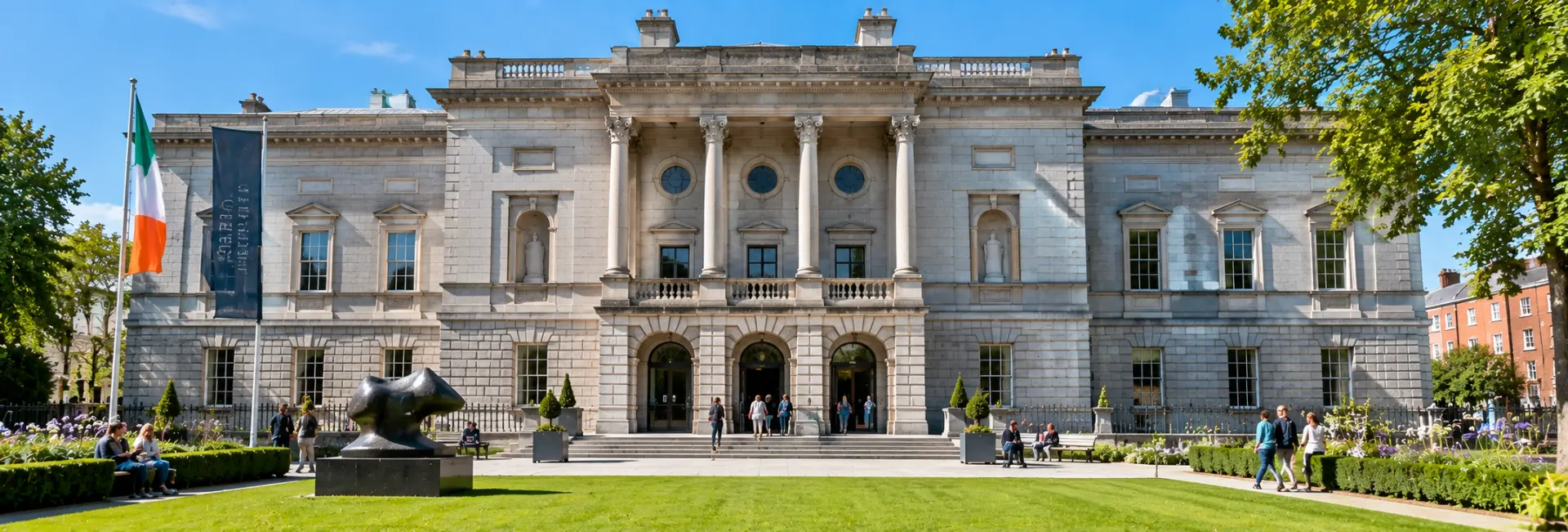
The Gallery today is made up of four interconnected wings, each added at a different stage of its history. The Dargan Wing, dating from the original 1864 building, and the Milltown Wing, added in 1903 to house a major bequest from the Milltown family, form the historic core facing Merrion Square.
The Beit Wing followed in 1968, built to display seventeen outstanding Old Master paintings gifted by Sir Alfred and Lady Clementine Beit in 1987, and named in their honour. The most recent addition, the Millennium Wing, opened in 2002 with an entrance on Clare Street and now hosts major temporary exhibitions, the Gallery Shop, and an art reference library beneath its sky-lit atrium.
Between the historic Dargan and Milltown Wings, the 2017 refurbishment created a new courtyard that helps visitors orient themselves as they move between the different eras of the building, and displays a large sculptural commission by Joseph Walsh.
Taken together, the four wings mean a visit naturally moves through more than a century and a half of architectural style in a single afternoon, from Francis Fowke's 19th-century stone façade facing Merrion Square to the glass-roofed, contemporary galleries of the Millennium Wing on Clare Street.
Collections & Exhibits
The National Collection spans roughly 16,000 works, including about 2,500 oil paintings alongside thousands of watercolours, drawings, prints, sculptures and other objects, covering the history of Western art from the early 14th century to the present day.
- Irish Art: the Gallery holds the most comprehensive collection of Irish painting in existence, from early easel painting through to 20th-century figures such as William Orpen, Paul Henry and Sarah Purser.
- The Yeats Collection: a dedicated Yeats Museum displays portraits by John Butler Yeats and landscapes by his son Jack B. Yeats, brother of poet W. B. Yeats.
- European Old Masters: strong holdings of Italian Baroque and Dutch and Flemish painting include work by Rembrandt, Vermeer, Rubens and Caravaggio.
- The Shaw Room: a grand entrance hall of portraits funded by playwright George Bernard Shaw's bequest, tracing notable Irish and Dublin figures from the Elizabethan era onward.
Because much of the collection is light-sensitive, works on paper and a small number of paintings are rotated or shown only during specific hours, so a particular favourite is not always guaranteed to be on view on any given day.
The Gallery is also home to the ESB Centre for the Study of Irish Art, a research library and archive holding information on thousands of Irish artists and arts organisations, which supports scholars as well as the Gallery's own curators in building out the national collection over time.
Must-See Highlights
Caravaggio's The Taking of Christ
The Gallery's best-known painting depicts Judas betraying Christ with a kiss, lit in the artist's signature dramatic style. Long presumed lost, it was rediscovered in 1990 hanging in a Jesuit house of study in Dublin and has been on loan to the Gallery since 1993.
Vermeer's Woman Writing a Letter, with her Maid
One of only a handful of Vermeers outside the Netherlands and United States, this intimate domestic scene is considered one of the finest works in the entire collection.
Frederic William Burton's Hellelil and Hildebrand
A watercolour depicting a pair of ill-fated lovers on a turret stair, this delicate work is regularly voted the public's favourite in the collection and, due to its fragility, is only displayed during limited hours each week.
The Shaw Statue and Room
A statue of George Bernard Shaw by Paolo Troubetzkoy greets visitors near the Clare Street entrance, marking the playwright's lifelong attachment to the Gallery, which he credited with much of his boyhood education.
Ways to Experience It
Most visitors explore the permanent collection independently, moving freely between the Dargan, Milltown, Beit and Millennium Wings at their own pace; a free audio guide can be borrowed on site, including a version aimed at younger visitors.
Free guided tours of the permanent collection run on weekend afternoons, with additional weekday tours added during the summer months. Regular talks, lectures and family-friendly workshops are also held throughout the year, alongside ticketed temporary exhibitions in the Millennium Wing that go beyond the free permanent displays.
Visitors with a particular interest in Irish art sometimes plan their route to move roughly chronologically through the ground-floor Irish galleries before crossing to the first floor for the European collection, though the layout is flexible enough that a shorter, highlights-only route works just as well for a first visit.
Best Time to Visit
Because admission to the permanent collection is free and there is no need to book ahead, timing a visit is mostly about avoiding crowds and making the most of the longer Thursday hours, when the Gallery stays open into the evening rather than closing in the late afternoon. Weekday mornings tend to be the quietest time to see the major paintings without competing for space.
As an entirely indoor attraction, the Gallery is also a reliable option on a wet Dublin day, and its central, walkable location makes it easy to combine with other Georgian Dublin sights before or after a visit. Opening hours vary by day of the week and can change around public holidays, so it is worth checking the current schedule before travelling.
Visitor Tips
- Admission to the permanent collection is free; only some temporary exhibitions in the Millennium Wing carry a charge.
- The main public entrance is on Clare Street, with a second entrance facing Merrion Square beside Leinster House.
- Entry to the galleries stops shortly before closing time each day, and the upper floors begin closing earlier than the rest of the building, so plan to arrive with enough time to see everything you want.
- Fragile works on paper, including the Gallery's best-loved watercolour, are only displayed during limited hours each week, so check the current display schedule if a specific piece is a priority.
- An on-site café and Gallery Shop make it easy to break up a longer visit or pick up a gift on the way out.
- The Gallery is closed on Good Friday and from 24 to 26 December each year.
Nearby Attractions
The Gallery's location beside Merrion Square places it within walking distance of several other major Dublin sights, in one of the city's best-preserved Georgian quarters.
- Merrion Square itself, a landscaped Georgian square with colourful doorways and a statue of Oscar Wilde, sits directly outside.
- Leinster House, seat of the Irish parliament, and the National Museum of Ireland – Archaeology are both a short walk away on Kildare Street.
- Trinity College Dublin and the Book of Kells are around an eight-minute walk to the north.
- St Stephen's Green is roughly an eleven-minute walk south, making a natural pairing for a half-day exploring Georgian Dublin.
FAQs about visiting the National Gallery of Ireland
Is the National Gallery of Ireland free to visit? +
Yes, admission to the permanent collection is free; only some temporary exhibitions in the Millennium Wing charge a separate fee.
What are the opening hours? +
Hours vary by day, with the Gallery generally open from mid-morning to 5:30pm and staying open until 8:30pm on Thursdays; it is closed on Good Friday and from 24 to 26 December.
Do I need to book tickets in advance? +
No booking is needed to see the permanent collection, though some ticketed temporary exhibitions may require advance booking during busy periods.
What is the Gallery's most famous painting? +
Caravaggio's "The Taking of Christ" is the best-known work, alongside Vermeer's "Woman Writing a Letter, with her Maid" and Frederic William Burton's watercolour "Hellelil and Hildebrand."
How long should I plan for a visit? +
A focused visit to the highlights can take around ninety minutes, but art lovers often spend two to three hours or more exploring all four wings.
Is the Gallery suitable for children? +
Yes, a free audio guide aimed at younger visitors is available, along with family workshops and activities held throughout the year.
What's nearby if I want to extend my visit? +
Merrion Square, Leinster House, the National Museum of Ireland on Kildare Street, and Trinity College are all within easy walking distance.
