Table of Contents
Overview
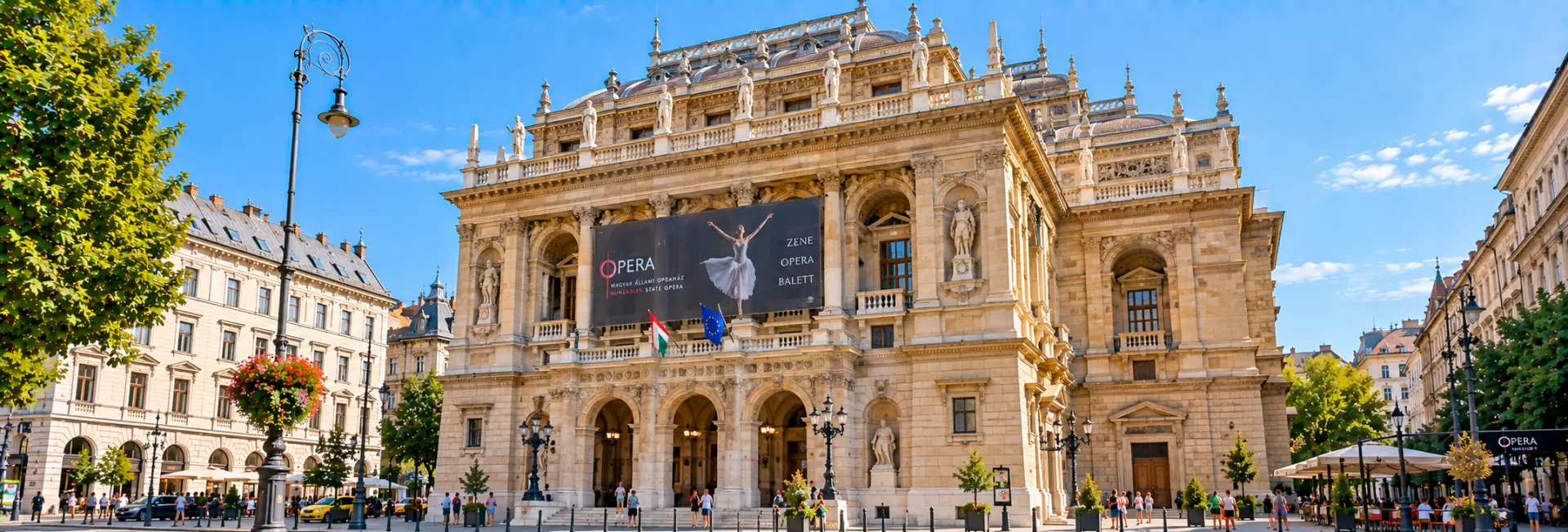
The Hungarian State Opera House sits at the heart of Budapest's grand Andrássy Avenue, a neo-Renaissance jewel that has hosted opera and ballet since 1884. Designed by Miklós Ybl, one of the leading Hungarian architects of the 19th century, the building was conceived to give the city a stage worthy of its growing cultural ambitions, and it remains the home of both the Hungarian State Opera company and the Hungarian National Ballet.
Smaller than some of Europe's great opera houses in seating capacity, it is nonetheless celebrated for the richness of its decoration and the quality of its acoustics, which musicians and critics have long ranked among the finest anywhere. A multi-year restoration completed in 2022 returned the building's frescoes, gilding, and stagecraft to something close to their original splendor, making a visit today as much about the architecture as the performance on stage.
Beyond its own walls, the Opera House anchors one end of Andrássy Avenue's grand 19th-century townscape, a setting that has made it as much a symbol of Budapest's civic identity as a working theatre. Whether encountered from the outside as a striking piece of streetscape or from within during a performance, it offers a rare combination of living cultural institution and preserved historical monument.
History
Origins and Construction
Before the Opera House existed, touring companies and the National Theatre carried Budapest's operatic life, and by the mid-19th century the city had outgrown those makeshift stages. Plans for a dedicated opera house gained momentum under Emperor Franz Joseph I, who helped fund the project alongside the city of Budapest. Miklós Ybl won the commission, and construction began in 1875 on a prominent plot along the newly laid-out Andrássy Avenue.
Ybl worked for nearly a decade to complete the building, overseeing not only the architecture but the coordination of the painters, sculptors, and craftsmen who would fill its interior with allegorical and mythological imagery celebrating music itself.
Opening and Early Years
The building opened to the public on 27 September 1884 as the Hungarian Royal Opera House, with a program built around works by Ferenc Erkel, the company's first music director and composer of Hungary's national anthem. The house quickly built a reputation for the quality of its productions, staging dozens of operas each season for enthusiastic Budapest audiences.
Its early prestige was reinforced by the appointment of internationally significant conductors, most notably Gustav Mahler, who directed the company from 1888 to 1891 and helped raise its standards to a European level. The tradition of drawing major musical figures to the podium continued well into the 20th century, including a tenure by Otto Klemperer in the years following the Second World War.
The building's social life grew alongside its artistic reputation. From 1886 onward, the Opera House became the setting for the Budapest Opera Ball, an annual society gathering held in the foyer and auditorium that turned the venue, for one night each year, into the center of the city's formal social calendar.
Renovation and Reopening
By the late 20th century, decades of use had taken a toll on the building, prompting a major restoration between 1980 and 1984 timed to mark the venue's centenary. A far larger renovation followed more recently: what began in 2017 as planned work on the stage machinery and electrical systems grew into a nearly five-year, full-scale restoration of the entire building, including its façade, roof, decorative surfaces, and backstage technology. The Opera House reopened to the public in March 2022, with the historic interiors carefully revived alongside modern performance infrastructure.
During the closure, the company kept performing by making use of its other venues, including the Erkel Theatre, a second house that has been part of the Hungarian State Opera since 1951, and the newly opened Eiffel Art Studios, a contemporary performance space inaugurated in 2021 inside a former railway building. Both venues continue to host productions alongside the restored historic house today.
Architecture & Design
Exterior
The Opera House is built in a neo-Renaissance style with Baroque flourishes, its symmetrical façade following a deliberately musical theme. Niches flanking the main entrance hold statues of Ferenc Erkel and Franz Liszt, Hungary's most celebrated composer, both carved by sculptor Alajos Stróbl. Wrought-iron lamps line the approach to the building, lighting the wide stone staircase that leads visitors inside.
The façade's proportions and detailing were carefully matched to the scale of Andrássy Avenue itself, so that the building reads as a civic monument as much as a theatre. Sphinx statues flank the main entrance steps, a decorative touch that has become one of the building's most photographed details.
Interior
Inside, a marble-columned foyer sets the tone for the rest of the building. Its vaulted ceiling carries murals by Bertalan Székely and Mór Than depicting the nine Muses, painted to frame the grand staircase where 19th-century opera-goers once paused to be seen in their finest evening wear.
- A horseshoe-shaped auditorium seating roughly 1,200 people across three tiers
- A bronze chandelier weighing over three tonnes, suspended beneath a ceiling fresco
- A stage that, at the time of construction, featured some of the most advanced hydraulic and revolving-stage technology in Europe
- A centrally placed royal box adorned with sculpture representing the four core operatic voice types
Recognition / Status
The Hungarian State Opera House stands within the section of Budapest recognized by UNESCO as a World Heritage Site, listed under "Budapest, including the Banks of the Danube, the Buda Castle Quarter and Andrássy Avenue." Andrássy Avenue itself was added to the original 1987 inscription in a 2002 extension, placing the Opera House among the architectural highlights that define the boulevard's protected streetscape.
Beyond its heritage status, the building is widely regarded by musicians and acousticians as one of the best-sounding opera houses in the world, a reputation built on measurements and performer testimony gathered over more than a century of use. A well-known assessment carried out by a team of international engineers in the 1970s placed its acoustics among the very best in Europe, a distinction the house has continued to trade on even as newer concert halls and opera houses have opened elsewhere on the continent.
Notable Features & Highlights
The Grand Staircase and Foyer
The building's ceremonial entrance sequence, from the stone staircase outside to the marble foyer within, was designed to turn a night at the opera into a social occasion in its own right. Gilded detailing, painted ceilings, and sculpted ornament accompany visitors from the street to their seats.
The Auditorium Fresco and Chandelier
The main hall's centerpiece is a ceiling fresco by Károly Lotz depicting Greek gods gathered on Mount Olympus, illuminated by a bronze chandelier weighing around three tonnes. Together they anchor the horseshoe-shaped auditorium, which was designed to give every seat clear sightlines to the stage.
The Royal Box and Sculptural Program
Centrally positioned across the three-tiered circle, the royal box is decorated with sculptures symbolizing the soprano, alto, tenor, and bass voice types, a detail that reflects the building's broader habit of folding musical themes into its decorative scheme.
Stage Technology
When it opened in 1884, the Opera House's stage was equipped with some of the most advanced machinery available, including a revolving stage and hydraulic lifting systems that allowed for elaborate scene changes. The recent renovation replaced much of this backstage infrastructure with modern equivalents while preserving the historic proscenium and auditorium that audiences see from their seats.
Ways to Experience It
The most complete way to experience the Opera House is to attend a live performance. The regular season runs from September to the end of June, staging a rotating repertoire from the Hungarian State Opera and the Hungarian National Ballet, alongside occasional concerts and galas.
- Attend an opera or ballet performance for the full combination of architecture, acoustics, and live artistry
- Join a guided daytime tour of the public interiors, typically offered in several languages including English, German, French, Italian, Spanish, and Hungarian
- Book a private or small-group tour for a more in-depth look at the building's history and restoration
- Check listings for performances at the company's other venues, the Eiffel Art Studios and Erkel Theatre, when the historic house is unavailable
Photography without flash is generally permitted in the public areas before and after a performance, making it easy to combine watching a show with taking in the architecture at a relaxed pace.
Best Time to Visit
For anyone hoping to see a performance, timing a visit to fall within the September-to-June season is essential, since the house typically closes for the summer months. Evenings bring the building to life, with the auditorium lit and in full use, while daytime guided tours offer a quieter, more detailed look at the architecture without a performance underway.
Because the Opera House sits in central Budapest, it can be visited comfortably in any season; a cold-weather evening performance and a warm-weather daytime tour each offer a distinctly different way of experiencing the building.
Visitor Tips
- Book performance tickets in advance, particularly for popular productions and weekend dates, as the auditorium holds only around 1,200 people
- There is no strict dress code, but many visitors dress smartly out of respect for the venue and the occasion
- Guided interior tours run separately from performances and are a good option for visitors who cannot attend an evening show
- The building is served by the Opera stop on Budapest's M1 metro line, making it an easy stop when exploring Andrássy Avenue
- Arrive with time to spare before a performance to take in the foyer and staircase, which are as much a part of the experience as the auditorium itself
Nearby Attractions
The Opera House sits on Andrássy Avenue, itself a UNESCO-listed boulevard lined with historic townhouses, boutiques, and cafés, making it a natural starting point for further exploration on foot.
- Andrássy Avenue's café and shopping stretch, extending toward Heroes' Square and City Park
- Liszt Ferenc Square, a lively pedestrian square with restaurants and bars just off the avenue
- St. Stephen's Basilica, a short walk away and one of Budapest's largest churches
- Heroes' Square and City Park, at the far end of Andrássy Avenue, home to museums and the Széchenyi thermal baths
FAQs about visiting the Hungarian State Opera House
What makes the Hungarian State Opera House famous? +
It is celebrated both as one of architect Miklós Ybl's masterpieces and as one of the best-sounding opera houses in the world, combining a richly decorated neo-Renaissance interior with acoustics that musicians have praised for well over a century.
When is the best time to visit? +
The performance season runs from September to the end of June, so plan around those months if you want to see a live opera or ballet; guided daytime tours of the building are available throughout the year.
How long does a visit take? +
A guided tour of the public interiors typically lasts around 45 minutes to an hour, while attending a full performance, including intermissions, can run two to three hours depending on the production.
Do I need to buy tickets in advance? +
Yes, booking ahead is recommended for both performances and guided tours, since the auditorium seats only around 1,200 people and popular shows can sell out.
Is there a dress code? +
There is no mandatory dress code, though many visitors choose to dress smartly for performances as a mark of respect for the venue and the occasion.
Is the Opera House suitable for children or visitors with limited mobility? +
Families are welcome, and the building has been updated with modern accessibility features as part of its recent renovation, though visitors with specific mobility needs should check current facilities with the box office before their visit.
How do I get to the Opera House? +
The building is directly served by the Opera stop on metro line M1, and it sits within easy walking distance of central Budapest landmarks along Andrássy Avenue.
Can I visit without attending a performance? +
Yes, guided interior tours run independently of the performance schedule and let visitors see the grand staircase, foyer, and auditorium up close during the day.
What's nearby to combine with a visit? +
Andrássy Avenue, Liszt Ferenc Square, St. Stephen's Basilica, and the Heroes' Square/City Park area are all within easy reach and pair well with a stop at the Opera House.