
Table of Contents
Overview
The Thyssen-Bornemisza National Museum completes Madrid's celebrated "Golden Triangle of Art," standing alongside the Prado and the Reina Sofía on the Paseo del Prado. Where those two museums each focus on a particular slice of art history, the Thyssen does something rarer: it walks visitors through seven centuries of Western painting in a single, continuous route, from medieval Italian panels to American Pop Art, almost without a gap.
The museum's collection began as a private one, assembled largely by a single family over two generations, which gives it a personal, curated feel that's different from the encyclopedic sprawl of many national galleries. Housed in a converted 18th-century palace on one of Madrid's grandest boulevards, it's often described by visitors as the most approachable of the city's three great art museums, both in scale and in how clearly its story is told from room to room.
History of the Museum
A Private Collection Built Across Generations
The core of the museum's holdings was assembled by the German-Hungarian industrialist Baron Heinrich Thyssen-Bornemisza starting in the 1920s, when he began acquiring Old Master paintings. After his death in 1947, the collection was divided among his heirs, and it was his son, Baron Hans Heinrich Thyssen-Bornemisza, who spent decades buying back scattered pieces and expanding the collection further, adding Impressionist, Expressionist, and modern works to what had originally been a more traditional group of paintings.
Coming to Madrid
By the late 1980s, the Baron was looking for a permanent home to display the collection publicly, and several countries reportedly competed for the honor. Spain won out, helped along by the involvement of the Baron's fifth wife, Carmen Cervera, a Spanish former beauty queen, and by the offer of a grand but underused palace on the Paseo del Prado. The collection opened to the public there in October 1992, and less than a year later, in June 1993, the Spanish state formally purchased the core collection from the Baron for a sum reported at around 350 million dollars, securing its long-term future in Madrid.
The Carmen Thyssen Extension
The story didn't end with the 1993 purchase. Carmen Cervera's own, separate collection, built as a continuation of the family's collecting tradition, was first shown to the public in 1996 and later given a permanent home in a purpose-built extension that opened in 2004, adding around two hundred more paintings and sculptures and pushing the museum's total holdings past a thousand works. That extension effectively doubled the museum's usable gallery space and allowed curators to display far more of the family's holdings at once than the original palace alone could ever have accommodated, turning what began as a temporary loan into one of the largest single collections on public view anywhere in Europe.
Architecture & Building
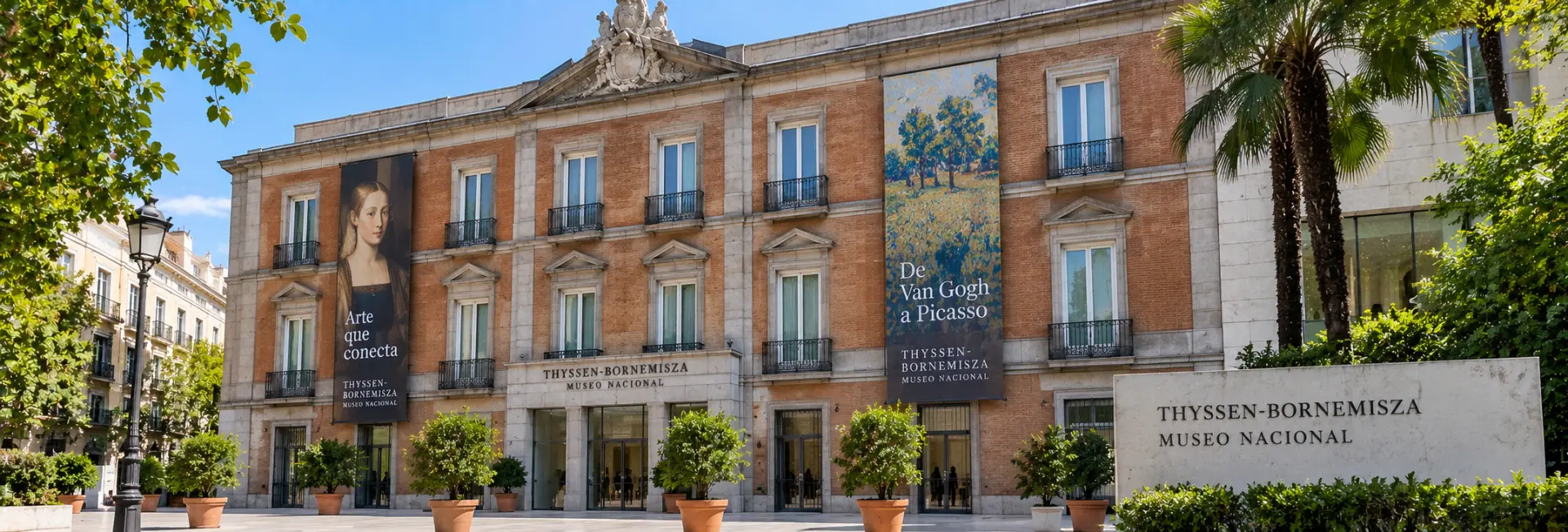
The museum occupies the Palacio de Villahermosa, an aristocratic mansion originally built in the late 18th century for the Duchess of Villahermosa and altered several times over the following two centuries, including a period as a bank headquarters before it stood empty and available in the 1980s. Only the palace's facades and its garden survived largely intact from the original building by the time it was chosen to house the Thyssen collection, and even the main entrance had shifted location more than once across the palace's earlier renovations, reflecting how thoroughly the building had already been reworked long before it became a museum.
Rafael Moneo's Conversion
Turning a grand but outdated palace into a functioning modern museum fell to the Spanish architect Rafael Moneo, who worked on the project between 1989 and 1992. Moneo largely rebuilt the interior behind the historic facades, since the existing floor plan couldn't accommodate a museum of this scale, while keeping the palace's exterior character intact. His design is best known for its warm terracotta-colored walls, natural stone floors, and carefully controlled skylighting, all chosen to let the paintings read clearly without competing with the architecture around them.
The 2004 Extension
To house the growing Carmen Thyssen collection, the museum later expanded into neighboring buildings along the same block, adding gallery space that maintains the same restrained material palette as Moneo's original renovation, so the newer wing reads as a continuation of the museum rather than a separate building bolted on.
Collections & Exhibits
The permanent collection is arranged chronologically across three floors, and the museum recommends starting at the top and working down, beginning with early Italian and Northern European painting from the 13th to 15th centuries and finishing with 20th-century avant-garde movements on the ground floor. This top-to-bottom route lets visitors trace the evolution of Western painting almost like a timeline made physical.
- Italian and Flemish primitives, including early panel paintings by artists such as Duccio
- German Renaissance painting, with works by Albrecht Dürer among others
- Dutch Golden Age and Baroque painting, including canvases by Rembrandt and Caravaggio
- 19th-century movements including Impressionism and Post-Impressionism, with paintings by Monet, Degas, and Van Gogh
- German Expressionism and early 20th-century American art, both areas in which the museum is especially strong relative to other Spanish collections
- The Carmen Thyssen wing, with further Impressionist, Old Master, and Spanish 19th-century paintings from the baroness's personal collection
Must-See Highlights
With close to a thousand works on display, most visitors focus on a shortlist of highlights rather than attempting to see everything in one visit.
- Early Northern European and Italian panel paintings on the top floor, a rare concentration of pre-Renaissance work outside a specialist museum
- The museum's run of German Expressionist paintings, one of the most significant groupings of this movement found in Spain
- Impressionist and Post-Impressionist canvases, including major paintings by Van Gogh and Gauguin
- A dedicated Rodin room, showcasing sculpture alongside the painting-heavy collection
- 20th-century American works, including pieces that bridge realism and early modernism, on the ground floor
Ways to Experience It
Most visitors follow the museum's suggested chronological route, but the layout also works well for a shorter, more targeted visit if time is limited, since each floor can largely stand on its own. An audio guide is available covering the highlights of the collection, and the museum periodically runs guided tours led by museum educators that dig into the stories behind specific paintings.
The museum also runs a full program of temporary exhibitions on its ground floor and lower level, often built around a single artist or theme, which are ticketed separately from the permanent collection but can be combined with it. These exhibitions regularly bring in loaned masterpieces that aren't part of the museum's own holdings, and they're a major part of why repeat visitors keep coming back rather than treating the museum as a one-time stop. For visitors planning to see all three museums on the Paseo del Prado, a combined pass covering the Thyssen, the Prado, and the Reina Sofía is sold at a reduced overall price.
- Follow the suggested top-down chronological route through the permanent collection
- Rent an audio guide for added context on individual paintings
- Check the current temporary exhibition schedule, since these often feature major loaned works
- Consider a combined ticket if visiting the Prado or Reina Sofía on the same trip
Best Time to Visit
The museum tends to be quieter on weekday mornings, shortly after opening, before tour groups and the midday crowds arrive. Saturdays draw more visitors, in part because of extended evening hours and a regular period of free admission later in the evening, which is popular with locals but means larger crowds during that window.
Monday afternoons offer a different rhythm entirely: the permanent collection is open for a shortened window with free admission, which makes it a good option for budget-conscious visitors willing to plan around the shorter hours, though it can also draw a bigger crowd than an average weekday. Outside of these patterns, visiting outside peak summer tourist season generally means a calmer experience throughout the galleries.
Visitor Tips
- Standard tickets cover both the permanent collection and any current temporary exhibitions; reduced-price tickets are available for students, seniors, and other eligible groups
- The permanent collection offers free admission on Monday afternoons, and Saturday evenings include a separate free-entry window in the later hours
- If planning to visit the Prado and Reina Sofía as well, the combined Paseo del Arte pass covering all three museums works out cheaper than buying tickets separately
- The museum closes on January 1, May 1, and December 25, so it's worth checking hours in advance around those dates
- The nearest metro station is Banco de España, a short walk from the museum's entrance on Paseo del Prado
Nearby Attractions
- Prado Museum, just a short walk south along the Paseo del Prado
- Reina Sofía Museum, completing the "Golden Triangle of Art" a bit further south
- Retiro Park, Madrid's grand green space, within easy walking distance
- Plaza de Cibeles and its landmark fountain, a few minutes' walk north
- Puerta del Sol, Madrid's central square, reachable on foot in about fifteen minutes
FAQs about visiting the Thyssen-Bornemisza Museum
What is the Thyssen-Bornemisza Museum known for? +
It's known for tracing the history of Western painting almost without interruption, from 13th-century Italian panels to 20th-century modern art, built originally from a single family's private collection.
How is the Thyssen-Bornemisza different from the Prado and Reina Sofía? +
The Prado focuses mainly on Spanish and other European masters up to the early 19th century, while the Reina Sofía covers 20th-century Spanish modern art; the Thyssen fills in the gaps between and around them, with strong Northern European, German Expressionist, and American holdings.
How much time should I plan for a visit? +
Most visitors spend between roughly one and a half and three hours seeing the permanent collection, depending on how closely they look and whether they add a temporary exhibition.
Is the Thyssen-Bornemisza Museum free to visit? +
It isn't free overall, but the permanent collection can be seen free of charge on Monday afternoons, and there's also a free entry window on Saturday evenings, both subject to capacity.
What's the best way to see all three museums in the Golden Triangle of Art? +
A combined Paseo del Arte pass covers the Thyssen-Bornemisza, the Prado, and the Reina Sofía at a lower combined price than buying separate tickets to each.
Do I need to book tickets in advance? +
Advance booking isn't strictly required but is recommended, particularly for weekends and the free admission windows, since capacity is limited and popular times can sell out.
What's the recommended route through the museum? +
The museum suggests starting on the top floor with the earliest paintings and working down, ending with 20th-century art on the ground floor, so the visit follows the same order the collection was historically formed in.
