
Table of Contents
Overview
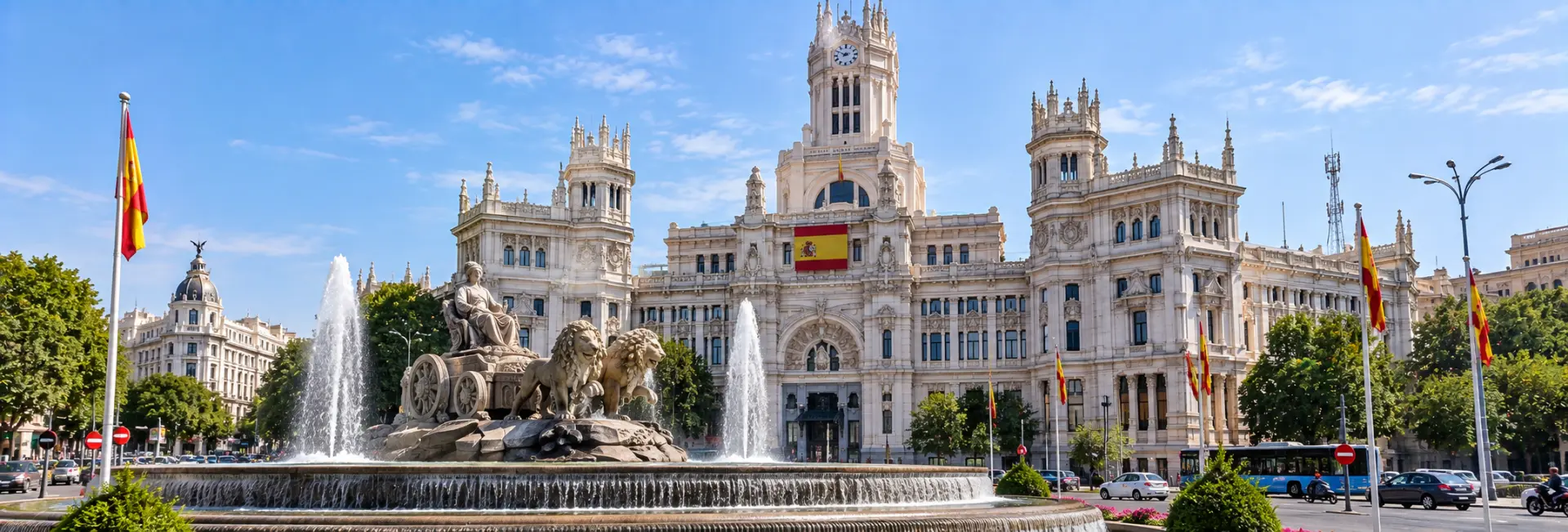
At the point where three of Madrid's grandest boulevards meet, a white marble goddess rides a lion-drawn chariot above a ring of traffic, watched over by one of the most striking buildings in the city. Plaza de Cibeles is technically a roundabout, but calling it that undersells what it actually is: the closest thing Madrid has to a single image that sums up the whole city, part fountain, part civic monument, part backdrop to national celebrations. It sits at the junction of Calle de Alcalá, Paseo de Recoletos, and Paseo del Prado, making it a natural crossing point between the old center and the museum district to the south.
The square takes its name from the fountain at its center, and its identity from the four monumental buildings that frame it on every side, most famously the dazzling white former post office that now serves as Madrid's City Hall. Locals and visitors alike treat the plaza as a natural meeting point and photo stop, and its silhouette, especially the City Hall's towers lit up at night, has become shorthand for Madrid itself, appearing on postcards, in films, and in countless traveler photos taken from nearly the same spot.
History
From Fountain to Landmark
The square's story begins with its fountain, commissioned by King Charles III in the late 18th century as part of a broader push to beautify Madrid with new public monuments and better water supply. The fountain wasn't originally built where it stands today; it was installed further up the boulevard, near the start of what is now Paseo de Recoletos, and only moved to its current, more central position in 1895.
A Square Renamed
The plaza itself has gone by several names over the years. It was first known simply as Plaza de Madrid, then renamed Plaza de Castelar around 1900 in honor of the Spanish statesman Emilio Castelar, before eventually settling into the name it carries today, taken from the goddess at its heart. Each of the four grand buildings that now frame the square was built or substantially reworked in the decades either side of 1900, turning what had been a relatively open crossroads into the enclosed, monumental space visitors see now.
A 20th-Century Civic Centerpiece
The most dramatic addition came in the early 20th century, when a vast new headquarters for Madrid's postal and telegraph service was built directly behind the fountain, designed by architects Antonio Palacios and Joaquín Otamendi and completed in 1919 after more than a decade of construction. That building has since changed roles more than once, moving from postal headquarters to municipal government offices, but its presence cemented Plaza de Cibeles as the ceremonial heart of the city, a role it still plays today whenever Madrid gathers to celebrate.
The Fountain of Cybele
The fountain was designed by the Spanish architect Ventura Rodríguez and built between 1777 and 1782, making it one of the older surviving monuments in central Madrid. Its central figure represents Cybele, an ancient goddess associated with nature, fertility, and the protection of cities, shown riding a chariot drawn by two lions and holding a scepter and a set of keys, symbols of her role as guardian of the city beneath her.
Materials and Craftsmanship
The three main sculpted figures, Cybele and her two lions, were carved from purple-toned marble quarried near the town of Montesclaros, in the province of Toledo, while the surrounding basin and architectural elements were carved from other stone, giving the monument a subtle contrast in tone that's easiest to appreciate up close. The sculptural work was carried out by Francisco Gutiérrez and Roberto Michel, working from Rodríguez's overall design.
From Utility to Symbol
Unlike a purely decorative monument, the fountain originally served a practical purpose, supplying drinking water to Madrid's residents in an era when public fountains were essential city infrastructure. Only once it was relocated to the center of the newly formed square in 1895 did it fully shift into the role it plays today: a decorative centerpiece and a symbol of the city itself, rather than a working utility.
Buildings Around the Square
Part of what makes Plaza de Cibeles so visually striking is that all four corners are occupied by significant, architecturally distinct buildings, each with its own history and current use.
- Palacio de Cibeles (formerly the Palacio de Comunicaciones): a dazzling white, neo-Plateresque former central post office completed in 1919, now home to Madrid's City Hall, the CentroCentro cultural space, and the Mirador Madrid rooftop viewpoint
- Palacio de Buenavista: an 18th-century palace originally built for the Dukes of Alba, now serving as the Spanish Army's General Headquarters
- Palacio de Linares: completed around 1900 for the Marquis of Linares, now home to the Casa de América cultural institution, and locally associated with a well-known ghost story about the family that once lived there
- Bank of Spain building: the headquarters of Spain's central bank, occupying the fourth corner of the square
Cultural Significance
Plaza de Cibeles carries a symbolic weight in Madrid that goes well beyond its architecture. It's best known nationally and internationally as the traditional gathering point for football celebrations: when Real Madrid wins a major title, fans flood the square and drape a scarf over the statue of Cybele herself, turning the fountain into an improvised trophy stand for the night. The Spanish national football team has also celebrated championships at the same spot, cementing the square's association with sporting triumph across the whole country, not just the capital, and giving the goddess an unofficial second job as Madrid's patron of victory.
Beyond sport, the square functions as a kind of civic stage for Madrid, hosting large public gatherings, official events, and celebrations tied to the City Hall housed in the Palacio de Cibeles. That dual identity, equal parts historic monument and living public square, is part of why residents treat it as far more than a scenic photo stop, and why the building behind the fountain matters just as much to the city's self-image as the fountain itself.
Ways to Experience It
Most visitors start by walking around the fountain itself and taking in the view of the Palacio de Cibeles behind it, which is especially dramatic when the building is illuminated after dark. From there, the palace rewards a closer look: its ground floor houses the free CentroCentro cultural center, with rotating exhibitions and a library, while a paid ticket gets visitors up to the Mirador Madrid, a rooftop observation deck offering 360-degree views over the square, Calle de Alcalá, and much of central Madrid.
Reaching the Mirador involves climbing a flight of stairs near the top of the building, and visits run on a timed schedule with limited capacity, so arriving without a long wait is easiest earlier in the day. Free guided tours of the viewpoint are also offered on select days, though these are conducted in Spanish only.
- Walk the full perimeter of the fountain for different photo angles
- Visit CentroCentro's free exhibitions inside the Palacio de Cibeles
- Book a Mirador Madrid time slot in advance to guarantee a spot
- Return after sunset to see the building and fountain illuminated
Best Time to Visit
The square looks different depending on the time of day, and it's worth seeing it more than one way if possible. By day, the white stone of the Palacio de Cibeles and the fountain's marble figures stand out sharply against Madrid's clear skies, and the surrounding traffic gives the plaza its full sense of scale. In the evening, the building's facade is lit up, and the fountain takes on a completely different, more theatrical character, which is when most of the classic photographs of the square are taken.
For the Mirador Madrid observation deck specifically, arriving shortly after opening on a weekday tends to mean shorter waits than weekend afternoons. Because the viewpoint closes on Mondays along with several public holidays, it's worth checking the current schedule before planning a visit around it.
Visitor Tips
- The Mirador Madrid observation deck requires climbing a staircase near the top floor, so it may not suit visitors with mobility difficulties; lifts are available with priority for those who need them
- CentroCentro's ground-floor exhibitions inside the Palacio de Cibeles are free to enter and don't require a Mirador ticket
- The square itself is a busy traffic roundabout, so cross only at the designated pedestrian crossings and signals
- The nearest metro station is Banco de España on line 2, just steps from the fountain
- If visiting after a major Real Madrid win, expect large crowds and possible road closures around the fountain
Nearby Attractions
- Puerta de Alcalá, a monumental gate a short walk up Calle de Alcalá
- Thyssen-Bornemisza Museum, just a few minutes' walk along the Paseo del Prado
- Retiro Park, Madrid's largest central green space, within easy walking distance
- Naval Museum, housed close to the square with exhibits on Spain's maritime history
- Círculo de Bellas Artes, a cultural center with its own rooftop viewpoint nearby
FAQs about visiting Plaza de Cibeles
What is Plaza de Cibeles known for? +
It's known for its 18th-century fountain depicting the goddess Cybele on a lion-drawn chariot, the grand white Palacio de Cibeles behind it, and its role as the traditional gathering spot for Real Madrid's championship celebrations.
Can you go inside the fountain or touch it? +
No, the fountain is a protected monument and visitors view it from the surrounding walkways rather than entering the water feature itself.
What is there to do inside the Palacio de Cibeles? +
The building houses Madrid's City Hall, the free CentroCentro cultural center with rotating exhibitions, and the paid Mirador Madrid rooftop observation deck with panoramic views of the city.
Is Plaza de Cibeles free to visit? +
Yes, the square and fountain are free to see at any time, and CentroCentro's ground-floor exhibitions are also free; only the rooftop Mirador Madrid viewpoint charges an entrance fee.
How long should I spend at Plaza de Cibeles? +
Seeing the fountain and surrounding buildings from outside takes about 15 to 20 minutes, while adding a visit to the Mirador Madrid viewpoint or CentroCentro's exhibitions can extend a visit to an hour or more.
When is the best time to photograph the fountain? +
Late afternoon and evening are popular, since the Palacio de Cibeles is illuminated after dark, giving the fountain a dramatic backdrop that's different from its daytime look.
Is Plaza de Cibeles within walking distance of other major sights? +
Yes, it sits at the start of the Paseo del Arte, within easy walking distance of the Thyssen-Bornemisza Museum, Retiro Park, and the Puerta de Alcalá.
