
Table of Contents
Overview
Kolomenskoye is a former royal country estate on a high bluff above the Moskva River in southern Moscow. For centuries it served as a summer retreat for the grand princes and tsars, and today it is a sprawling museum-reserve of roughly 390 hectares, combining old churches, rebuilt palaces, wooden buildings from across Russia and wide green parkland.
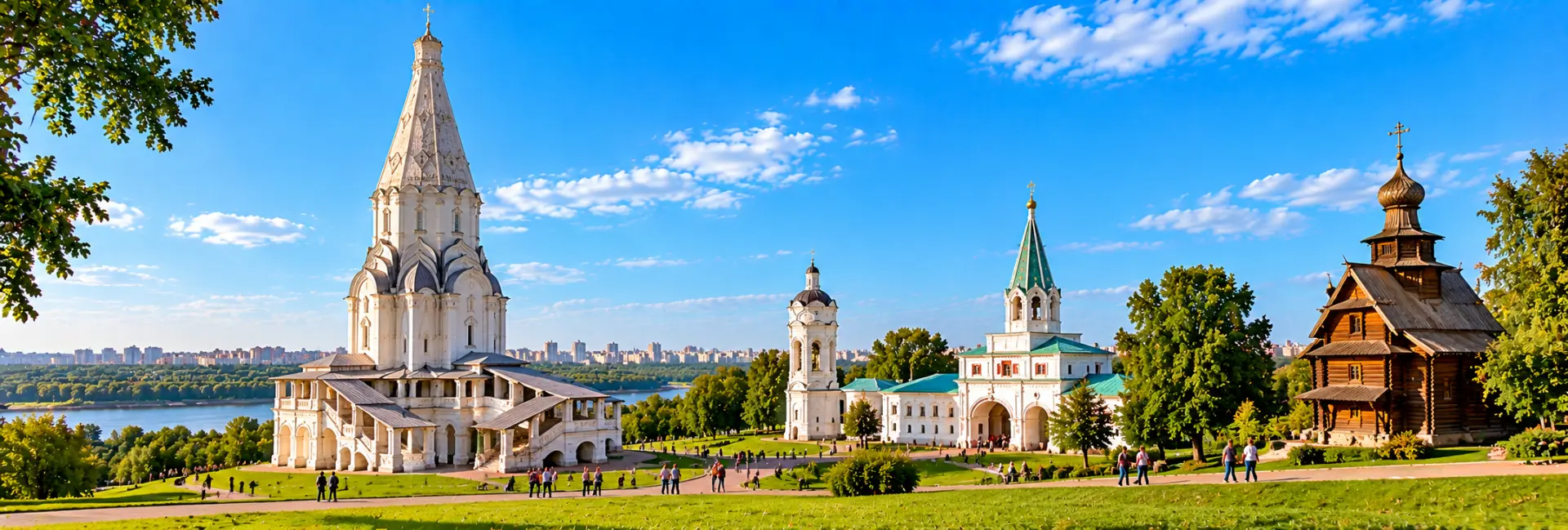
Its best-known landmark is the white, tent-roofed Church of the Ascension, a masterpiece of sixteenth-century Russian architecture and a UNESCO World Heritage Site. Around it, rolling hills, old oaks and apple orchards give the whole place the feel of a countryside escape within the city limits.
Because the park is free to enter and the scenery changes with every season, Kolomenskoye is popular with locals and visitors alike. It works equally well for a short riverside walk, a full day of museums and history, or a relaxed family picnic.
History
A Princely Village
The area has been settled since ancient times, and the village of Kolomenskoye is first recorded in the fourteenth century in the will of Grand Prince Ivan Kalita. Over the following generations it became a favourite summer residence for the rulers of Moscow, thanks to its fresh air, river views and good hunting and farming land.
The Age of the Tsars
In the sixteenth century Vasily III and later his son Ivan the Terrible enjoyed the estate and built here, and in the 1600s Tsar Alexei Mikhailovich turned it into one of the grandest wooden palace complexes in the country. In 1662 the estate became the scene of the Copper Riot, a popular uprising over debased coinage and rising prices, when angry crowds marched here to confront the tsar.
Decline and Museum Status
Interest in the estate faded as the capital moved to St Petersburg, and Catherine the Great ordered the decaying wooden palace to be dismantled in the late 1760s. The church survived, however, along with other historic buildings, and in the early Soviet period the area became a museum devoted to preserving architectural monuments. The architect and restorer Pyotr Baranovsky, its first director, shaped the idea of an open-air museum of wooden architecture, and the estate has since grown into one of Moscow's major heritage sites.
Church of the Ascension & UNESCO Status
The Church of the Ascension was consecrated on 3 September 1532, built on the orders of Vasily III to celebrate the long-awaited birth of his heir, the future Ivan the Terrible. It is widely seen as the first stone church in Russia to use a tent roof, a pointed, tower-like form borrowed from wooden architecture.
Rising about 62 metres, the church stands on a cross-shaped base and soars upward in an octagonal body topped with a slender tent and a small dome. Unusually, there are no supporting pillars inside, which adds to the impression of height. Its influence spread across Russia, and the tent-roof style remained popular for more than a century.
Recognition
UNESCO added the church to the World Heritage List in 1994, recognising it as an innovative step in Russian Orthodox church design. It is one of only a few Moscow monuments to hold this status.
A Second Church Nearby
Across a ravine stands the five-tented Church of St John the Baptist in Dyakovo, thought to date from the middle of the sixteenth century. It is often described as a stage between the Ascension church and the famous St Basil's Cathedral on Red Square, making the pair especially interesting for architecture lovers.
Palace of Tsar Alexei Mikhailovich
The original wooden palace of Alexei Mikhailovich, built in the 1660s and 1670s, was so elaborate that it was called the eighth wonder of the world. It was a cluster of interconnected buildings with some 270 rooms, 3,000 windows and dozens of towers, covered in brightly painted carving.
By the eighteenth century the palace had fallen into disrepair, and it was taken apart in the late 1760s, though detailed plans and models survived. In 2010 a reconstruction was opened on a new site within the park, built according to old drawings and images.
What You Can See
The rebuilt palace houses a historical museum, with rooms decorated in the colourful style of the seventeenth century and displays of royal life, craftsmanship and court ceremony. Costumes are available in some seasons for visitors who want photographs in the style of the tsar's court. It is one of the park's most popular indoor attractions, and a good rainy-day choice.
Related Buildings
Near the old royal core you will also find the tent-roofed Saviour Gate, the Kazan Church and the restored Sytny Dvor, a seventeenth-century service building that now hosts exhibitions. Together they give a sense of how the royal precinct was once laid out.
Wooden Architecture & Historic Estates
One of Kolomenskoye's special features is its collection of wooden structures brought here from all over Russia. This open-air approach began in the 1920s and continues to give the estate a distinctive atmosphere.
- House of Peter the Great: a modest log cabin where Peter lived while overseeing shipbuilding in Arkhangelsk, later moved to Kolomenskoye and surrounded by recreated orchards.
- Bratsk Stockade Tower: a defensive tower from a Siberian fort, a reminder of Russia's eastward expansion.
- Nikolo-Korelsky Monastery Gate Tower: a wooden gate from a monastery on the White Sea coast.
- Meadery from Preobrazhenskoye: a rural building recalling traditional honey drinks and village life.
- Peasant and Blacksmith Farmsteads: recreated rural homesteads that show how local people lived and worked.
- Beekeeper's Farm: an exhibition about honey and beekeeping, often with tastings.
Orchards, Gardens & Riverside Park
The Apple Orchards
Kolomenskoye's orchards grow on the site of the tsars' own gardens and are among the park's best-loved features. In spring they burst into blossom, and in late summer and autumn the trees are heavy with fruit. Art installations in some orchards add a modern touch.
Meadows, Ravines and Riverbank
Beyond the orchards the estate unfolds into open meadows, wooded ravines and old oak groves, with paths that lead down toward the river. The elevated position gives fine views across the Moskva, and the low slopes are popular for sledding in winter.
A Park for Everyone
Locals use the grounds for jogging, cycling, picnics and family outings, and seasonal festivals fill the lawns with music, crafts and food stalls. The sheer size of the park means you can find a quiet spot even on busy days.
Ways to Experience It
Walk the Royal Core
Begin at the Church of the Ascension and the old gates, then continue to the palace, the Sytny Dvor and the exhibition buildings. This route covers the most important historic sights in a couple of hours.
Explore the Museums
The estate runs a number of permanent exhibitions, including displays on local history, seventeenth-century art, falconry, honey and rural life. Pick two or three that suit your interests rather than trying to see them all.
Go Beyond the Sights
Take a slow stroll through the orchards, picnic on a hillside, or join one of the seasonal festivals and guided tours. In warm months you may find boat trips on the river and, as a tourist novelty, horse-drawn rides in the park.
Best Time to Visit
By Season
Spring is excellent for apple blossom, and late summer brings green meadows and long days for picnics. Autumn paints the old trees in gold and red, making it ideal for photographs of the white church. Winter transforms the estate into a snowy landscape, with sledding and a quiet, almost fairy-tale mood, although it can be bitterly cold.
By Time of Day
Mornings are peaceful and good for the church and riverside views. Late afternoon light gives the white stone a warm glow, and weekends are noticeably busier than weekdays, especially around the main museums.
Visitor Tips
- Getting there: the nearest metro stations are Kolomenskaya and Kashirskaya, each a walk of several hundred metres to different park entrances. Choose the entrance based on where you want to begin.
- Cost: the park is free, but individual museums and exhibitions charge admission. Check official sources for current prices and hours.
- Opening times: museum buildings usually close one day a week and keep shorter hours than the park, so confirm before your visit.
- Time needed: allow at least two to three hours for the main historic area, and a full day if you want to see several museums and wander the orchards.
- Comfort: bring comfortable shoes, as the grounds are hilly and distances between sights are long, and carry water in summer.
- Church etiquette: the Church of the Ascension is both a museum and a consecrated temple, so dress modestly and behave respectfully inside.
- Before you travel: entry rules and government travel advice for Russia can change, so check the latest requirements for your nationality well in advance.
Nearby Attractions
Kolomenskoye sits in the south of Moscow, so it pairs naturally with other estates and historic sites in the same part of the city. Tsaritsyno, Catherine the Great's pseudo-Gothic palace and park, makes a good second stop for another day or a long afternoon, offering a very different architectural style and a large fountain.
Closer to the centre, the Donskoy Monastery is a fortified religious complex founded in the late sixteenth century and is easy to reach by metro. For something more relaxed, the Moskva River embankment near the park provides open views and quiet walking routes.
FAQs about visiting Kolomenskoye
What is Kolomenskoye famous for? +
It is known for the white, tent-roofed Church of the Ascension, a UNESCO World Heritage Site, along with a rebuilt wooden palace, historic orchards and a collection of wooden buildings from across Russia.
Is Kolomenskoye free to enter? +
Yes, the park itself is free. Museums and some exhibitions inside it require tickets.
How long should I spend there? +
Plan on two to three hours for the main historic area. A full day is better if you want to visit several museums and explore the orchards and riverside.
How do I get to Kolomenskoye by metro? +
Take the metro to Kolomenskaya or Kashirskaya station and walk to the nearest park entrance. The park is large, so entrances are some distance apart.
Can I go inside the Church of the Ascension? +
The church is open as a museum and is also a consecrated temple, so access can depend on the day and any services. Check the current schedule before you visit.
Is Kolomenskoye good for children? +
Yes. Open lawns, orchards, animals and costumes at some events, seasonal festivals and winter sledding make it a favourite for families.
What is the best season to visit? +
Spring for apple blossom and autumn for golden foliage are especially beautiful, though summer picnics and snowy winter walks have their own appeal.
