
Table of Contents
Overview
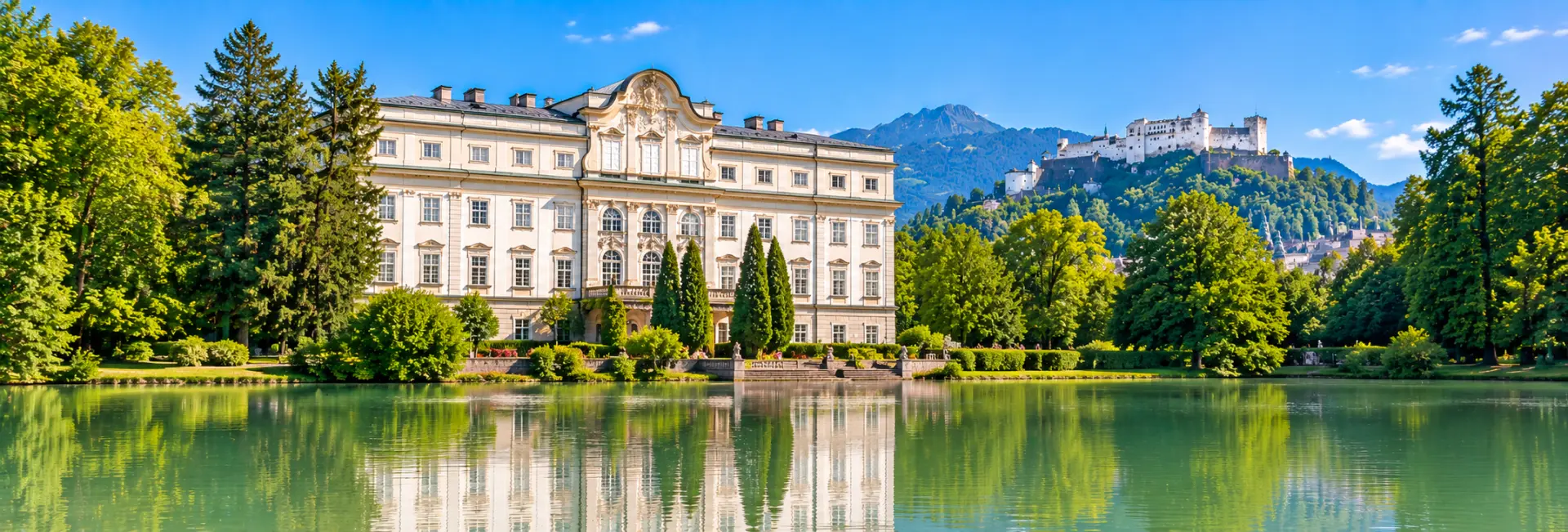
Schloss Leopoldskron is an eighteenth-century rococo palace on the southern edge of Salzburg, mirrored in the still water of the Leopoldskroner Weiher. Its long pale facade, backed by the Alps and the Hohensalzburg Fortress on the skyline, is among the best-known views in the city.
The building has led several lives. It began as a summer residence for a prince-archbishop, became a stage for the theatre director Max Reinhardt, was seized under Nazi rule, and since the late 1940s has been the home of an international non-profit forum, the Salzburg Global Seminar. Part of it now operates as a hotel. Many visitors also know it as the lakeside setting of The Sound of Music.
One practical point shapes any visit. The palace and its park are private, open only to hotel guests and invited visitors. You can still enjoy the setting very well from the public path around the lake, which is how most people see it.
History
The Archbishop's Summer Residence
Construction began in 1736 for Leopold Anton von Firmian, the prince-archbishop of Salzburg, who named the estate after himself. Work continued into about 1740, and Firmian died in 1744. His fortune had grown in part through the expulsion of more than 22,000 Protestants from the archbishopric, since the property they left behind was acquired by the church authorities. His heart is buried in the palace chapel, while the rest of his body lies in Salzburg Cathedral.
Decline and Reinvention
The estate stayed with the Firmian family until 1837. After that it passed through a series of owners, including a banker and two waiters who hoped to turn it into a hotel, and it slipped into poor repair. When Max Reinhardt bought it in 1918, the building badly needed saving.
The Reinhardt Years
Reinhardt spent roughly twenty years restoring the palace and filling it with theatre, music and guests. He turned its rooms into stages for his productions and hosted lively social gatherings. Alongside Hugo von Hofmannsthal and Richard Strauss, he used the house as a base for planning the Salzburg Festival.
Confiscation and Return
In 1938 the Nazi regime confiscated the palace as Jewish property, and Reinhardt, who had fled Austria, died in the United States in 1943. After the war the building was returned to his heirs. Stumbling stones near the entrance now commemorate Reinhardt and another person connected to the house.
The Salzburg Global Years
In 1946 Reinhardt's widow, the actress Helene Thimig, offered the palace to Clemens Heller and his fellow Harvard students, who founded the Salzburg Seminar in American Studies. The group first rented the building in 1947 and bought it in 1959, adding the neighbouring Meierhof farm buildings in 1973. Since 2014 the palace and Meierhof have run as Hotel Schloss Leopoldskron, with the income supporting the foundation's work.
Architecture & Notable Rooms
The palace follows the baroque and rococo taste of its period. Its facade is long and stately, with thirteen window bays across four storeys and a slightly projecting central section topped by a curved gable. The stucco ornament, including the Firmian coat of arms and the Salzburg lion, is the work of Johann Kleber.
The Library
Reinhardt created a library inspired by the famous library at St Gall in Switzerland. It is among the most atmospheric rooms in the house and remains a working space for seminars today.
The Venetian Room and Mirror Room
Two of the most celebrated interiors are the Venetian Room and the Mirror Room. The Venetian Room, a festive reception space, inspired the ballroom set in the film. The Mirror Room multiplies light and reflections across its walls, and is frequently singled out as the most striking space in the palace.
Chapel and Garden Theatre
- The chapel, which holds the heart of the founding archbishop
- A garden theatre added by Reinhardt, which fits his belief that the grounds should be as theatrical as the rooms
- Statuary installed in the 1920s, which has been restored in recent years with government support
The Lake & Grounds
The Leopoldskroner Weiher is a pond of about thirteen hectares, roughly 650 metres long and 220 metres wide. It was created around 1500 as a holding basin for water from the Almkanal, long before the palace existed, and it later became part of the palace gardens. Today the water and shoreline are protected for both heritage and landscape reasons.
The palace park covers about seven hectares and runs down to the lake. Beyond the private gardens, a public path circles the whole water, and this is where visitors get their views.
Walking the Lake
The loop is about 3.3 kilometres and takes about 45 minutes at an easy pace on level, well-kept paths. From different points on the shore you see the palace, the Hohensalzburg Fortress and the Gaisberg in changing combinations, and a small playground gives families a place to pause.
Wildlife
The water supports plenty of birdlife, including ducks, swans, grey geese and grebes, along with fish and frogs. Early in the day the shore is quiet enough to watch them without much disturbance.
Cultural Significance
A Cradle of the Salzburg Festival
The palace is often called the birthplace of the Salzburg Festival, because Reinhardt, Hofmannsthal and Strauss shaped their plans for reviving Salzburg's music and theatre tradition here. The festival itself began in 1920 and has since become one of the great summer arts events in Europe.
A Postwar Meeting Place
The Salzburg Seminar was created to bring together young people from countries that had been enemies in the Second World War, at a time when American forces still occupied parts of Austria and Germany. It was sometimes described as a Marshall Plan of the mind. Over the decades it grew from short workshops into a forum on global issues such as health, climate and the role of the arts in society.
A Living Venue
The house has stayed active in the cultural life of the city. It has hosted seminars, weddings and celebrated events, including a fashion show by Karl Lagerfeld in the Venetian Room in December 2014. Open-air Shakespeare performances in the park continue in the spirit of Reinhardt's era.
The Sound of Music Connection
What Was Filmed Here
The 1965 film used Leopoldskron and its lakefront for several memorable moments. The exterior of the palace stood in for the von Trapp family villa, and the terrace and lake appear in scenes where the family drinks lemonade, Maria and the Captain argue by the water, and the children's boat tips into the lake. Some terraces seen on screen were built as replicas, complete with copies of the palace's horse-statue gates.
What Was Not
Most of the villa interiors were recreated on a studio set rather than filmed inside the palace. The Venetian Room did serve as inspiration for the ballroom. It is also worth knowing that the real von Trapp family never lived here. They lived in a more modest home elsewhere in Salzburg, so the link is cinematic rather than historical.
That said, the view is the same one that drew the film crew, and fans find it just as satisfying today, particularly on a calm day when the palace reflects in the water.
Ways to Experience It
- Walk the lake path for the classic view of the palace, with the fortress and mountains behind it
- Join a Sound of Music tour, which usually includes a stop at a lakeside viewpoint and commentary on the film locations
- Cycle from the city, which is an easy ride of a few kilometres
- Stay at the hotel, which gives guests access to the palace rooms, the library and the chapel
- Attend a seminar, event or special occasion, which is the other route inside the grounds
There is no general ticket for walk-in tours of the palace or park, so plan around the view from outside unless you are a guest or have an invitation.
Best Time to Visit
Season
Summer shows the palace at its closest to how it looks in the film, with full green foliage and warm light on the water. Spring is a lovely second choice, with fresh leaves and mild weather for the lake walk. Autumn brings gold along the shoreline and thinner crowds, while winter is quiet and crisp.
Time of Day
Early morning is best for calm water and clear reflections, and for photographing the facade without people in the frame. Late afternoon gives warmer light, but tour groups can crowd the main viewpoints around midday.
Visitor Tips
- Do not enter the park or grounds uninvited, as access is limited to guests and customers of the house
- Bring comfortable shoes for the lake path, which is flat and easy but can be damp after rain
- Check the official hotel site if you hope to visit the Meierhof cafe, since its public access can vary
- Reach the site by bus or bicycle, as parking in the area is limited
- Allow about an hour if you want to walk the full loop and take photographs
- Respect the nature protection around the water and keep a distance from nesting birds
Nearby Attractions
The palace sits a few kilometres south of the Old Town, so it combines well with other Salzburg sights.
- Mönchsberg: the wooded hill just to the north, with walking paths and city viewpoints
- Hohensalzburg Fortress: visible from the lake and reachable by funicular from the Old Town
- Nonnberg Abbey: the Benedictine convent linked to the real Maria von Trapp
- Mirabell Gardens: another Sound of Music location, close to the centre
- Hellbrunn Palace: a playful Baroque summer residence to the south, with trick fountains and the famous gazebo
- Almkanal: the historic canal that feeds the lake, good for a quiet walk
FAQs about visiting Schloss Leopoldskron
Can I go inside Schloss Leopoldskron? +
Generally not. The palace and park are private and open only to hotel guests and people attending events. Visitors without a booking can see the palace from the public lake path.
Is Schloss Leopoldskron free to see? +
Yes, if you view it from the public path around the Leopoldskroner Weiher. There is no general entry ticket for the palace or its gardens.
Was The Sound of Music filmed at Schloss Leopoldskron? +
Yes. The palace exterior, terrace and lake appear in several scenes, including the capsizing boat. Many interiors were built on a studio set instead.
Did the real von Trapp family live here? +
No. The family lived in a more modest home in Salzburg, so the palace is linked to the film rather than to their real history.
How far is it from the city centre? +
It lies a few kilometres south of the Old Town, an easy bike ride or a short bus trip away.
How long does the lake walk take? +
The loop around the water is about 3.3 kilometres and takes roughly 45 minutes at an easy pace.
Can I stay at the palace? +
Yes. Part of the complex operates as Hotel Schloss Leopoldskron, with rooms in the palace and the Meierhof building. Hotel guests can use the library and the chapel.
Is the lake path accessible? +
The path is flat and in good condition, so it suits most visitors, including families with strollers. Surfaces can be soft after heavy rain.
