
Table of Contents
Overview
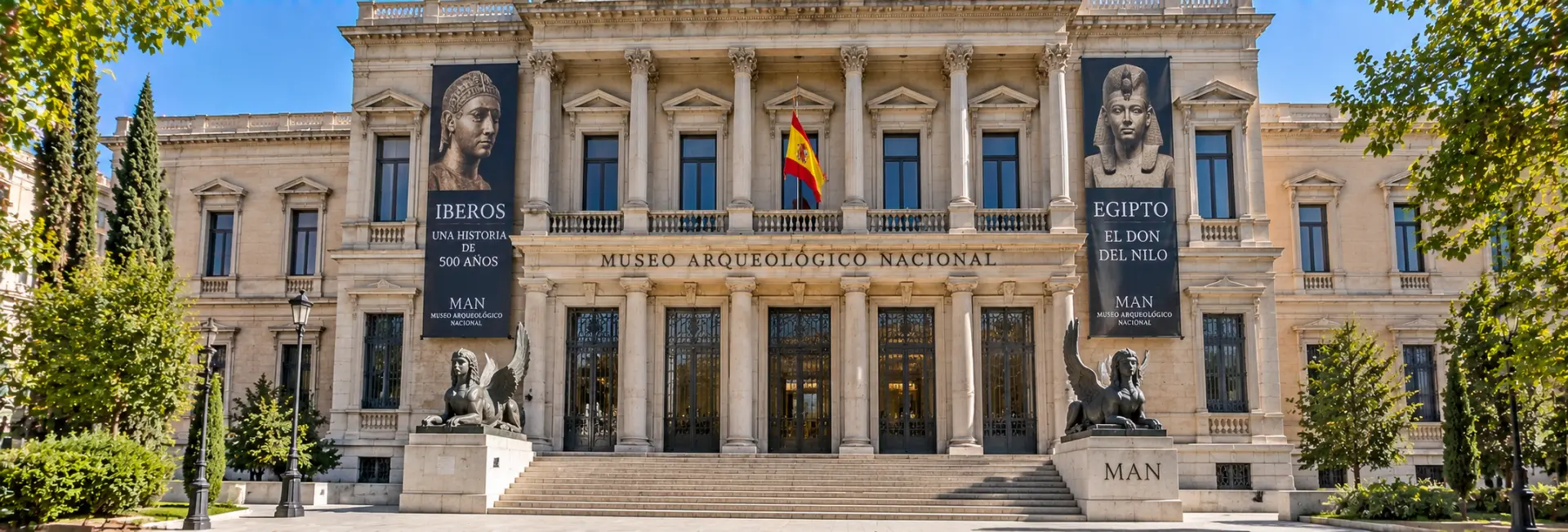
If the Prado and the Reina Sofía cover Spain's art, the National Archaeological Museum covers pretty much everything that came before it. Tucked into the same grand 19th-century building as the National Library, right beside Plaza de Colón in the upscale Salamanca district, it walks visitors through thousands of years of history using actual objects pulled from Spanish soil, rather than paintings about the past.
The star of the collection is the Lady of Elche, a striking limestone bust of an Iberian woman that's become one of the most recognizable faces in Spanish archaeology. But there's a lot more packed into this building, from Roman mosaics and Visigothic crowns to a full-scale replica of the Altamira cave paintings, all laid out in a museum that got a complete overhaul in the 2010s and now feels a lot more modern than its stately exterior suggests.
History
Founded by a Queen
Queen Isabella II established the museum by royal decree in 1867, intending it to gather together the archaeological, numismatic, and decorative art collections that had been scattered across various royal holdings. It was meant to give Spain's own past, and a fair amount of material from further afield, a proper home in one place.
Settling Into Its Current Building
The museum didn't start out in its current location. It first opened in Madrid's Embajadores district before moving in 1895 into the neoclassical building it still occupies today, purpose-built by architect Francisco Jareño between 1866 and 1892. Extension work in 1968 added considerably more exhibition space, since the growing collection had started outgrowing the original layout.
A Six-Year Renovation
By the 2000s, the museum needed more than a facelift. It closed its doors in 2008 for a complete renovation, and Spain's Ministry of Culture ended up spending around 65 million euros reworking the building's interior and rethinking how the collection was displayed. When it reopened in 2014, visitor numbers climbed dramatically, nearly tripling compared to before the closure, a sign the new approach to presenting the collection had struck a chord.
Architecture & Design
The building itself is a solid piece of 19th-century neoclassical architecture, sharing its grand facade and much of its floor space with the National Library of Spain next door. That shared history shows in the scale of the place, wide staircases, tall ceilings, and a layout clearly built for an era when museums were meant to feel imposing.
The 2008 to 2014 renovation didn't touch that historic character so much as work around it. Architects covered several of the building's old inner courtyards and turned them into new exhibition halls, complete with stairwell towers that let large objects be viewed from multiple angles rather than just head-on. The result is a museum that still looks and feels 19th-century from the outside, but functions like a thoroughly modern exhibition space once you're inside.
- Roughly 30,000 square meters of total floor space
- About 13,000 objects on permanent display
- Covered inner courtyards converted into exhibition halls during the renovation
- Shares its building with the National Library of Spain
- Collection organized chronologically, from prehistory through the 19th century
Cultural Significance & Traditions
The Lady of Elche
No single object defines this museum quite like the Lady of Elche does. Discovered by a farm worker in 1897 near the town of Elche, this limestone bust of an Iberian woman, likely carved in the 4th or 5th century BC, has become something close to a national icon, standing in for Spain's pre-Roman past the way a handful of paintings stand in for its later art history.
A Cross-Section of Spanish History
Because the collection spans so many periods, walking through the museum doubles as a crash course in who has passed through Spain over the centuries: Iberian sculptors, Roman settlers, Visigothic kings, and the Islamic dynasties that ruled much of the peninsula for hundreds of years. Pieces like the Visigothic votive crowns and Islamic ivories fill in chapters of Spanish history that don't get much space in the country's more famous art museums along the nearby Art Walk.
A Cave You Can Visit Without Leaving Madrid
One of the more unusual pieces in the museum is a full-scale replica of the Altamira cave and its Stone Age paintings, built because the original cave in Cantabria is far too fragile for regular visitors. It's a clever workaround that lets people see, up close, artwork that's tens of thousands of years old without putting the real thing at risk.
What to See There
With around 13,000 objects on display, it helps to know what to prioritize on a first visit.
- The Lady of Elche, the museum's signature piece and a highlight of the Iberian sculpture galleries
- The replica of the Altamira cave, tucked into the lower level
- The Treasure of Guarrazar, a set of Visigothic votive crowns
- The Mausoleum of Pozo Moro, a striking piece of Iberian funerary architecture
- The museum's Roman mosaics and sculpture, including the Statue of Livia
- Islamic-era ivories and ceramics from the medieval period
The galleries are arranged in roughly chronological order, so working through the museum floor by floor gives a natural sense of how Spain's history unfolds, from prehistoric tools all the way up to 19th-century artifacts.
Ways to Experience It
Given the size of the collection, it's worth deciding ahead of time how deep you want to go.
- Join the English-language guided tour, offered on Saturday mornings and included in the price of admission
- Focus on the ground floor's Iberian and prehistoric collections if you're short on time, since that's where most of the museum's best-known pieces live
- Use the informative panels and touchable replicas scattered throughout, added during the renovation specifically to make the material more approachable
- Set aside extra time for the Altamira cave replica, which tends to be a highlight even for visitors who aren't especially into archaeology
Because the museum sits close to the Prado, Thyssen-Bornemisza, and Reina Sofía, it also works well as a change of pace partway through a longer museum day in this part of Madrid.
Best Time to Visit
Weekday mornings tend to be the quietest time to visit, especially right after opening, before tour groups and school visits pick up later in the day. The museum keeps shorter hours on Sundays and holidays, closing by mid-afternoon, so plan accordingly if that's the day you have available.
Admission is free on Saturday afternoons after 2pm and on Sunday mornings, which makes those windows appealing for budget-conscious visitors, though they also tend to be considerably busier as a result. If a quieter visit matters more to you than saving on the ticket price, a weekday visit is generally the better bet.
Visitor Tips
- The museum is closed on Mondays, so plan around that if you're mapping out a Madrid itinerary
- Regular hours run 9:30am to 8pm Tuesday through Saturday, and 9:30am to 3pm on Sundays and holidays
- Entry is free on Saturday afternoons after 2pm and all day Sunday morning, otherwise there's a modest admission fee
- The nearest metro stops are Serrano and Colón, both a short walk from the entrance
- English-language guided tours run on Saturdays at 10am, last around 90 minutes, and are included with your ticket, though group sizes are limited so it's worth arriving early to sign up
Nearby Attractions
Sitting in the Salamanca district near Plaza de Colón, the museum is within easy reach of several other central Madrid sights.
- Plaza de Colón, directly next to the museum
- Retiro Park, a short walk south
- Paseo de Recoletos, lined with cafes and mansions, just beyond the plaza
- Prado Museum, reachable on foot along the Art Walk
- Salamanca shopping district, known for its upscale boutiques
FAQs about visiting the National Archaeological Museum
What is the National Archaeological Museum known for? +
It's best known for the Lady of Elche, a famous Iberian limestone bust, along with its wide-ranging collection covering Spanish history from prehistory through the 19th century.
How old is the museum? +
It was founded in 1867 by Queen Isabella II, though it's been in its current building since 1895.
Is the museum free to visit? +
Entry is free on Saturday afternoons after 2pm and on Sunday mornings. Outside those windows, there's a standard admission fee.
How long should I plan for a visit? +
Most visitors spend two to three hours here, though history enthusiasts could easily spend longer given the size of the collection.
What days is it closed? +
The museum is closed on Mondays, along with a handful of public holidays.
How do I get there? +
The Serrano and Colón metro stops are both within walking distance of the entrance on Calle de Serrano.
Is there an English-language tour available? +
Yes, guided tours in English run on Saturdays at 10am, last about 90 minutes, and are included in the ticket price.
What's the Altamira cave replica, and why is it a replica? +
It's a full-scale reproduction of a Stone Age cave in Cantabria famous for its ancient paintings. The original cave is closed to most visitors to protect the fragile artwork, so the replica lets people see it up close without the risk.
Is the museum suitable for visitors who aren't into archaeology specifically? +
Yes. The 2014 renovation added interactive panels, touchable replicas, and clearer context throughout, which makes the collection more approachable even for casual visitors.
Can I combine this with other Madrid museums in one day? +
It's doable, since the museum sits close to the Prado, Thyssen-Bornemisza, and Reina Sofía, though given its size it works better as its own dedicated stop or paired with just one other museum.
