
Table of Contents
Overview
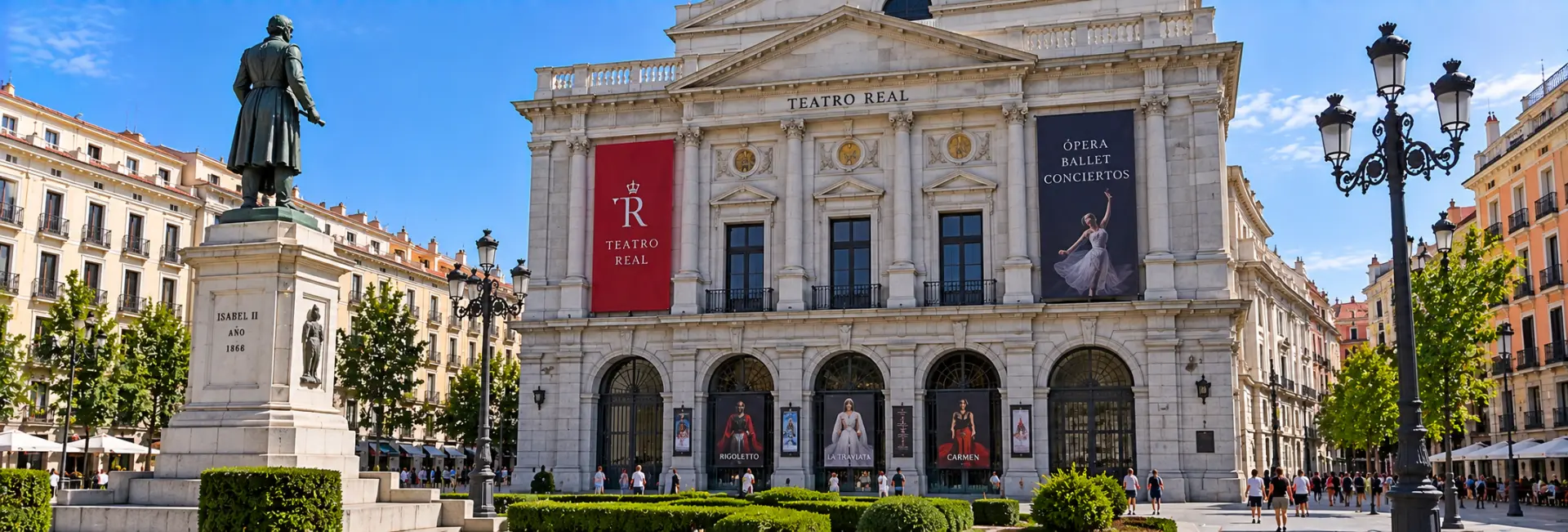
Facing the Royal Palace across the curve of Plaza de Oriente, the Teatro Real is Madrid's grand opera house and one of the most storied stages in Europe. Its history reads almost like an opera plot in itself: an ambitious 19th-century construction that took over three decades to finish, decades of glittering premieres, a sudden collapse into structural danger, a 41-year closure, and finally a triumphant return as one of the continent's leading opera venues. Few working theatres anywhere can claim quite so dramatic a backstory before the curtain has even risen on a single performance.
Known locally simply as "El Real," the theatre today hosts opera, ballet, and symphonic concerts on a stage built for spectacle, backed by some of the most advanced stage machinery in Europe. Visitors can experience it either by attending a live performance or by taking one of several guided tours that reveal the building's ornate salons, historic auditorium, and behind-the-scenes workings even without a ticket to a show, making it a rewarding stop regardless of what's playing that week.
History
An Earlier Theatre on the Same Ground
The site has hosted a theatre since long before the current building existed. In 1738, under King Philip V, the Real Teatro de los Caños del Peral opened on this same spot, taking its name from a public laundry facility that had stood nearby as part of Madrid's old water system. That earlier theatre had its own place in Spanish history: it was where the Cortes de Cádiz, the assembly that drafted Spain's first constitution, held some of its sessions in 1814.
A Long and Difficult Construction
King Ferdinand VII, wanting Madrid to have an opera house that could rival those of other European capitals, ordered a redesign of Plaza de Oriente in 1817 that included a grand new theatre on the site. Construction began in 1818 under architect Antonio López Aguado, but chronic funding shortages stretched the project out for more than three decades; López Aguado died before it was finished, and the work was completed by Custodio Teodoro Moreno and Francisco Cabezuelo. The Teatro Real finally opened in 1850, under Queen Isabella II, with a performance of Donizetti's opera La Favorita.
Early Glory and a Long Closure
For roughly its first seventy-five years, the Teatro Real ranked among the most important opera houses in Europe, drawing major figures of the era, including a visit from composer Giuseppe Verdi in 1863 for the Spanish premiere of his opera La forza del destino. The legendary Ballets Russes also performed on this stage in 1925, with dancer Vaslav Nijinsky and composer Igor Stravinsky both in attendance, a sign of just how central the theatre was to European performing arts at the time. A fire damaged the building in 1867, and its fortunes worsened considerably in 1925, when construction work on Madrid's new metro line caused subsidence beneath the theatre, forcing its closure over structural safety concerns. The building sat closed for 41 years, a period that included further damage during the Spanish Civil War, when it was used as a weapons depot.
From Concert Hall Back to Opera House
The theatre reopened in 1966, but only as a symphonic concert hall rather than a full opera venue, a role it filled for the following decades. It wasn't until 1991 that a major renovation began with the specific goal of restoring it as a working opera house, a project that took six years to complete. The Teatro Real reopened in its current form on 11 October 1997, in the presence of King Juan Carlos and Queen Sofía, with a program dedicated to composer Manuel de Falla, and a week later hosted the world premiere of a contemporary opera, signaling its intent to serve both classic and new repertoire going forward.
Architecture & Building
The Teatro Real occupies an irregular hexagonal footprint, a shape dictated by the awkward plot it was given at the edge of Plaza de Oriente. Its neoclassical facade, facing the square and the Royal Palace beyond it, gives little hint of the building's dramatic interior volumes, which include a stage house tall and deep enough to rank among the largest in Europe.
A Rebuilt Stage for the Modern Era
Behind the historic facade, the 1990s renovation installed one of the most technically advanced stage systems on the continent, built around a stacked platform mechanism that lets multiple sets be assembled at once and swapped between scenes with unusual speed. The main stage runs around 30 meters deep and can be extended further using additional stage areas reaching toward the building's outer walls when a production calls for it.
Preserving the Historic Character
Even with its modern technical core, the renovation was careful to preserve the theatre's 19th-century character wherever possible, particularly in the main auditorium, whose classic horseshoe shape and historic decoration were restored rather than replaced. The result is a building that functions as a fully modern opera house while still looking and feeling like the 19th-century theatre that first opened here in 1850.
Inside the Theatre
The main auditorium follows the traditional horseshoe shape found in grand European opera houses, seating close to two thousand people across its stalls and tiers of boxes, including a royal box positioned for the best possible view of the stage. The scale only becomes fully apparent once inside, since the exterior gives little sense of just how large the hall really is.
- The horseshoe-shaped main auditorium, with tiered boxes and a dedicated royal box
- Historic second-floor salons that recreate the atmosphere of the theatre's 19th-century social life, some displaying artwork from Spain's national collections
- A former ballroom, now used as a function space, with a striking ceiling of tiny lights arranged to represent the night sky over Madrid on the theatre's original 1850 opening night
- An advanced backstage and stage-machinery area, visible on select guided tours
Performances & Programming
Opera remains the heart of the Teatro Real's programming, but its season also includes ballet, symphonic concerts, and recitals, drawing major international singers, dancers, and conductors throughout the year. A recurring late-night series known as Las noches del Real offers a more informal, lower-priced way to catch shorter performances, while a dedicated pedagogical program introduces children and young audiences to opera through specially designed activities.
Beyond its regular season, the theatre has also hosted major national and international events over the years, including the Eurovision Song Contest in 1969, film-industry award ceremonies, and, since 2012, Spain's televised Christmas lottery draw, each using the historic hall as a dramatic backdrop.
Ways to Experience It
The most complete way to experience the Teatro Real is to attend a live performance, when the theatre's acoustics, lighting, and atmosphere all come together in a way that's hard to replicate on a daytime tour alone. For visitors who can't catch a show, though, the theatre offers several types of guided visits that don't require a performance ticket.
- General tour: covers the theatre's history and main public spaces, offered in multiple languages throughout the day
- Artistic tour: focuses on the creative and performance side of the venue
- Technical tour: goes behind the scenes to explain the stage machinery and production process
- Nocturnal tour: runs after evening performances for a different perspective on the building
- Young tour: designed specifically for children and families
Self-guided visits with an audio guide are also available in several languages for those who prefer to explore at their own pace.
Best Time to Visit
For a guided daytime visit, mornings tend to be calmer than the early afternoon, when tour groups and independent visitors overlap. General tours run at regular intervals through midday, so arriving close to opening gives the best chance of a smaller group.
For attending a performance, the opera and ballet season runs through most of the year with a lighter schedule in the height of summer, so checking the current season's calendar ahead of a trip is worthwhile if seeing a specific production matters. Popular shows and premieres tend to sell out well in advance, so booking early is the safest approach for anyone hoping to combine a Madrid visit with a night at the opera.
Visitor Tips
- Guided tours do not include access to the stage itself, which remains a working area reserved for performers and staff
- Ticket prices for performances vary widely depending on the seat and production, so it's worth comparing options if budget is a concern
- Reduced-price guided tours are available for seniors, students, and large families, with free entry for young children
- The nearest metro station is Ópera, served by multiple lines, just steps from the theatre's entrance
- Formal performances tend to draw a slightly dressed-up crowd, though there is no strict dress code enforced at the door
Nearby Attractions
- Royal Palace of Madrid, directly across Plaza de Oriente from the theatre
- Almudena Cathedral, a short walk beyond the palace
- Sabatini Gardens, a landscaped garden along the palace's northern side
- Plaza Mayor, Madrid's historic main square, a short walk to the southeast
- Mercado de San Miguel, a popular covered food market close to Plaza Mayor
FAQs about visiting the Teatro Real
What is the Teatro Real known for? +
It's Madrid's principal opera house, known for its dramatic history of closures and rebuilding, its horseshoe-shaped 19th-century auditorium, and its position facing the Royal Palace across Plaza de Oriente.
Why was the Teatro Real closed for so long? +
Structural subsidence linked to nearby Madrid metro construction forced its closure in 1925, and further damage during the Spanish Civil War, combined with a lack of funding for repairs, kept it shut as a theatre for 41 years.
Can you visit the Teatro Real without seeing a performance? +
Yes, the theatre offers several guided tour options, including general, artistic, technical, and family-oriented tours, as well as a self-guided audio tour, all of which run independently of the performance schedule.
How many people can the Teatro Real seat? +
The main auditorium seats close to two thousand people, arranged in the traditional horseshoe shape typical of major European opera houses.
Is the stage included in the guided tours? +
No, the stage and backstage performance areas remain off-limits to tour groups since they're working spaces for performers and crew.
What kind of performances does the Teatro Real host? +
Its main season centers on opera, alongside ballet, symphonic concerts, and recitals, plus a late-night performance series and dedicated programming for younger audiences.
How far in advance should I book tickets for a performance? +
Popular productions and premieres can sell out weeks or months ahead, so booking as early as possible is recommended for anyone hoping to see a specific show during their visit.
