Table of Contents
Overview
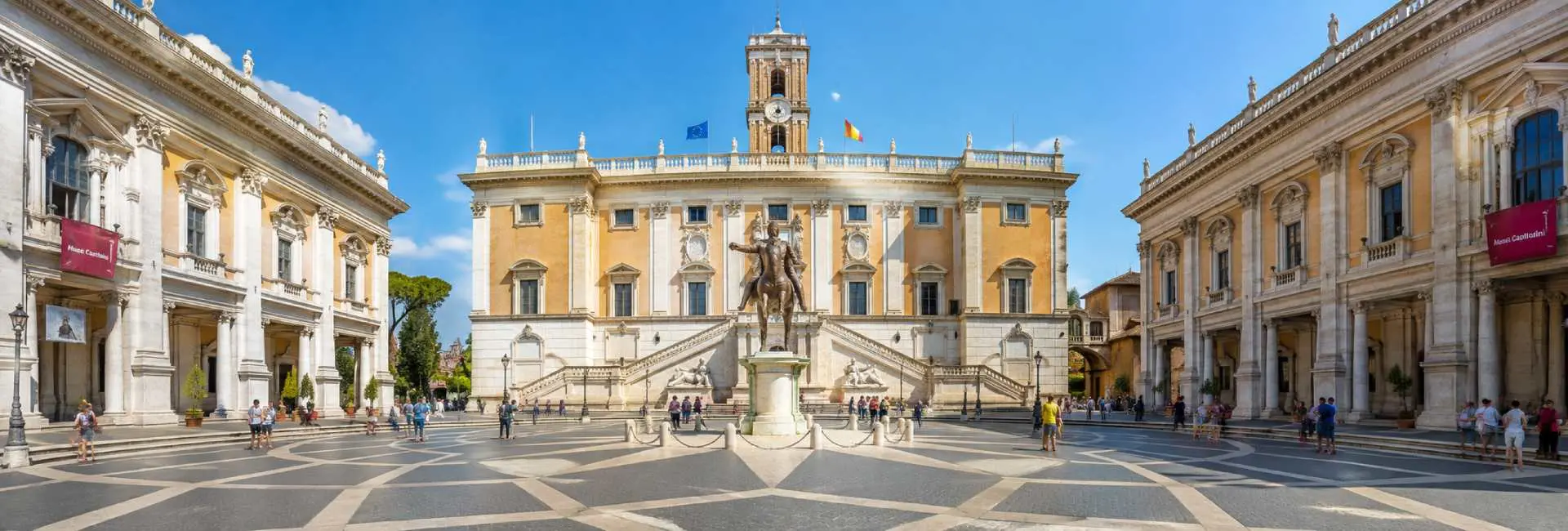
The Capitoline Museums sit atop the Capitoline Hill in the heart of Rome, occupying two Renaissance palaces on the majestic Piazza del Campidoglio. As the city's civic museum, the collection spans more than two thousand years, from Etruscan and Roman antiquities to Renaissance and Baroque paintings and sculpture. Visitors come for icons like the Capitoline She-Wolf and the bronze equestrian statue of Marcus Aurelius, but the setting itself, a piazza designed by Michelangelo with a terrace overlooking the Roman Forum, is just as much a part of the experience.
History
Origins Under Pope Sixtus IV
The museum's story begins in 1471, when Pope Sixtus IV donated a group of ancient bronze statues to the people of Rome, including the Capitoline She-Wolf and the Spinario. Rather than keeping the works within Church property, the pope placed them on public display on the Capitoline Hill, an act often cited as the founding gesture of the world's first public museum collection.
Growth Through the Renaissance
Over the following century, later popes added further donations, including sculptures removed from the Vatican as the Church distanced itself from pagan imagery. In 1536, Pope Paul III commissioned Michelangelo to redesign the neglected hilltop square ahead of a visit from Emperor Charles V, giving the site the monumental civic identity it retains today.
Opening to the Public in 1734
The museums officially opened their doors to visitors in 1734 under Pope Clement XII, following the acquisition of a major private collection that might otherwise have left Rome. This moment is widely regarded as the birth of the modern public museum, a place where art could be viewed by anyone rather than reserved for private owners.
Napoleonic Losses and Later Growth
Like much of Rome's artistic patrimony, the Capitoline collection suffered under Napoleon, when the Treaty of Tolentino sent key works to Paris in 1797. Many pieces were returned after 1815, thanks in part to the efforts of sculptor Antonio Canova. Through the 19th and 20th centuries, further donations and municipal acquisitions continued to expand the collection into what visitors see today.
Recognition & Status
The Capitoline Museums are widely described as the oldest public museum in the world, tracing that status back to their 1734 opening under Clement XII. Owned and operated by the municipality of Rome, they remain the city's principal civic museum, distinct from the Vatican Museums and independently curated. The collection and its Michelangelo-designed setting have made Piazza del Campidoglio one of the most celebrated public squares in the world.
Piazza del Campidoglio & Architecture
Michelangelo's Design
In 1536, Michelangelo drew up plans for the trapezoidal piazza that fronts the museums, orienting it toward St. Peter's Basilica rather than the ancient Roman Forum below. Construction stretched on for well over a century after his death, with later architects following his design closely, including the star-patterned oval pavement, only fully realized in the 20th century.
The Cordonata and Piazza Features
A grand ramped staircase known as the Cordonata leads up to the square, flanked by ancient Egyptian lion statues and, higher up, classical figures of Castor and Pollux. At the center of the piazza stands a copy of the bronze equestrian statue of Marcus Aurelius; the original, one of the few surviving Roman bronze equestrian statues in existence, is preserved inside the museum.
Three Palaces, One Museum
The complex is framed by three buildings: Palazzo Senatorio, Rome's historic city hall, and the twin Palazzo dei Conservatori and Palazzo Nuovo, which together house the museum collections. An underground passage connects the two exhibition palaces beneath the square, allowing visitors to move between them without stepping back outside.
Key Areas of the Museum
Palazzo dei Conservatori
This palace holds the core of the ancient sculpture collection, along with grand ceremonial halls decorated with frescoes depicting early Roman history. It is also where visitors first encounter the fragmented colossal statue of Constantine in the courtyard.
Palazzo Nuovo
Facing the Palazzo dei Conservatori across the piazza, the Palazzo Nuovo houses rows of ancient Roman portrait busts, philosopher statues, and other Greco-Roman antiquities, arranged much as they were when the building first opened to visitors.
Galleria Lapidaria
Linking the two palaces beneath the piazza, this underground gallery displays a collection of ancient inscriptions and epigraphic material, doubling as the connecting route between the museum's two main buildings.
Pinacoteca Capitolina
On the upper floor of the Palazzo dei Conservatori, the picture gallery holds the museum's paintings, with works spanning the 14th to 18th centuries, including pieces by Caravaggio, Titian, Rubens, and van Dyck.
Caffarelli Terrace
Part of the museum complex extends into the neighboring Villa Caffarelli, whose terrace offers one of the best panoramic views over the Roman Forum available anywhere in the city.
Notable Highlights
Ancient Sculpture
- Capitoline She-Wolf – a bronze wolf, with the suckling figures of Romulus and Remus added in the Renaissance, tied to Rome's founding myth
- Equestrian Statue of Marcus Aurelius – the original 2nd-century bronze, one of very few Roman equestrian bronzes to survive intact
- Dying Gaul – a marble copy of a Hellenistic original, portraying a defeated warrior with striking pathos
- Colossus of Constantine – surviving marble fragments (head, hand, and foot) from a monumental seated statue of the emperor
- Capitoline Venus – a marble statue of the goddess, admired since antiquity as a model of idealized beauty
- Spinario – a bronze figure of a boy removing a thorn from his foot, among the collection's oldest pieces
- Marforio – a colossal reclining river god, once one of Rome's famous "talking statues" used for anonymous political satire
Renaissance and Baroque Art
- Bust of Medusa by Gian Lorenzo Bernini – a marble portrait capturing the mythical figure at the moment of her transformation
- Paintings by Caravaggio, including an early depiction of Saint John the Baptist
- Romulus and Remus by Peter Paul Rubens, part of the Pinacoteca's collection of European masters
Ways to Experience It
Most visitors explore the Capitoline Museums independently, following the layout across the two main palaces and the connecting underground gallery. For those who want more context, guided tours and audio guides are widely available and can help make sense of a collection that spans millennia.
- Self-guided visit using the museum's printed or digital floor plan
- Skip-the-line guided tours focused on the collection's major highlights
- Audio guides for an independent but narrated visit
- Combined tickets pairing the museums with temporary exhibitions or with the Centrale Montemartini, the museum's satellite branch
Best Time to Visit
The Capitoline Museums are open year-round and rarely feel as crowded as Rome's largest attractions, making them relatively flexible to plan around. Weekday mornings shortly after opening tend to be the quietest, while weekends and the first Sunday of each month, when many state museums offer free entry, draw larger crowds. Visiting in the late afternoon can also mean cooler temperatures and better light from the Caffarelli Terrace for views over the Forum.
Visitor Tips
- Book tickets online in advance, especially in peak season, to reserve an entry time and skip the ticket-office line
- Set aside two to three hours to see the highlights across both palaces without rushing
- Use the underground Galleria Lapidaria to move between the Palazzo dei Conservatori and Palazzo Nuovo without leaving the building
- Don't confuse the Capitoline Museums with the Vatican Museums; they are separate institutions on opposite sides of the city
- Check for reduced-price windows and free-entry days, such as the first Sunday of the month, if traveling on a budget
- Step out onto the Caffarelli Terrace for one of the best views of the Roman Forum, even if short on time elsewhere
Nearby Attractions
- Roman Forum – directly below the Capitoline Hill, easily combined with a museum visit
- Piazza Venezia and the Altare della Patria monument, a short walk away
- Santa Maria in Aracoeli – a historic church on the same hill, reached by a separate staircase
- Palazzo Venezia, a nearby Renaissance palace with its own museum collection
FAQs about The Capitoline Museums
What are the Capitoline Museums known for? +
They're known for one of the world's great collections of ancient Roman sculpture, including the Capitoline She-Wolf and the bronze equestrian statue of Marcus Aurelius, and for being widely considered the oldest public museum in the world.
How much time should I plan for a visit? +
Most visitors spend two to three hours seeing the main highlights across the two palaces, though art and history enthusiasts often stay longer.
Do I need to book tickets in advance? +
It isn't strictly required, but booking online is strongly recommended, particularly in peak season, since it secures an entry time and avoids waiting at the ticket office.
Is entry ever free? +
Certain visitors, such as EU citizens under 18, qualify for free entry, and the first Sunday of each month offers free admission to many state and civic museums, including the Capitoline. Reduced rates are also sometimes available during set discount windows, so it's worth checking current terms before visiting.
How do I get to the Capitoline Museums? +
The museums sit on Piazza del Campidoglio, reached most dramatically via the Cordonata staircase from Piazza d'Aracoeli, within easy walking distance of the Roman Forum and Piazza Venezia.
Are the Capitoline Museums the same as the Vatican Museums? +
No, they're entirely separate institutions. The Capitoline Museums are Rome's municipal museum on the Capitoline Hill, while the Vatican Museums belong to Vatican City and require a different ticket and location.
Is the museum accessible for visitors with mobility needs? +
The museums offer accessibility accommodations, though the historic palaces include some uneven or stepped areas, so visitors with specific mobility needs may want to check current accessibility details before their visit.
What's the best time of day to visit? +
Weekday mornings shortly after opening tend to be the quietest, while the Caffarelli Terrace is especially rewarding in the late afternoon light.