Table of Contents
Overview
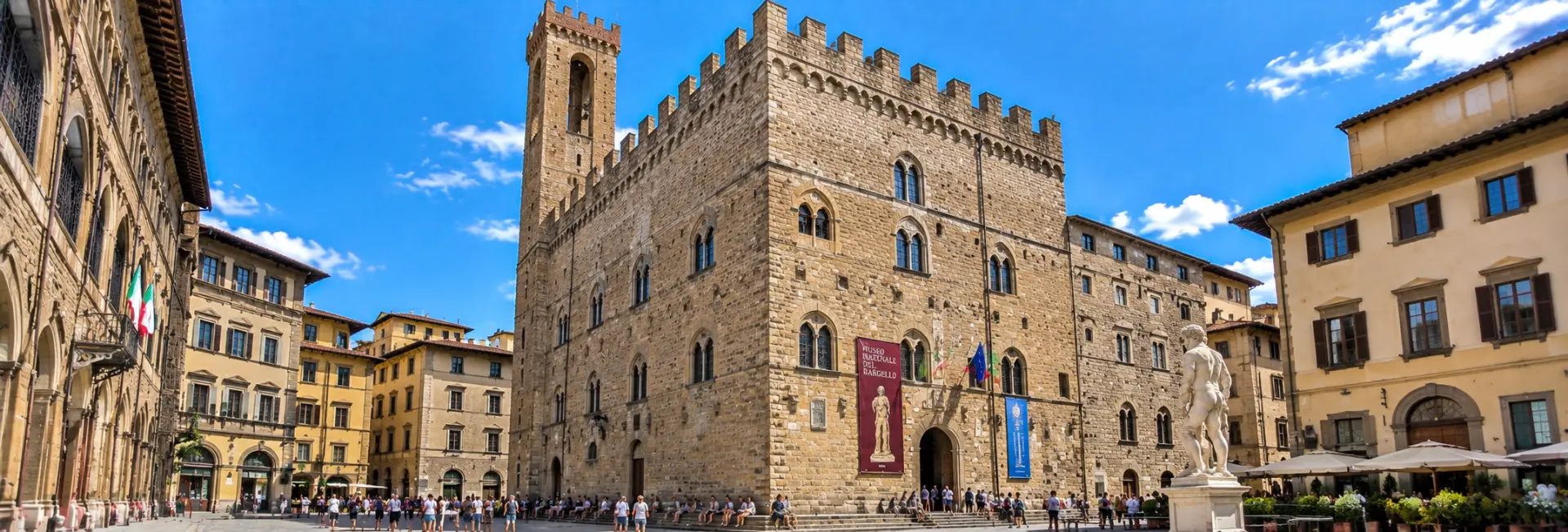
Housed in a fortress-like medieval palace a few streets from Piazza della Signoria, the Museo Nazionale del Bargello holds Florence's most important collection of Renaissance sculpture, gathered inside a building that has already lived several earlier lives as a courthouse, a police headquarters, and a prison. Its rooms bring together works by Donatello, Michelangelo, Verrocchio, Cellini, and Giambologna, alongside collections of arms and armor, ivories, textiles, and decorative arts, making it the single best place in the city to trace the development of Florentine sculpture across the 14th, 15th, and 16th centuries. Considerably quieter than the Uffizi or the Accademia, the Bargello rewards visitors with close, largely unobstructed views of works that would otherwise be surrounded by crowds elsewhere in Florence.
History
A Medieval Seat of Government
Construction of the Palazzo del Bargello began in 1255 under the master builder Lapo Tedesco, making it one of the oldest surviving public buildings in Florence. It was originally built as the headquarters of the Capitano del Popolo, the city's military and judicial leader, and later served as the seat of the Podestà, the chief magistrate of the medieval commune; the many painted coats of arms of these officials still line the walls of the internal courtyard. Its council hall once hosted the Council of the Hundred, on which the poet Dante Alighieri served before being condemned to exile from within these same walls.
Prison and Police Headquarters
From 1574 the building took on a very different role, becoming the residence of the city's chief of police, known as the bargello, and functioning as a prison. Cells were built across several floors, and public executions were carried out in the courtyard until 1786, when Grand Duke Pietro Leopoldo abolished capital punishment in Tuscany, the first state in Europe to do so.
Italy's First National Museum
The palace was restored and opened to the public as a museum in 1865, shortly after Florence briefly became the capital of the newly unified Kingdom of Italy, making it the country's first national museum. Its collection grew through donations and transfers from other Florentine institutions, including sculptures moved from local churches and the important decorative-arts collection later assembled by the French collector Louis Carrand.
Architecture & Design
The Bargello's exterior is defensive in character, with crenellated battlements, small windows, and the fifty-seven-metre Torre della Volognana, whose lower levels once served as a cramped prison cell and which still dominates the surrounding skyline. At its center lies an arcaded courtyard surrounded by covered walkways, an open external staircase leading to the upper floor, a well at its center, and dozens of stone coats of arms belonging to the various Podestà and judges who once served in the building.
Inside, a series of grand medieval halls — including the vaulted ground-floor armory and the first-floor Donatello Room, formerly the general council chamber — were adapted in the 19th century to display sculpture, and the building's severe, largely unornamented stonework provides a plain backdrop that lets individual works stand out.
Donatello and the Courtyard Sculptures
The museum's most celebrated room, the former general council chamber, is dedicated to Donatello, whose bronze David — the first freestanding nude male sculpture cast since antiquity — is displayed alongside his marble David and his heraldic lion, the Marzocco, long a symbol of the Florentine republic. Nearby stands Donatello's marble Saint George, moved here from its original niche at the church of Orsanmichele, and his playful bronze Amor-Attis, works that together show the range of styles he explored across several decades of his career.
- Donatello's bronze David, one of the Renaissance's most influential and studied sculptures
- His marble David, an earlier and more traditionally draped treatment of the same subject
- The Marzocco and the marble Saint George, moved here from the church of Orsanmichele
- Terracotta reliefs and glazed sculpture by Luca and Andrea della Robbia displayed in adjoining rooms
Michelangelo, Cellini & the Renaissance Bronze Rooms
A dedicated room brings together several of Michelangelo's early sculptures, including his youthful Bacchus, the unfinished bust known as Brutus, and the marble relief of the Madonna and Child known as the Pitti Tondo, offering a chance to compare his work directly with that of contemporaries such as Andrea del Verrocchio, whose own bronze David is displayed nearby. Later galleries hold small bronzes and preparatory models by Benvenuto Cellini and Giambologna, including studies connected to large-scale sculptures that still stand in Florence's public squares.
Together, these rooms let visitors follow the shift from Donatello's 15th-century naturalism through Michelangelo's classical revival to the more elaborate, dynamic style of the later Mannerist sculptors working for the Medici court.
The Baptistery Doors Competition Panels
Among the Bargello's most historically significant holdings are two bronze relief panels, both depicting the sacrifice of Isaac, submitted by Lorenzo Ghiberti and Filippo Brunelleschi for the famous 1401 competition to design a new set of doors for Florence's Baptistery. Ghiberti's winning panel and Brunelleschi's losing entry are displayed side by side, offering a rare direct comparison between two design approaches that historians often treat as marking the symbolic starting point of the Renaissance in Florentine art.
The Chapel of the Magdalene and Giotto's Dante
On the first floor, reached through the Carrand Room, a small chapel known as the Cappella della Maddalena preserves fragmentary frescoes attributed to Giotto's workshop, painted in the 1330s when the room served as the private chapel of the Podestà. After the building became a prison in the 16th century, the same chapel was used to hold condemned prisoners on their final night before execution, and its frescoes were later plastered over and forgotten.
Rediscovered and restored in the 1840s, the chapel's Last Judgment scene includes what is widely considered the earliest surviving portrait of the poet Dante Alighieri, shown among the blessed in Paradise holding a copy of his own Divine Comedy — a detail made all the more striking given that Dante's own trial and sentence of exile took place in this very building.
Best Time to Visit
The Bargello keeps shorter and more variable hours than Florence's largest museums, generally opening only until early afternoon and closing on some weekdays each month, so it's worth checking the current schedule before planning a visit. Because it draws far fewer visitors than the Uffizi or the Accademia, arriving at almost any point during opening hours tends to mean a relatively uncrowded visit, though the first hour after opening remains the quietest.
Visitor Tips
- Check opening days in advance, since the Bargello closes earlier than most major Florence museums and is not open every day of the week
- Allow around one to one and a half hours to see the main sculpture rooms without rushing
- Visit early or in the late afternoon for the quietest galleries
- Don't skip the Cappella della Maddalena on the first floor, easy to miss but home to the earliest known portrait of Dante
- Look for the Ghiberti and Brunelleschi Baptistery competition panels, which are easy to overlook among the museum's larger sculptures
Nearby Attractions
Set in the heart of Florence's historic center, the Bargello is within easy walking distance of several of the city's major sights.
- Piazza della Signoria and Palazzo Vecchio, a few minutes' walk away
- The Uffizi Gallery, roughly five minutes on foot
- Florence's Duomo and Baptistery, a short walk north
- The Basilica of Santa Croce, about ten minutes away
FAQs about visiting the Bargello Museum
What is the Bargello Museum known for? +
It's Florence's leading museum of Renaissance sculpture, set inside a 13th-century fortress that later served as a police headquarters and prison, and it holds major works by Donatello, Michelangelo, and Cellini.
What is Donatello's David and why is it significant? +
It's a bronze statue in the museum's main hall considered the first freestanding nude male sculpture cast since antiquity, and it's widely seen as one of the defining works of early Renaissance sculpture.
Is the Bargello less crowded than the Uffizi or the Accademia? +
Yes, it generally draws far fewer visitors than Florence's largest museums, so lines and gallery crowding are rarely an issue even at busier times of day.
How long should I plan for a visit? +
Around one to one and a half hours is usually enough to see the main sculpture rooms, the Baptistery competition panels, and the Cappella della Maddalena without rushing.
What are the bronze panels in the museum's collection? +
They're the two surviving entries by Lorenzo Ghiberti and Filippo Brunelleschi from the 1401 competition to design new doors for Florence's Baptistery, displayed side by side for direct comparison.
What is the Cappella della Maddalena? +
It's a small chapel on the first floor with 14th-century frescoes attributed to Giotto's workshop, including what is considered the earliest surviving portrait of the poet Dante Alighieri.
Is the Bargello Museum open every day? +
No, it keeps more limited and variable hours than Florence's larger museums and closes on some weekdays each month, so it's worth checking the current schedule before visiting.
What's nearby the Bargello Museum? +
Piazza della Signoria, the Uffizi Gallery, Florence's Duomo, and the Basilica of Santa Croce are all within a short walk.