Table of Contents
Overview
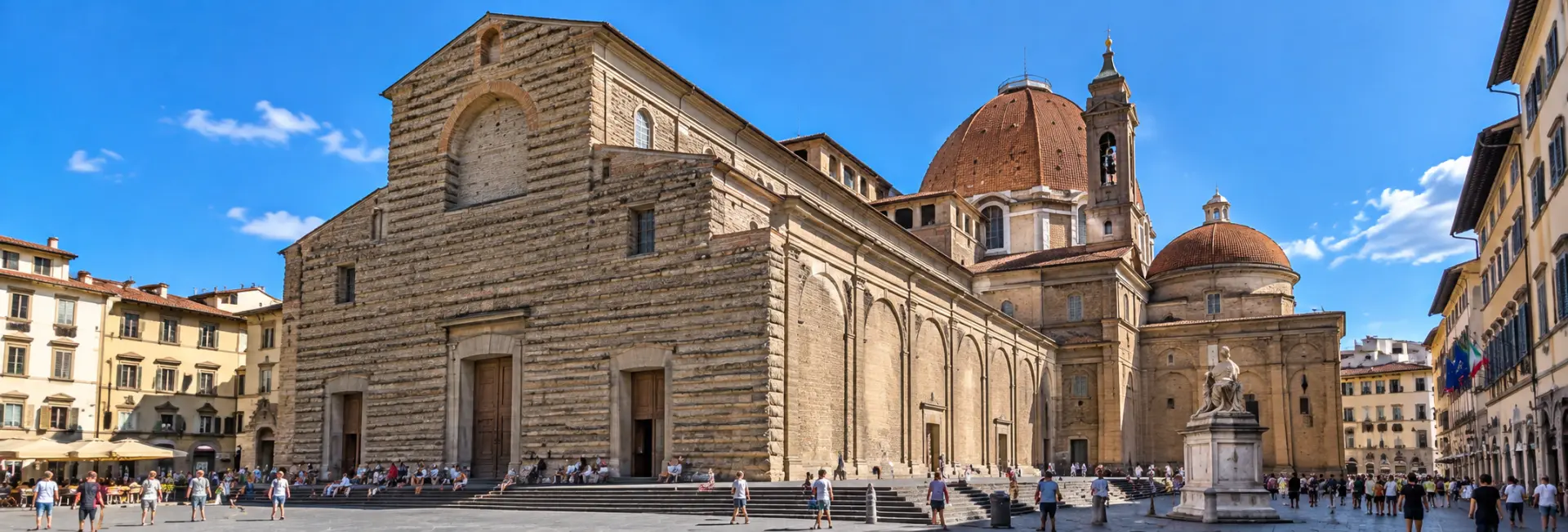
Basilica di San Lorenzo stands just north of Florence's Duomo, at the center of the city's historic San Lorenzo market district, and is counted among the oldest church sites in Florence, with a first building consecrated on the spot in 393 AD. For roughly three centuries, that early church even served as Florence's cathedral, before the role passed to the building that later became today's Duomo. What visitors see now is largely the work of Filippo Brunelleschi, commissioned by the Medici family in the early 15th century to rebuild the church as their own parish and family burial place. The result is often described as the first true Renaissance building in Florence, and its plain, unclad brick façade — left unfinished for more than five centuries — stands in deliberate contrast to the calm, orderly interior and the dense concentration of Renaissance art and architecture packed into the wider complex, including major works by Donatello and Michelangelo.
History
An Ancient Foundation
The first church on this site was consecrated in 393 AD, when it stood outside Florence's city walls, and it served for roughly three centuries as the city's cathedral before that role passed to the church that would eventually become the Duomo.
Rebuilding Under the Medici
In the early 1400s, the wealthy banker Giovanni di Bicci de' Medici funded a full reconstruction of the church and hired the architect Filippo Brunelleschi to design it. Work on the Old Sacristy began in 1419 and was largely finished by 1428, while construction of the main body of the church continued after Brunelleschi's death in 1446, reaching substantial completion by 1459 under the patronage of his sons Cosimo and Piero. Side chapels continued to be added into the 1490s.
A Family Church and Mausoleum
Over the following centuries, San Lorenzo became the Medici family's parish church and principal burial site, eventually holding the tombs of every major Medici ruler from Cosimo the Elder to Cosimo III. Popes Leo X and Clement VII, both Medici by birth, later commissioned Michelangelo to add the New Sacristy and the Laurentian Library to the wider complex.
Architecture & Design
Brunelleschi designed San Lorenzo around strict mathematical proportion, using grey pietra serena stone set against white plastered walls to outline arches, columns, and pilasters that are decorative rather than load-bearing. Rows of Corinthian columns divide the nave from the side aisles, and rounded arches replace the pointed Gothic forms typical of earlier Florentine churches, producing a calm, orderly interior that became a model for Renaissance church design across Italy. As one of the largest churches in Florence, San Lorenzo follows a Latin-cross plan with a wide nave and a run of side chapels, a scale that reflects its long role as the Medici family's principal place of worship.
Externally, the building's massing is more complex than its plain façade suggests: a smaller dome caps Brunelleschi's Old Sacristy on one side, a matching dome sits above Michelangelo's New Sacristy on the other, a taller octagonal dome rises over the domed Chapel of the Princes at the rear, and a fourth, smaller dome marks the crossing of the church's transept.
The Unfinished Façade
Despite its architectural importance, San Lorenzo has never had a finished exterior. Its front wall has stood as rough, undressed brick and stone since construction ended in the 15th century, and it remains that way today. Michelangelo won a competition in 1516 to design a marble façade for the church, and his surviving wooden model shows an ambitious classical scheme of columns, niches, and sculpture, but the project was abandoned for financial and political reasons and construction never began.
The bare brick front has since become one of the most recognizable sights on Piazza San Lorenzo in its own right, a visible reminder of an unfinished Renaissance commission standing directly in front of one of Florence's most complete Renaissance interiors.
Interior Highlights & Art
Inside, the basilica houses an important collection of Renaissance and earlier art. Two bronze pulpits near the high altar were Donatello's final works, left incomplete at his death in 1466 and finished by his students; they depict scenes from the Passion and the life of Christ in dense, expressive relief.
- A marble marker in front of the high altar marks the tomb of Cosimo the Elder, the first Medici ruler, in the crypt below
- Fra Filippo Lippi's Annunciation and Rosso Fiorentino's Marriage of the Virgin are among the notable panel paintings in the side chapels
- Bronzino's large fresco of the Martyrdom of Saint Lawrence covers a wall of the left aisle
- The crypt below the church holds the tombs of Donatello and other members of the Medici family
The Old Sacristy, Library & Medici Chapels
The wider San Lorenzo complex is really several distinct spaces built up over more than a century, each with its own history and, in most cases, its own separate ticket. Brunelleschi's Old Sacristy, decorated with stucco reliefs and bronze doors by Donatello, is included in the standard basilica ticket and is considered one of the purest expressions of early Renaissance architecture in Florence.
Michelangelo's Laurentian Library, reached through its own vestibule and famous sculptural staircase, holds one of Europe's most important collections of Renaissance manuscripts and is ticketed separately from the basilica. The Medici Chapels — comprising Michelangelo's New Sacristy with its Medici tombs and the domed, marble-lined Chapel of the Princes — form a state-run museum with its own entrance on Piazza Madonna degli Aldobrandini, entirely separate from the church itself.
Best Time to Visit
The basilica is open to sightseers Monday through Saturday, roughly from mid-morning to late afternoon, and is closed to tourist visits on Sundays, when it operates as an active parish church. Arriving close to opening time on a weekday is the most reliable way to see the interior, Old Sacristy, and crypt without heavy crowds, since tour groups visiting the nearby Duomo and Medici Chapels tend to build up through the late morning and early afternoon.
Because the Medici Chapels and Laurentian Library keep their own separate hours and sometimes close on different days, it's worth checking each one's current schedule individually before planning a visit that covers the whole complex in one day.
Visitor Tips
- Buy tickets for the basilica and crypt at the cloisters, entered to the left of the church when facing the unfinished façade
- Plan for at least an hour to see the basilica and Old Sacristy properly, and add extra time if visiting the Medici Chapels or Laurentian Library on the same day
- Remember that the Medici Chapels require a separate ticket and entrance from Piazza Madonna degli Aldobrandini, not from inside the church
- Dress modestly, covering shoulders and knees, as is expected in active places of worship across Florence
- Visit on a weekday morning for a quieter experience, since the surrounding market streets and piazza get busy with both shoppers and tour groups later in the day
Nearby Attractions
San Lorenzo sits at the center of one of Florence's busiest sightseeing and shopping areas, making it simple to combine with several other landmarks in a single outing.
- Mercato Centrale, Florence's historic covered food market, immediately behind the basilica
- Palazzo Medici Riccardi, the Medici family's earlier residence, a short walk away
- Florence's Duomo and Baptistery, about five minutes on foot
- Santa Maria Novella train station, roughly a ten-minute walk
FAQs about visiting Basilica di San Lorenzo
What is Basilica di San Lorenzo known for? +
It's one of Florence's oldest churches and the Medici family's parish church and burial site, rebuilt by Brunelleschi in the early Renaissance and famous for its rough, never-finished façade.
Why doesn't the church have a finished façade? +
Michelangelo won a 1516 competition to design a marble front for the church, but the project lost funding and political support before construction began, leaving the brick exterior bare ever since.
Are the Medici Chapels included in the basilica ticket? +
No, the Medici Chapels — including Michelangelo's New Sacristy and the Chapel of the Princes — are a separate state-run museum with their own entrance, ticket, and opening hours.
How long should I plan for a visit? +
Allow at least an hour for the basilica, Old Sacristy, and crypt alone; visiting the Laurentian Library or Medici Chapels as well will add significant extra time, since each has its own entrance.
Is Basilica di San Lorenzo open on Sundays? +
Generally no — the church is closed to tourist visits on Sundays because it's in use as an active parish church, though it does reopen for sightseeing from Monday to Saturday.
What's the best time to visit to avoid crowds? +
Arriving on a weekday close to opening time is the most reliable way to see the interior before tour groups heading to the Duomo and Medici Chapels build up later in the morning.
What shouldn't I miss inside? +
Donatello's bronze pulpits near the altar, Brunelleschi's Old Sacristy, and the tomb of Cosimo the Elder in front of the high altar are among the highlights included in the standard basilica ticket.
Is Basilica di San Lorenzo near other Florence attractions? +
Yes, it's right behind Mercato Centrale and within a short walk of Palazzo Medici Riccardi, the Duomo, and Santa Maria Novella train station.