Table of Contents
Overview
The Odeon of Herodes Atticus, often called the Herodeion, is a Roman-era stone theatre built into the southwest slope of the Acropolis in Athens. Unlike the ruined temples and sanctuaries elsewhere in the city, it is still a working performance venue, with acoustics honed over nearly 1,900 years continuing to carry music and drama to audiences today.
Built in the 2nd century AD as a personal memorial, the Odeon has outlived its original purpose many times over, surviving destruction, centuries of neglect, and a 20th-century restoration to become the centerpiece of the annual Athens Epidaurus Festival. Its half-circle of stone seating, framed by the three-story brick facade behind the stage, makes it one of the most photographed structures on the Acropolis hillside.
History
A Memorial Built in Grief
The Odeon was commissioned by Herodes Atticus, a wealthy Athenian orator, senator, and one of the most prominent benefactors of the Roman world, and completed around 161 AD. He built it in memory of his wife, Aspasia Annia Regilla, who had died shortly before construction began, turning personal loss into a lasting gift to the city.
Herodes Atticus was already known for his philanthropy elsewhere in Greece, having funded renovations to the nearby Panathenaic Stadium, restoration work at Delphi, and improvements to the water supply of Corinth. The Odeon became the most visible of these projects, a building that combined private mourning with public generosity on a monumental scale.
Destruction and Centuries of Ruin
Originally, the theatre was fully enclosed by a cedar wood roof, an engineering feat that gave it exceptional acoustics for musical and literary performances rather than the large-scale drama staged at the nearby Theatre of Dionysus. That roof was destroyed when Herulian invaders sacked Athens in 267 AD, and the building was left open to the sky and gradually abandoned, its stone reused and its seating buried under centuries of debris and soil.
20th-Century Restoration
The Odeon remained largely forgotten until the 20th century, when archaeological clearance work uncovered the extent of the surviving structure. A major restoration in the 1950s rebuilt the seating and orchestra area using Pentelic marble, the same stone used in antiquity, and the theatre reopened to the public in 1955 after centuries of silence.
That reopening marked the beginning of the Odeon's second life as a functioning venue, one that has now lasted nearly as long as the gap between its original construction and its rediscovery felt significant at the time. Later conservation efforts over subsequent decades focused on cleaning weathered surfaces, filling structural cracks, and periodically renewing seating, keeping the ancient stone usable for modern audiences without altering its essential form.
Architecture & Design
Scale and Seating
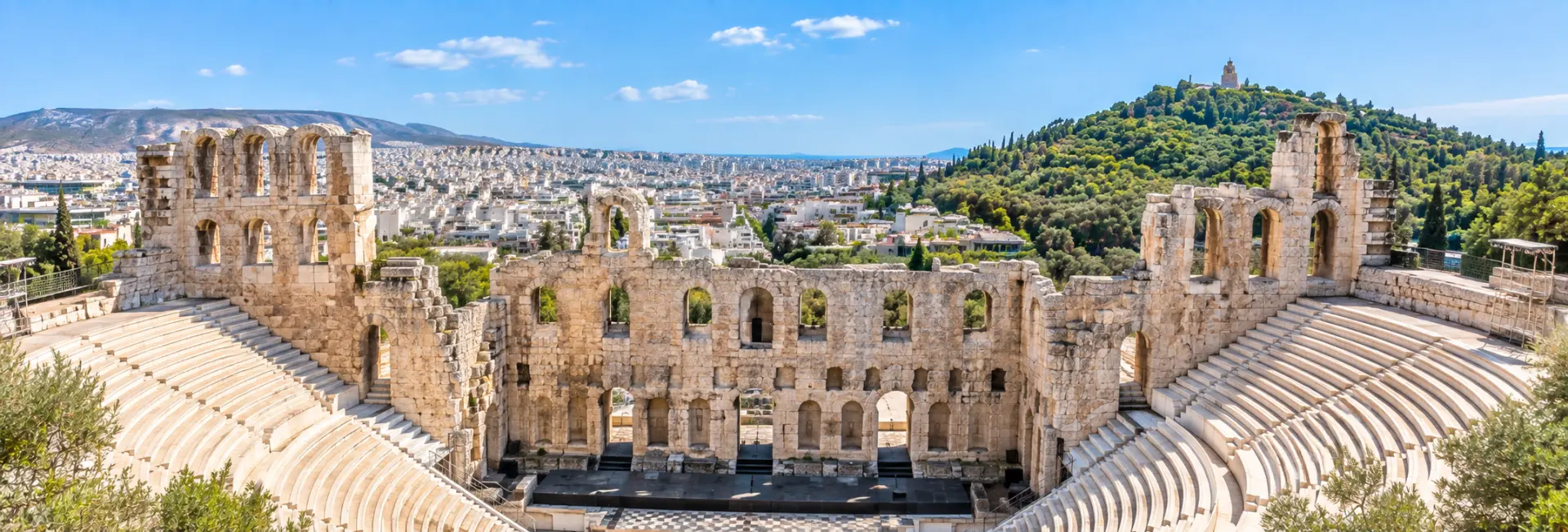
The Odeon was built as a classic Roman theatre form set into the natural hillside, with a semicircular auditorium of stone tiers rising toward the top of the slope. In its restored state it seats around 5,000 people, arranged in tiers that curve around a circular orchestra and a raised stage at the base.
The Stage Facade
Behind the stage stands the theatre's most recognizable feature: a towering three-story facade of arched openings, originally faced in marble and mosaic, that once formed the back wall of the enclosed auditorium. Though weathered and partially ruined, the arches still dominate views of the theatre from the surrounding hillside and frame every performance staged in front of them.
The Odeon is often compared with the older Theatre of Dionysus on the opposite slope of the Acropolis, but the two structures served different purposes. Where the Theatre of Dionysus was built for the mass audiences of Athenian drama, the Odeon was designed on a more intimate, acoustically refined scale suited to music and oratory, a distinction that still shapes how each venue is used by festival organizers today.
- Seating capacity: approximately 5,000
- Construction material: primarily stone and marble, including Pentelic marble used in restoration
- Original roof: cedar wood, destroyed in 267 AD and never rebuilt
- Distinctive feature: three-story arched stage facade
Restoration and the Athens Epidaurus Festival
Since its 1955 reopening, the Odeon has served as the primary venue for the Athens Epidaurus Festival, Greece's leading performing arts festival, held each summer from May to October. Its stage has hosted an extraordinary range of performers over the decades, from opera singers like Maria Callas and Luciano Pavarotti to popular acts such as Frank Sinatra, Elton John, and Coldplay, alongside Greek National Opera productions and classical theatre.
The theatre's long service has not come without cost to the ancient stone, and in 2025 Greek authorities confirmed that the Odeon would close after that summer's festival season for a major, multi-year restoration expected to last at least three years, with the exact reopening date still undetermined. Because of this, performance schedules and public access can change significantly, and anyone planning a visit around a show or a close-up look at the seating area should confirm the theatre's current status before making plans.
The closure has forced the Athens Epidaurus Festival to consider alternative venues for its main productions in the meantime, a significant shift for an event that has used the Odeon as its flagship stage for seven decades. Culture officials have said the scope of the restoration work will depend on structural studies still underway, meaning the theatre's eventual return to active use may look somewhat different from the version audiences knew before the closure.
Cultural Significance
The Odeon occupies an unusual place among Athens' ancient monuments: rather than standing as a preserved ruin, it has continued to function, on and off, in something close to its original role as a performance space. That continuity gives it a different kind of significance from purely archaeological sites nearby, tying it as much to Greece's modern cultural calendar as to its Roman past.
For many Athenians, the Odeon is inseparable from summer itself, its stage lit against the darkened Acropolis serving as the backdrop for the Athens Epidaurus Festival's most memorable nights. Artists who have performed there frequently describe the experience as unlike any modern venue, a rare case of ancient architecture still actively shaping the character of the events staged within it.
That sense of continuity is part of why the announced multi-year closure for restoration was met with such public attention in Greece. For a festival now in its eighth decade, losing its central stage, even temporarily, underscores just how deeply the Odeon has become woven into the country's cultural identity rather than remaining a purely historical curiosity.
Ways to Experience It
Because the theatre functions as an active performance venue rather than a general walk-through archaeological site, how visitors experience it depends heavily on timing and current access.
- Attend a performance during the Athens Epidaurus Festival season, when the interior seating and stage are open to ticket holders
- View the exterior facade and hillside setting from Dionysiou Areopagitou Street, which runs alongside the theatre and offers clear views even when it is closed
- Combine a visit with the Acropolis itself, since the Odeon sits directly on the approach path up the southwest slope
- Check current festival listings and restoration updates before planning a trip specifically to see the interior, since access varies by season and ongoing conservation work
Best Time to Visit
For most travelers, the best way to experience the Odeon is to attend an evening performance during the Athens Epidaurus Festival, typically running from May through October, when the theatre is lit and in active use. Evening shows also avoid the intense summer heat that can make daytime visits to the surrounding hillside uncomfortable.
Outside festival season, or during periods when the theatre is closed for restoration, the best time to view it is during daylight hours while walking Dionysiou Areopagitou Street, when the facade and hillside setting are clearly visible from outside the perimeter. Early morning or late afternoon light tends to bring out the texture of the weathered stonework best, and the pedestrian street itself is far more pleasant to walk before the midday heat sets in.
Visitor Tips
- Confirm current access and any restoration-related closures before planning a visit, since the theatre has been undergoing major conservation work with an uncertain reopening date
- Book festival performance tickets well in advance, as popular shows sell out quickly
- Wear comfortable shoes, since the surrounding hillside paths are made of uneven stone
- Bring a light layer for evening performances, as temperatures can drop once the sun sets
- Combine a visit with the Acropolis and Acropolis Museum, which sit just a short walk away
Nearby Attractions
- The Acropolis of Athens, directly above the Odeon on the same hillside
- The Acropolis Museum, a short walk east along Dionysiou Areopagitou Street
- The Theatre of Dionysus, the older ancient theatre on the southeast slope of the Acropolis
- Areopagus Hill, offering panoramic views over the Ancient Agora and the city
- Plaka, the historic old town, just north of the Acropolis slopes
FAQs about visiting the Odeon of Herodes Atticus
Who built the Odeon of Herodes Atticus? +
It was built around 161 AD by Herodes Atticus, a wealthy Athenian senator and benefactor, as a memorial to his wife Regilla.
Can I visit the Odeon of Herodes Atticus every day? +
No, the theatre is generally only open to the public during scheduled performances, and it has also been closed for extended restoration work, so current access should always be checked before visiting.
What is the Athens Epidaurus Festival? +
It is Greece's leading performing arts festival, held each summer, for which the Odeon has traditionally served as the main venue for opera, theatre, dance, and concerts.
How many people can the Odeon of Herodes Atticus hold? +
In its restored form, the theatre seats approximately 5,000 people.
Is the Odeon of Herodes Atticus part of the Acropolis ticket? +
Viewing the exterior from the surrounding path is part of a typical Acropolis visit, but entry into the seating area itself is generally reserved for ticketed performances, not general daytime sightseeing.
What happened to the original roof? +
The theatre originally had a cedar wood roof that enclosed the auditorium for better acoustics, but it was destroyed when Herulian invaders sacked Athens in 267 AD and was never rebuilt.
Is the Odeon currently open? +
As of the most recent announcements, the theatre closed after its 2025 festival season for a multi-year restoration project, so visitors should confirm its current status before planning a visit built around it.
What else is nearby? +
The Acropolis, Acropolis Museum, Theatre of Dionysus, Areopagus Hill, and the Plaka district are all within easy walking distance of the Odeon.