Table of Contents
Overview
Standing on the north edge of the Acropolis, just steps from the far larger Parthenon, the Erechtheion is easy to underestimate at first glance and impossible to forget once its story is understood. This modest-sized Ionic temple packed an unusual amount of religious weight into one building, serving as the meeting point for several of Athens's oldest and most sacred cults at once.
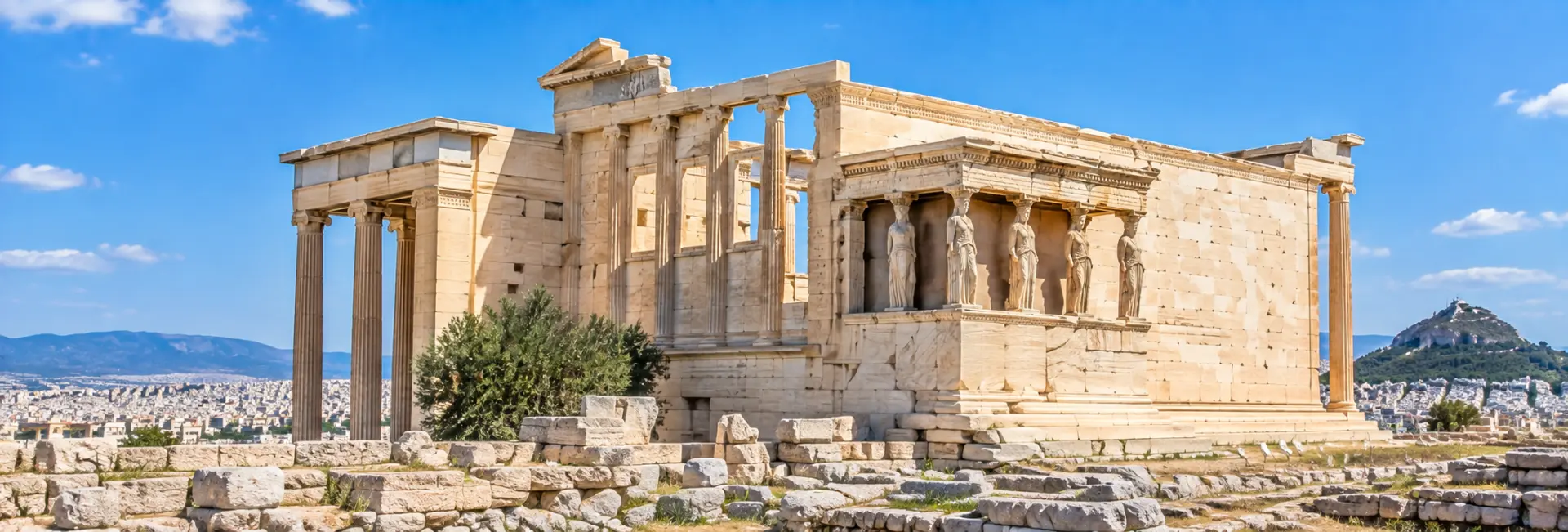
Its fame today rests largely on a single architectural flourish: the Porch of the Caryatids, where six sculpted maidens stand in place of ordinary columns, supporting the roof on their heads with an ease that has captivated visitors for over two thousand years. Beyond that porch, though, the temple's unusual, asymmetrical layout reflects a building designed around inherited myths and older shrines rather than a blank architectural slate.
Where the neighboring Parthenon was built as a single, unified statement of civic pride, the Erechtheion reads more like an accumulation of sacred obligations that its architects had to reconcile within one roofline. That difference in purpose is part of what makes it worth slowing down for: a visitor who only glances at it from the Parthenon's shadow misses a building that rewards a closer, more patient look.
History
Origins and the Site's Older Shrines
The ground beneath the Erechtheion had been considered sacred long before its present walls went up, with earlier structures on the same patch of the Acropolis reaching back toward the Bronze Age. Ancient tradition held that this spot marked the very ground where Athena and Poseidon competed for patronage of the city, and that the mythical king Kekrops was buried nearby, making it one of the most storied locations on the entire hill.
Construction of the temple seen today is generally dated to between 421 and 406 BC, a period that included a lull in the long Peloponnesian War when major public building could resume. Building accounts inscribed in stone from those final years survive and give historians unusually precise evidence for how the project was managed, even though the identity of its chief architect remains debated among scholars, with the fifth-century architect Mnesikles among the leading candidates.
The temple's very name is itself a modern convention rather than an ancient certainty. Ancient writers described a shrine on the Acropolis dedicated to Erechtheus, but which physical building they meant has become a genuine scholarly puzzle, and the label "Erechtheion" that guides and signage use today is a matter of long-standing convention rather than settled fact.
Damage, Reuse and Restoration
Fire damaged the building at least twice in antiquity, and its role shifted dramatically over the centuries that followed: it was converted into a Christian church, later served as a residence during the Frankish occupation of Athens, and under Ottoman rule became part of a garrison complex. The heaviest blow came during the 1820s war for Greek independence, when cannon fire during a siege brought down part of the Maiden Porch and the west facade.
Restoration efforts began not long after Greece's independence and have continued in phases ever since, including a large-scale intervention in the early twentieth century and further conservation work carried out by a dedicated restoration service established in the 1970s. Ongoing study of the building continues to refine scholars' understanding of its original interior layout, much of which was erased by centuries of change in use.
Architecture & Design
Unlike the Parthenon's clean, symmetrical rectangle, the Erechtheion sprawls across several different levels connected by steps and small terraces, a layout usually explained by the sloping, uneven ground it was built on and the need to accommodate multiple older shrines within one structure. The main east-facing porch presents a conventional row of six Ionic columns, but the rest of the building breaks from convention at almost every turn.
- The Porch of the Caryatids on the south side, where six carved maidens replace columns entirely
- A northern porch with tall, elegant Ionic columns and richly decorated door and window frames
- An interior split across two levels, with the western half of the building set noticeably lower than the east
- Detailed carved ornament, including palmette chains and bead-and-reel patterns, applied with unusual richness for a temple of its size
Built largely from Pentelic marble quarried near Athens, the temple originally carried a decorative frieze of contrasting dark limestone inlaid with pale marble figures, a technique rarely used elsewhere in Greek architecture. Sunlight interacting with trace iron in the marble also gives parts of the structure a faint honey tone at certain times of day, a quality later admired by generations of visitors and artists.
The building's Ionic order, with its scroll-shaped capitals and slender proportions, offered a deliberate visual contrast to the heavier Doric columns of the Parthenon nearby, and the Erechtheion is often cited as one of the finest surviving examples of that style. Its influence carried well beyond ancient Greece, shaping details found centuries later in Roman temples and, further still, in the Greek Revival buildings that spread across Europe and the Americas in the eighteenth and nineteenth centuries.
Cultural & Religious Significance
Rather than honoring a single deity, the Erechtheion functioned as a shared sanctuary for a cluster of Athens's foundational religious figures: the goddess Athena in her role as protector of the city, the sea god Poseidon, and the legendary early king Erechtheus, from whom the building takes its modern name. Cult worship of Poseidon and the mythical king appears to have been closely intertwined, reflecting old Athenian traditions that predate the Classical-era building itself.
The temple also preserved a direct physical link to the city's founding myths. Just outside its walls stood the sacred olive tree said to have been Athena's gift to Athens during her contest with Poseidon, while the temple grounds were believed to contain both the tomb of Kekrops and marks left by Poseidon's trident. For Athenians, the building was less a single monument than a living index of the stories that explained who they were.
That layered religious purpose likely explains why the temple's interior arrangement has proven so difficult for modern scholars to reconstruct. Rather than a single altar facing a single cult statue, the building seems to have accommodated separate spaces for Athena, for Poseidon and Erechtheus together, and for other minor local deities, all coexisting under one roof in a way with few close parallels elsewhere in the Greek world.
Notable Features
The Porch of the Caryatids remains the temple's signature feature and one of the most photographed details anywhere on the Acropolis. Of the six original maidens, one was removed in the early nineteenth century and is now held in the British Museum, while the remaining originals have been moved to the Acropolis Museum for protection, with weatherproof casts standing in their place on the temple itself.
- The sculpted frieze that once encircled parts of the building, of which numerous fragments survive despite heavy losses over time
- A carved ceiling inside the north porch, traditionally associated with marks believed to have been left by Poseidon's trident
- Elaborately decorated doorways and window frames considered among the finest surviving examples of Classical Greek stonework
- Remnants of the sanctuary once dedicated to Pandrosos, daughter of Kekrops, adjoining the temple's western end
Visitors examining the building closely can still make out subtle differences between the six caryatids, evidence that they were carved as individuals rather than as identical repeated figures, a detail easy to miss without pausing at the porch for more than a passing glance.
Visiting Etiquette & Tips
- The Erechtheion sits within the fenced Acropolis archaeological site, so visitors need a valid Acropolis ticket to view it up close
- A roped viewing area keeps visitors a short distance from the porch itself, so a zoom lens or binoculars help for a closer look at the Caryatids' detail
- The surrounding marble pathways are uneven and can be slippery when wet, so sturdy, flat shoes are strongly advised
- There is little shade anywhere near the temple, making sun protection and water essential, especially in the warmer months
- As with the rest of the Acropolis, climbing on ruins, touching carved surfaces, or removing any stone fragments is strictly prohibited
Best Time to Visit
Because the Erechtheion sits along the main pedestrian route across the Acropolis summit, it tends to be busiest whenever the wider site is at its most crowded, particularly late morning through early afternoon in high season. Arriving close to opening time or in the final couple of hours before closing generally means a noticeably quieter porch and better light for photographs.
The soft, low-angle sunlight of early morning or late afternoon also brings out the marble's warm coloring most vividly, especially around the Caryatid porch. Visiting in spring or autumn avoids both the harshest summer heat, which can be intense with no shade across the summit, and the thinner winter opening hours some Acropolis facilities keep.
Nearby Attractions
Because the Erechtheion stands within the Acropolis itself, its most obvious companions are the other monuments sharing the same hilltop, making it easy to see several major sites in a single ticketed visit.
- The Parthenon, a short walk south across the summit and the dominant structure on the Acropolis
- The Propylaea, the monumental gateway visitors pass through on the way up to the summit
- The Temple of Athena Nike, a small, elegant temple perched near the Acropolis entrance
- The Acropolis Museum, a short walk downhill, which displays the original Caryatid statues and other sculpture removed from the site for preservation
FAQs about visiting the Erechtheion
What is the Erechtheion known for? +
It's best known for the Porch of the Caryatids, where six sculpted maidens serve as columns, and for having housed the shared worship of Athena, Poseidon and Athens' legendary early kings.
Are the Caryatid statues at the temple original? +
No. The originals are preserved in the Acropolis Museum, and one is in the British Museum; the figures standing on the temple today are weatherproof casts.
How much time should I set aside to see it? +
Most visitors spend 15 to 20 minutes at the Erechtheion itself, though it's worth pairing with a longer visit to the rest of the Acropolis summit.
Do I need a separate ticket for the Erechtheion? +
No separate ticket is needed; it's included with general admission to the Acropolis archaeological site.
Can I get close to the Caryatid porch? +
A roped barrier keeps visitors a short distance away to protect the structure, so a zoom lens or binoculars help for a closer look at the details.
Why does the temple have such an unusual, uneven shape? +
Its irregular, multi-level layout is generally attributed to the sloping ground it was built on and the need to incorporate several older, pre-existing shrines into a single building.
Is the Erechtheion included in Acropolis guided tours? +
Yes, virtually all guided tours of the Acropolis stop at the Erechtheion, usually right after the Parthenon, since the two buildings sit close together on the summit.
What else should I see nearby? +
The Parthenon, the Propylaea gateway, and the Temple of Athena Nike are all within a few minutes' walk, and the Acropolis Museum downhill displays the original Caryatid sculptures.