Table of Contents
Overview
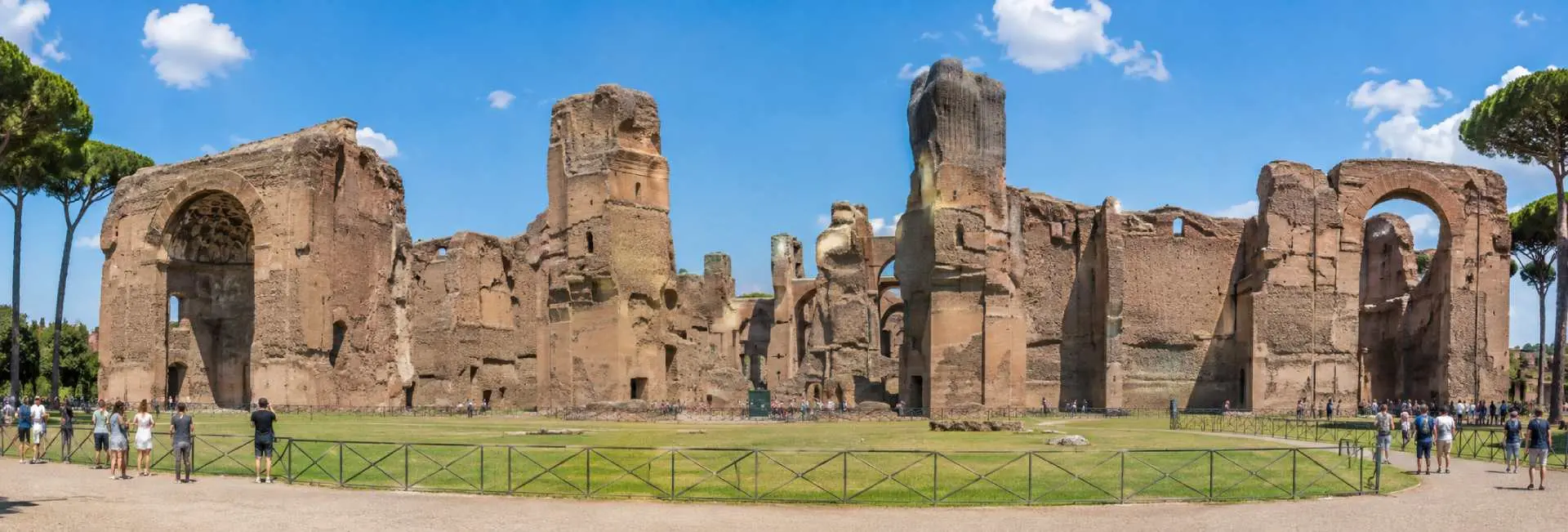
The Baths of Caracalla, known in antiquity as the Thermae Antoninianae, are among the most awe-inspiring ruins in Rome. Once a vast public bathing and leisure complex capable of hosting thousands of visitors a day, the site today is an open-air archaeological park where towering brick walls, sunken pools, and fragments of mosaic floor hint at the scale of what stood here nearly 1,800 years ago.
More than just a place to wash, the baths were a social institution central to Roman daily life, combining bathing rituals with exercise, conversation, and entertainment. Their surviving remains, among the best-preserved of any Roman bath complex, offer a rare, tangible sense of just how ambitious Imperial Rome's public architecture could be.
History
Origins Under Septimius Severus
Construction began in 206 AD under Emperor Septimius Severus, who envisioned a bathing complex that would rival anything Rome had seen before. The site was leveled and prepared using a large workforce, and building continued for years before the complex was ready to open.
Completion Under Caracalla
The baths take their name from Severus's son and successor, Caracalla, during whose reign the main structure was completed and formally opened around 216 AD. Work on decorative and peripheral elements continued for years afterward, with some parts of the complex not fully finished until the reign of Alexander Severus.
Use and Decline
The baths remained in active use for over three centuries, serving Romans of many social classes. Their operation depended entirely on a dedicated aqueduct branch supplying enormous volumes of water daily. When the Ostrogoths cut the aqueducts during the siege of Rome in the 6th century, the baths could no longer function and were gradually abandoned. In the centuries that followed, much of the marble cladding and decorative stone was stripped away and reused elsewhere in the city.
Recognition & Status
- Included within the "Historic Centre of Rome" UNESCO World Heritage Site listing, recognized for its cultural, architectural, and historical value.
- Regarded as the second-largest bath complex ever built in ancient Rome, after the later Baths of Diocletian.
- Considered one of the best-preserved large-scale Roman bath complexes in the world, retaining walls, floor levels, and underground service areas rarely surviving elsewhere.
- Long celebrated by architects and historians as a landmark of Roman engineering, admired and studied since the Renaissance.
Architecture & Engineering
The complex covered roughly 100,000 square metres, with the central bath building itself measuring over 200 metres in length. Its walls, built from brick-faced concrete, once rose to remarkable heights, with the central hall's vault reaching an estimated 44 metres, a scale that would not be surpassed by many later European buildings for centuries.
Heating and Water Systems
The baths relied on a hypocaust system, a network of underfloor and in-wall channels that circulated hot air from furnaces to heat rooms and water. This required a small army of workers operating around the clock, tending furnaces hidden below and behind the visible bathing halls.
Decoration
Floors and walls were once covered in colourful mosaics, marble veneer, and sculpture, much of which has since been removed or relocated to museums. Surviving mosaic fragments, particularly those depicting athletes, still give a sense of the complex's original opulence.
Key Areas
- Frigidarium – the cold-bathing hall and largest interior space, where the tallest surviving walls now stand.
- Tepidarium – the warm intermediate room bathers passed through to ease between temperature extremes.
- Caldarium – the hot-bathing hall, originally a huge domed rotunda positioned to catch maximum sunlight.
- Natatio – the open-air swimming pool, roughly Olympic in scale, that anchored the main axis of the complex.
- Palaestrae – twin exercise courtyards flanking the central halls, used for wrestling and athletic training before bathing.
- Gardens and outer precinct – the wider grounds included libraries, shops, and walking areas surrounding the central bath building.
The Underground World & Mithraeum
Beneath the visible ruins lies an extensive network of service tunnels, stretching roughly two kilometres, through which enslaved workers moved fuel, managed plumbing, and kept the furnaces running without ever entering the bathing halls above.
Within this underground network sits a Mithraeum, a sanctuary dedicated to the mystery cult of Mithras and among the largest known spaces of its kind. Visitors descending into the tunnels can see the sunken worship space and imagine the parallel world of labor and belief operating just below the marble floors overhead.
Ways to Experience It
- Self-guided walking route through the main halls, following the frigidarium–tepidarium–caldarium axis.
- Underground tours through the service tunnels and Mithraeum, typically requiring a separate time slot and the ability to manage steep stairs.
- Audio guides and, at times, virtual reality headsets that reconstruct how the halls would have appeared when fully decorated and in use.
- Summer opera and outdoor performances staged among the ruins by Rome's opera house, using the ancient walls as a dramatic backdrop.
Visitor Tips
- The site is large and mostly uncovered, so wear comfortable shoes and bring sun protection, since shade is limited.
- Underground and Mithraeum access can require separate timed entry and involves steep stairs, so it isn't suitable for all visitors.
- The main route is wheelchair accessible, with ramps and a tactile map at the entrance, though the underground sections are not.
- Opening hours vary by season and the site may have reduced hours on certain days, so check the official ticketing source before visiting.
- Booking tickets in advance is recommended in peak season to avoid long queues at the entrance.
Nearby Attractions
- Circus Maximus – the ancient chariot-racing valley, a short walk north and free to visit.
- Aventine Hill and the Orange Garden – a quiet hilltop park with sweeping views over the city.
- Appian Way – Rome's ancient road, with catacombs and countryside walking routes further south.
- Palatine Hill and the Colosseum – imperial-era sites reachable within a short trip, often combined on the same ticket.
Common Questions about Baths of Caracalla
What are the Baths of Caracalla? +
They are the ruins of one of ancient Rome's largest public bathing complexes, built in the early 3rd century AD and used for over 300 years before falling into disuse.
How much time should I plan for a visit? +
Around 90 minutes covers the main complex comfortably; add another 30–40 minutes if you're also visiting the underground tunnels and Mithraeum.
Are the Baths of Caracalla part of the Roma Pass? +
Yes, they're included among the participating sites on both the 48-hour and 72-hour Roma Pass options.
Is the underground section included in a standard ticket? +
Access to the underground tunnels and Mithraeum is often available but may require a separate timed slot, so it's worth checking availability when booking.
Is the site accessible for visitors with mobility needs? +
The main route is wheelchair accessible with ramps, but the underground Mithraeum area involves steep stairs and isn't accessible.
Can I see an opera or concert at the Baths of Caracalla? +
In summer, the site sometimes hosts open-air opera and concerts staged among the ruins, though productions have at times shifted to other venues, so check current listings before planning around a performance.
What's the best way to get there? +
The Circo Massimo metro stop on Line B is about a 5–10 minute walk away, and several bus routes also stop close to the entrance.
What's nearby that pairs well with a visit? +
Circus Maximus and the Aventine Hill are both a short walk away, making them easy to combine with a visit to the baths in the same trip.