Table of Contents
Overview
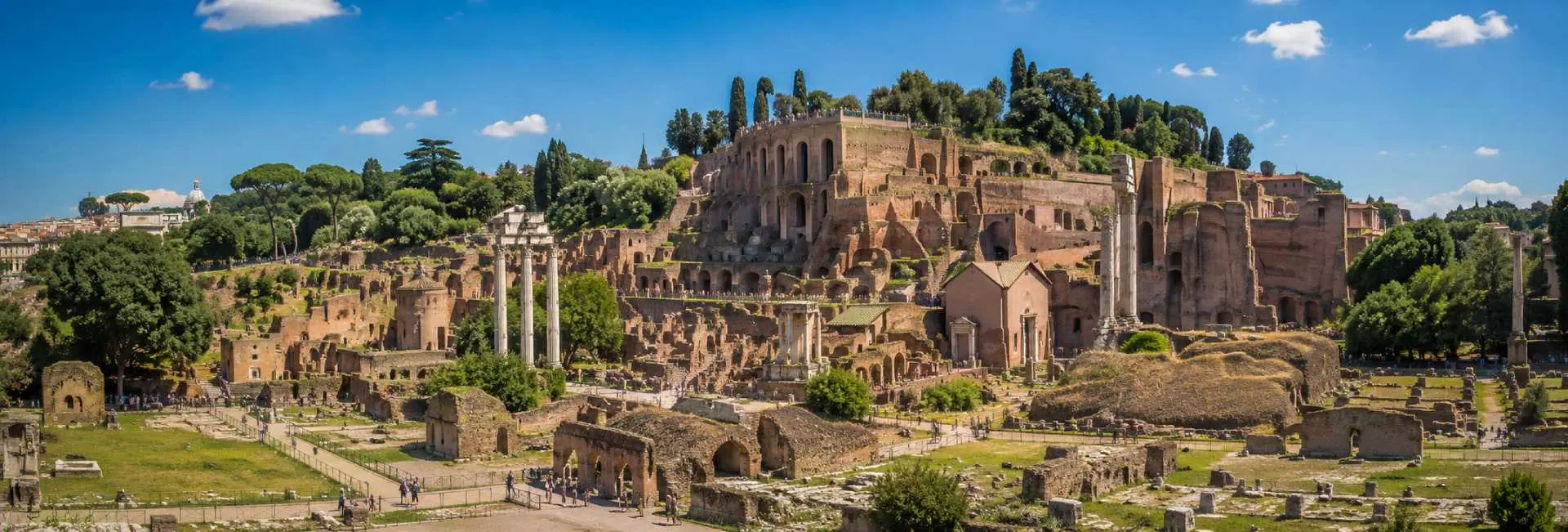
Rising above the Roman Forum in the heart of the city, Palatine Hill is considered the birthplace of Rome itself. According to legend, it is where Romulus founded the city in 753 BC, and centuries later it became the most exclusive address in the ancient world, home to emperors from Augustus to Domitian.
Today the hill is a sprawling archaeological park where visitors can wander among the ruins of imperial palaces, shaded gardens, and museum collections, all while taking in some of the best panoramic views in Rome.
History
Origins and Legend
Archaeological evidence shows the Palatine was inhabited as early as the 10th century BC, with Bronze Age huts uncovered dating to the 9th and 8th centuries BC. Roman mythology places the hill at the very start of the city's story: the twins Romulus and Remus were said to have been nursed by a she-wolf in a cave on its slopes before Romulus founded Rome there.
Republic to Empire
By the 1st century BC, the Palatine had become one of the most fashionable residential areas in Rome, home to figures such as Cicero and Mark Antony. Under Augustus and the emperors who followed, the hill was transformed into an imperial domain, filled with grand palaces including the Domus Flavia, Domus Augustana, and Domus Tiberiana.
Decline and Rediscovery
After the fall of the Western Roman Empire, the hill gradually fell into ruin and was largely abandoned. Interest returned during the Renaissance, when Cardinal Alessandro Farnese acquired part of the site and laid out ornate gardens over the buried ruins, an area still visible today as the Farnese Gardens.
Recognition & Status
Palatine Hill sits within the Historic Centre of Rome, which was inscribed as a UNESCO World Heritage Site in 1980. It is managed jointly with the neighboring Roman Forum and Colosseum as part of the Parco Archeologico del Colosseo, reflecting its status as one of the most significant archaeological zones in the world.
Key Areas & Ruins
The Imperial Palaces
The Domus Flavia and Domus Augustana formed the sprawling official and private residences of Emperor Domitian, complete with reception halls, courtyards, and a sunken garden stadium. Nearby, the Domus Tiberiana was Rome's first purpose-built imperial palace, begun under Tiberius.
The Farnese Gardens
Laid out in the 16th century over the ruins of Tiberius's palace, the Farnese Gardens are considered among the earliest private botanical gardens in Europe. Terraces, pavilions, and shaded pathways make this one of the most peaceful corners of the hill.
The Palatine Museum
Housed in a former convent, the Palatine Museum displays sculpture, frescoes, and everyday objects recovered from excavations on the hill, offering context for the ruins scattered outside.
Notable Landmarks
Several individual sites within the Palatine complex draw particular attention from visitors:
- House of Augustus – the relatively modest private residence of Rome's first emperor, with well-preserved frescoes
- House of Livia – believed to have belonged to Augustus's wife, known for its vividly painted interior walls
- Hut of Romulus (Roma Quadrata) – traces of an Iron Age hut associated with the legendary founding of Rome
- Stadium of Domitian – a long, sunken garden built in the form of a racetrack, likely used for private walks rather than actual races
- Lupercal – the traditional site of the cave where legend says the she-wolf nursed Romulus and Remus
Cultural Significance & Legends
Few sites carry as much symbolic weight in Roman mythology as the Palatine. It is here that Romulus is said to have killed his brother Remus in a dispute over leadership, an act that gave Rome both its name and its founding myth. The hill's name itself is thought to derive from Pales, an ancient deity associated with shepherds and flocks.
The Palatine was also the stage for the Lupercalia, an ancient fertility festival held each February, and later became so closely tied to imperial rule that the word "palace" in many modern languages descends directly from "Palatine."
Ways to Experience It
Visitors can explore the Palatine independently or as part of a guided experience, and it is almost always visited together with the adjoining Roman Forum.
- Self-guided walk – explore at your own pace using on-site information panels
- Guided tours – small-group or private tours that explain the layout of the imperial palaces and mythology in more depth
- Combined ticket – a single ticket typically covers the Palatine, Roman Forum, and Colosseum
- Special access tours – some operators offer entry to areas like the House of Augustus, which have limited daily visitor numbers
Best Time to Visit
Spring (April to May) and fall (September to October) offer the most comfortable temperatures for walking the hill's uneven, largely unshaded paths. Summer visits are best made early in the morning or late afternoon to avoid the midday heat.
Because the Palatine tends to draw fewer crowds than the Colosseum, it can also serve as a quieter alternative during the busiest midday hours of a Rome itinerary.
Visitor Tips
- Wear comfortable, sturdy shoes, as much of the terrain is uneven gravel and stone
- Bring water and sun protection, since shade is limited across most of the site
- Enter via the Via di San Gregorio entrance, near the Arch of Constantine, which is often less crowded than other entry points
- Allow at least two to three hours to see the Palatine and Roman Forum together
- Check current opening hours and ticket requirements in advance, as these can change seasonally
Nearby Attractions
The Palatine's central location makes it easy to combine with several of Rome's other major ancient sites.
- Roman Forum – directly adjacent, and included on the same ticket
- Colosseum – a short walk away, also covered by the combined ticket
- Circus Maximus – visible from the hill's southern edge, once Rome's largest chariot-racing venue
- Arch of Constantine – located near the Via di San Gregorio entrance
Common Questions about Palatine Hill
What is Palatine Hill known for? +
It is traditionally regarded as the birthplace of Rome, where Romulus is said to have founded the city, and later became the site of grand imperial palaces built by emperors such as Augustus and Domitian.
Is Palatine Hill part of the same ticket as the Colosseum? +
Yes, a single combined ticket typically grants access to the Palatine Hill, Roman Forum, and Colosseum, though it's worth confirming current pricing and validity before your visit.
How much time do I need to visit Palatine Hill? +
Most visitors spend one to two hours on the Palatine itself, or two to three hours if combining it with a full visit to the adjoining Roman Forum.
Is Palatine Hill suitable for visitors with limited mobility? +
The site involves uneven paths, gravel surfaces, and some inclines, which can be challenging for wheelchair users or those with mobility issues, so it's worth checking current accessibility routes in advance.
What's the best time of day to visit? +
Early morning or late afternoon tends to be quieter and cooler, especially in summer, while the hill generally sees fewer crowds than the Colosseum throughout the day.
Can I visit the House of Augustus and House of Livia? +
Yes, though access is sometimes limited to a set number of visitors per day or included only with specific tour options, so it's best to check availability before planning around them.
What should I combine with a Palatine Hill visit? +
The Roman Forum and Colosseum are the natural pairings, both within walking distance and typically covered by the same ticket, while the Circus Maximus and Arch of Constantine are also close by.
Do I need a guide to appreciate Palatine Hill? +
Not necessarily, as on-site panels provide context, but a guide can help make sense of the layered ruins and bring the mythology and imperial history to life more vividly.