Table of Contents
Overview
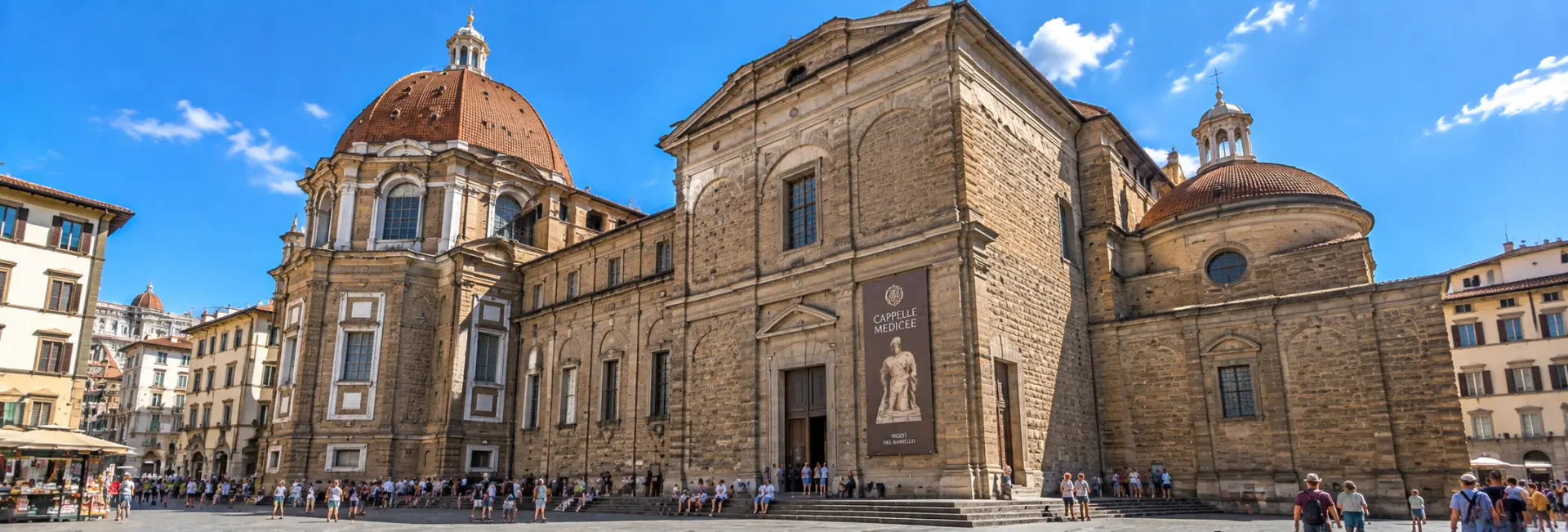
The Medici Chapels form a separate museum attached to the back of Florence's Basilica di San Lorenzo, built over more than a century as the funerary complex of the Medici family and the Grand Dukes of Tuscany who descended from them. The museum combines two very different spaces under one roof: Michelangelo's austere, sculpture-filled New Sacristy, begun in 1520, and the vast, gem-encrusted Chapel of the Princes, begun in 1604 as an opulent mausoleum for the ruling Medici grand dukes. Together with the crypt beneath them, the two chapels trace the Medici family's rise from Florentine bankers to hereditary rulers, and hold some of Michelangelo's most studied sculptures alongside one of the largest surviving displays of Florentine pietre dure stone inlay. The museum draws several hundred thousand visitors a year, making it one of the most visited parts of the wider San Lorenzo complex, alongside the basilica and the Laurentian Library.
History
A Family Mausoleum in the Making
Plans for a grand Medici burial complex took shape in 1520, when Cardinal Giulio de' Medici, the future Pope Clement VII, commissioned Michelangelo to design a new sacristy at San Lorenzo to honor recently deceased members of the family, mirroring Brunelleschi's Old Sacristy on the opposite side of the church. Michelangelo worked on the project intermittently until 1534, when he left Florence for Rome and never returned, leaving several sculptures and architectural details unfinished.
The Chapel of the Princes
A second, far larger project began in 1604, when Grand Duke Ferdinando I de' Medici moved forward with an idea first floated by his father Cosimo I: an immense octagonal mausoleum for the ruling branch of the family. Built to a design associated with Don Giovanni de' Medici and the architect Matteo Nigetti, the Chapel of the Princes took shape gradually over decades, and parts of its elaborate stone decoration were still being completed as late as the 20th century.
From Private Chapel to State Museum
The chapels passed out of Medici and then Habsburg-Lorraine family control and into Italian state ownership in 1869, when they were separated administratively from the adjoining basilica and opened to the public as a museum, a status the complex retains today under Italy's state museum system.
Architecture & Design
The two chapels present a deliberate architectural contrast. The New Sacristy is a compact, cube-shaped space finished in grey pietra serena stone and white plaster, closely following the proportional language Brunelleschi had already used elsewhere in San Lorenzo, but treated by Michelangelo with sculpted walls, curved pediments, and blind windows that break from strict classical convention. Architectural historians regard it as an early and influential example of the more expressive, less rule-bound style that would come to be called Mannerism.
The Chapel of the Princes, by contrast, is a soaring octagonal hall roughly 59 metres tall at the top of its dome, faced almost entirely in colored marble, granite, and semi-precious stone rather than paint or plaster, giving the two adjoining spaces a strikingly different feel despite standing only steps apart.
The New Sacristy
Michelangelo's New Sacristy holds the tombs of two young Medici dukes, Giuliano, Duke of Nemours, and his nephew Lorenzo, Duke of Urbino, each set beneath a pair of reclining allegorical figures usually known as Day and Night on one tomb and Dawn and Dusk on the other. A statue of the Madonna and Child by Michelangelo, flanked by figures of the Medici family's patron saints carved by his assistants, stands on the wall between the two tombs, above the unmarked graves of Lorenzo the Magnificent and his brother Giuliano, who never received the freestanding tombs originally planned for them.
- The figures of Day and Night, on Giuliano's tomb, are among the most closely studied sculptures of the Renaissance
- Michelangelo left the sacristy's architecture and several sculptures unfinished when he departed Florence for Rome in 1534
- A small hidden room beneath the sacristy, rediscovered in 1975, contains charcoal wall drawings attributed to Michelangelo and is open only by reservation, in very small groups
The Chapel of the Princes
The Chapel of the Princes serves as the mausoleum of the Medici grand dukes, with six monumental sarcophagi set into niches around its octagonal walls, though only a handful were ever topped with the bronze grand-ducal statues originally planned. Every surface is faced in polychrome marble, granite, and pietre dure, the Florentine technique of inlaying cut, polished semi-precious stones into elaborate patterns, including coats of arms representing the cities of the Tuscan grand duchy set into the walls.
Work on the decoration continued long after the chapel's 1604 groundbreaking, and parts of its inlaid floor were still being finished as late as the 20th century, making the space as much a showcase of the pietre dure craft practiced by the city's Opificio delle Pietre Dure workshop as it is a royal tomb.
The Crypt and Michelangelo's Secret Room
A low, vaulted crypt beneath both chapels holds the simpler tombs of lesser-known Medici family members and, later, of the Habsburg-Lorraine grand dukes who succeeded them, along with part of the basilica's treasury of vestments and reliquaries. A separate funerary monument to Cosimo the Elder, the family's first great patron, also stands in this lower level.
Beneath the New Sacristy, a narrow room discovered in the 1970s preserves dozens of charcoal drawings on its walls, thought to have been sketched by Michelangelo while he was in hiding in Florence in 1530. Because the room is small, fragile, and reached by a steep, narrow staircase, visits are limited to a handful of people at a time, arranged in advance, and are not accessible to young children or visitors with mobility restrictions.
Best Time to Visit
The Medici Chapels typically open most days of the week, closing only on selected days each month, and keep considerably longer hours than the basilica itself, opening in the early morning and running into the early evening. Arriving shortly after opening on a weekday is the most reliable way to see the New Sacristy without a crowd blocking the view of the tombs, since visitor numbers build steadily through the late morning as tour groups covering the wider San Lorenzo complex arrive.
Because the chapels, the basilica, and the Laurentian Library are administered and ticketed separately, it's worth checking each site's current opening days before combining more than one of them in a single visit.
Visitor Tips
- Book Michelangelo's Secret Room well in advance if you want to see it, since only a few visitors are admitted per short time slot and it isn't shown to everyone
- Enter from Piazza Madonna degli Aldobrandini, on the far side of the basilica from Piazza San Lorenzo, rather than looking for an entrance inside the church
- Allow roughly forty-five minutes to an hour to see the crypt, New Sacristy, and Chapel of the Princes at an unhurried pace
- Check for free-admission days, including the first Sunday of the month, if visiting on a flexible schedule
- Combine the visit with the basilica or Laurentian Library only if time allows, since each requires its own separate ticket and entrance
Nearby Attractions
The Medici Chapels sit within the same monumental block as several other major Florence sights, all within easy walking distance.
- Basilica di San Lorenzo, immediately adjoining the chapels but entered separately
- Mercato Centrale, Florence's historic covered food market, a short walk away
- Palazzo Medici Riccardi, the family's earlier residence, close by
- Florence's Duomo and Baptistery, roughly a five-minute walk
FAQs about visiting the Medici Chapels
What are the Medici Chapels? +
They're a state-run museum attached to Florence's Basilica di San Lorenzo, combining Michelangelo's New Sacristy and the marble-and-gemstone Chapel of the Princes as the burial complex of the Medici family and the Grand Dukes of Tuscany.
Are the Medici Chapels the same as the Basilica of San Lorenzo? +
No, they're a separate museum with their own entrance on Piazza Madonna degli Aldobrandini, ticketed and administered independently from the adjoining basilica.
What's the difference between the New Sacristy and the Chapel of the Princes? +
The New Sacristy is Michelangelo's smaller, sculpture-filled chapel holding tombs of two Medici dukes, while the larger Chapel of the Princes is an octagonal mausoleum for the ruling grand dukes, faced almost entirely in colored marble and inlaid semi-precious stone.
Can I visit Michelangelo's Secret Room? +
Only with an advance reservation for a short, small-group time slot, since the room is reached by a steep staircase and isn't suitable for young children or visitors with mobility restrictions.
How much time should I plan for a visit? +
Around forty-five minutes to an hour is usually enough to see the crypt, New Sacristy, and Chapel of the Princes without rushing.
When is the best time to visit? +
Arriving shortly after opening on a weekday gives the best chance of seeing the New Sacristy before tour groups covering the wider San Lorenzo complex build up later in the morning.
Is there a combined ticket with the Basilica of San Lorenzo? +
No, the chapels, the basilica, and the Laurentian Library are ticketed separately, so it's worth checking each site's current hours if you plan to visit more than one in a day.
What's nearby the Medici Chapels? +
The Basilica di San Lorenzo, Mercato Centrale, Palazzo Medici Riccardi, and Florence's Duomo are all within a few minutes' walk.