
Table of Contents
Overview
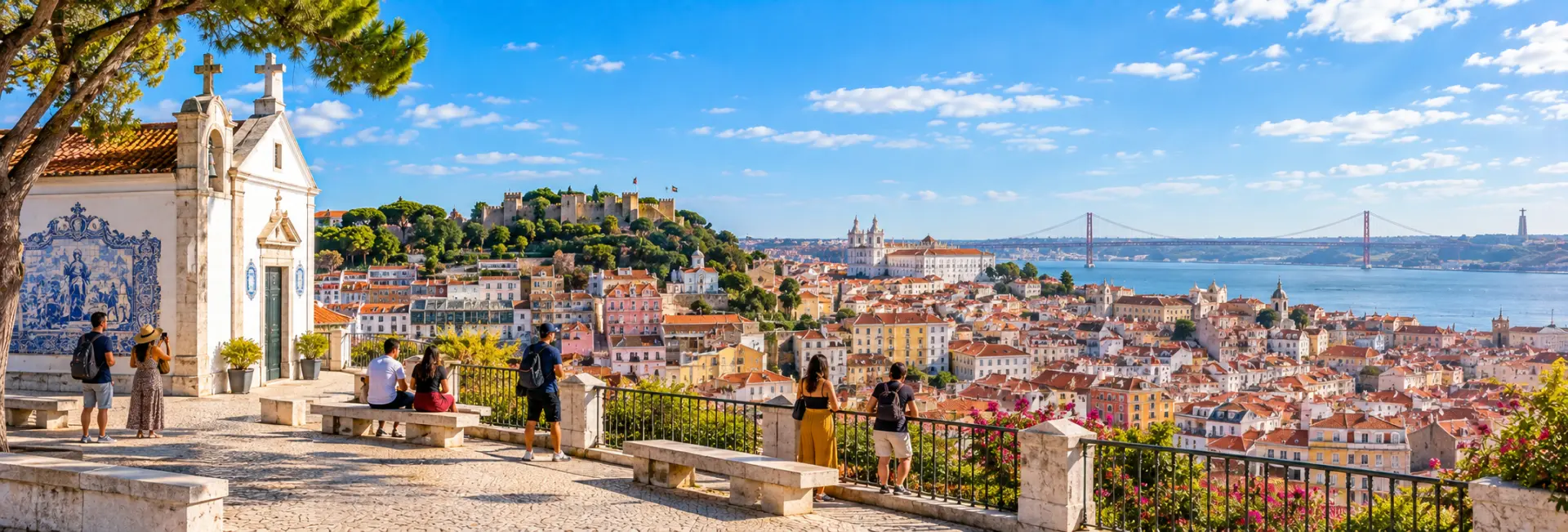
Miradouro da Senhora do Monte sits at the top of the hill that rises behind Graça, and it holds the distinction of being the highest viewpoint in central Lisbon. From its terrace the city falls away in almost every direction: the castle, the river, the domes and rooftops of the old quarters, and on a clear day the hills far beyond the centre.
It is a simple space by design, a paved terrace with benches, a scattering of trees and a small whitewashed chapel at one end. What makes it worth the climb is the openness of the panorama, wider than most of Lisbon's other famous viewpoints because there is no higher ground nearby to interrupt it.
The miradouro has long had a reputation as a romantic spot, quieter and less commercial than some of the city's more photographed lookouts, though word has spread and it now draws a steady stream of visitors, musicians and tuk-tuks through the day.
History
The hill has been a lookout and a place of devotion since well before it became a fixture on tourist itineraries. The chapel that gives the viewpoint its name dates back to the eighteenth century and was originally dedicated to Saint Gens, a bishop martyred in Roman times, though it later became associated more closely with the image of the Virgin housed inside, from which the site takes its everyday name.
The surrounding hill, part of the historic parish of São Vicente, developed as this side of Lisbon grew beyond the old walled centre, with the terrace gradually taking shape as a formal viewpoint rather than an informal patch of high ground. Its reputation as a place for courting couples goes back generations, tied to its relative seclusion at the top of a residential hill, well away from the main routes through the old city.
In more recent decades the miradouro has shifted from a mostly local secret to one of the fixtures of Lisbon sightseeing, a change driven largely by its position as the single best panoramic vantage point the city offers from solid ground.
The View
The panorama from Senhora do Monte spans roughly 210 degrees, taking in the south, west and north of the city in a single sweep. Because the terrace sits above the Graça viewpoint and has no taller ground blocking it nearby, the view reaches further and wider than most of Lisbon's other miradouros.
Landmarks typically identifiable from the terrace include:
- São Jorge Castle, sitting on its own hill across the valley
- The Tagus estuary opening out to the south
- The Baixa grid and the rooftops of Alfama and Mouraria below
- The 25 de Abril Bridge in the distance on a clear day
- The hills of Bairro Alto and, further north, the modern high-rises of the Avenidas Novas district
A tiled panel at the viewpoint helps identify the main landmarks, functioning as a kind of illustrated map for anyone trying to place what they are looking at.
The viewpoint faces west, which makes it a natural place to watch the sky change colour in the evening. In winter the sun sets low enough to disappear behind the Tagus estuary itself, producing one of the more striking sunsets in the city; in summer the hills of Bairro Alto block the sun itself, though the sky above still puts on a show.
The Chapel and Its Legends
The small chapel at the edge of the terrace is unassuming from the outside and rarely open, generally unlocked only for a couple of hours on select afternoons. Inside, tradition holds that a particular chair once eased the pain of childbirth for any pregnant woman who sat in it, a belief said to have drawn even Portuguese queens over the centuries.
Outside, a glass-encased image of the Virgin stands facing the terrace, and it is this image, rather than the chapel's formal dedication, that gave the whole viewpoint its popular name. The railings nearby have also picked up the more modern custom of love locks, left by couples in keeping with the hill's long-standing romantic reputation.
Whether or not the chapel happens to be open on the day of a visit, its presence shapes the atmosphere of the whole terrace, giving what is otherwise a straightforward viewing platform a quieter, more devotional undertone.
Ways to Experience It
Most visits to Senhora do Monte are simple: walk up, take in the view, sit for a while. A few variations are worth knowing about.
- On foot: the standard approach, usually combined with a wider walk through Graça and Alfama, since the miradouro sits at the top of both.
- By tram: tram 28 runs through the wider Graça area, though it does not stop directly at the viewpoint, so some walking uphill is unavoidable.
- By tuk-tuk: a popular way to reach the top without the climb, and part of why the terrace can feel busy with chartered groups in the middle of the day.
- With a drink in hand: informal pop-up bars and passing vendors are a regular feature of the terrace, and bringing your own drink to sit and watch the sunset is a well-worn local habit.
- With live music: buskers and small groups of musicians often set up on or near the terrace, adding to its atmosphere in the evening.
The viewpoint is free and unticketed at all times, with no opening hours of its own, though the chapel keeps its own limited schedule.
Best Time to Visit
Time of day
Sunset is the obvious draw, particularly in winter when the sun drops behind the estuary rather than the hills. Arriving thirty to forty minutes before sunset secures a good spot on the benches before the crowd thickens. Mornings are far quieter and give clean views of the city in sharp light, without the tuk-tuk traffic that builds through the afternoon.
Season
Winter sunsets are the most dramatic, thanks to the low western sun over the water, though the terrace has no real shelter from wind or rain. Spring and autumn combine mild weather with good visibility. Summer brings the largest crowds and the haziest air, since heat and humidity can soften the distant views, and the sunset itself disappears behind Bairro Alto's hills rather than the water.
Whatever the season, a clear day matters more here than at almost any other Lisbon viewpoint, since the whole appeal rests on how far you can see.
Visitor Tips
- The climb up from Graça or Alfama is steep, so comfortable shoes make a real difference.
- Arrive early for sunset if you want a bench; the terrace fills quickly in the final hour of daylight.
- The chapel is usually locked. If you want to see inside, check locally for its limited opening times rather than counting on access.
- There are no facilities directly at the miradouro itself, so plan a stop in Graça beforehand if needed.
- Petty theft is a low but real risk in any crowded tourist viewpoint in Lisbon; keep valuables close, especially after dark.
- Getting here on foot from central Alfama or Graça is a genuine hill climb; if that is a concern, a tuk-tuk or taxi to Largo do Monte avoids the steepest stretch.
- Pack a light layer even in summer, since the exposed terrace catches the evening breeze once the sun goes down.
Nearby Attractions
The miradouro sits within a short walk of several of Graça and Alfama's other landmarks, making it easy to fold into a longer walking route.
- Miradouro da Graça: a short walk downhill, offering a similar but slightly lower angle on the same panorama.
- Jardim da Cerca da Graça: a garden just below the viewpoint with its own castle views and more space to sit.
- Igreja e Convento da Graça: the large church and former convent anchoring the neighbourhood below.
- São Jorge Castle: visible from the terrace and reachable on foot across the valley, downhill and back up the opposite slope.
- Alfama: the historic quarter tumbling downhill towards the river, ideal for continuing a walk after sunset.
- Feira da Ladra flea market: held on Campo de Santa Clara nearby, on Tuesdays and Saturdays.
A natural route is to walk up from Alfama or Graça in the late afternoon, watch the sunset at Senhora do Monte, then wind back down through the lit streets of Graça for dinner.
FAQs about visiting Miradouro da Senhora do Monte
What makes this viewpoint special? +
It is the highest point in central Lisbon, giving a wider and more open panorama than most of the city's other miradouros, since there is no higher ground nearby to block the view.
Is there an entrance fee? +
No. The viewpoint is a public terrace with free, unrestricted access at all times.
What can you see from the top? +
São Jorge Castle, the Tagus estuary, the rooftops of Alfama and Mouraria, the Baixa grid, and on clear days the 25 de Abril Bridge and the hills beyond the city centre. A tiled panel on site helps identify the landmarks.
Is it a good sunset spot? +
Yes, and it is one of the most popular reasons to visit. Winter sunsets are especially striking because the sun drops behind the Tagus estuary; in summer it sets behind the hills of Bairro Alto instead.
Can I go inside the chapel? +
Rarely. The small chapel at the edge of the terrace is usually closed and opens only occasionally, generally for a couple of hours on select afternoons.
How do I get there? +
On foot from Graça or Alfama, both a genuine uphill walk. Tram 28 passes through the wider area but does not stop at the viewpoint itself, and tuk-tuks and taxis can reach Largo do Monte directly for those who prefer to skip the climb.
Is it busy? +
It can be, particularly around sunset and during the day in summer, when tuk-tuk groups and buskers gather. Early mornings are noticeably quieter.
Is it accessible for visitors with limited mobility? +
The approach on foot involves a steep climb from any direction, so a taxi or tuk-tuk directly to Largo do Monte is the easier option for anyone who cannot manage the hill.
What else is nearby? +
Miradouro da Graça and the Jardim da Cerca da Graça are a short walk downhill, with the Graça church, São Jorge Castle and the lanes of Alfama all within easy reach for a longer walk.
