
Table of Contents
Overview
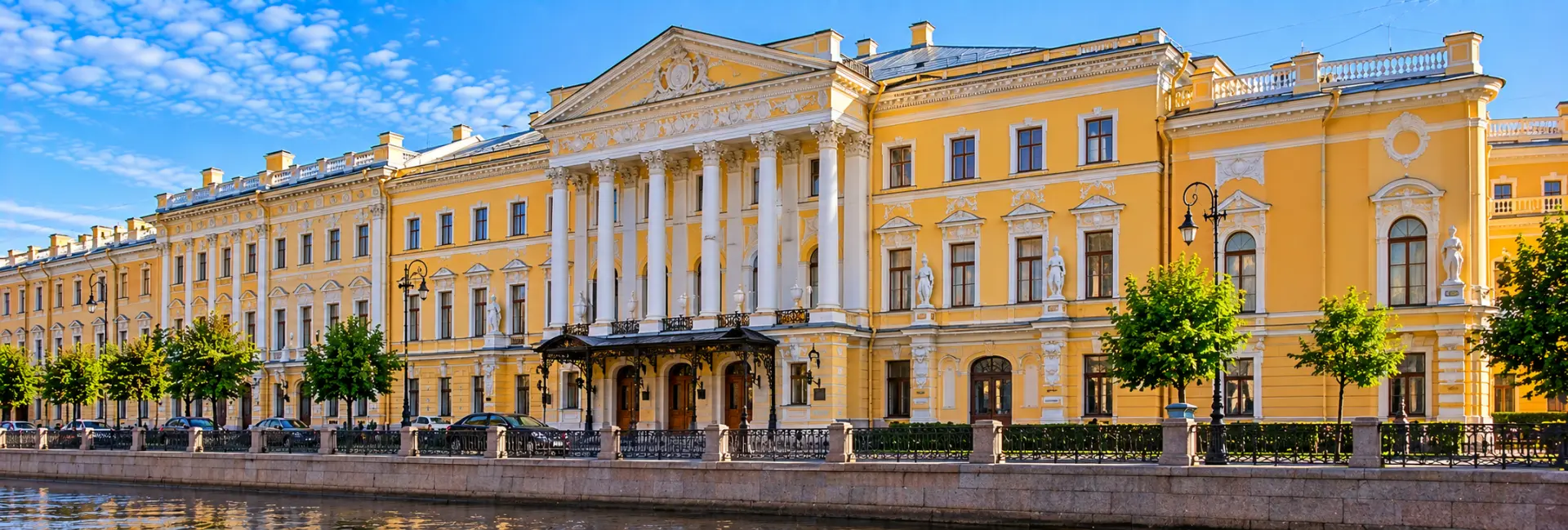
The Yusupov Palace, also called the Moika Palace, is one of the few aristocratic mansions in Saint Petersburg where visitors can still step inside rooms that look much as they did in the days of the imperial elite. Standing on the bank of the Moika River, it was home to five generations of the Yusupovs, one of the richest families in Russia, between 1830 and the Revolution.
The palace is famous for two very different reasons. Inside are sumptuous state rooms, painted ceilings, silk-hung salons and a tiny, ornate private theatre. It is also the place where the controversial mystic Grigori Rasputin was killed in December 1916, a story that draws many visitors to its ground-floor and basement rooms.
Today the building combines a museum of aristocratic life with an active cultural venue. It is a rewarding stop for anyone curious about the city's palace interiors, the history of the Russian nobility or the last years of the Romanov era.
History
An Eighteenth-Century Beginning
The site once held a wooden palace belonging to Tsarevna Praskovia Ivanovna, a niece of Peter the Great. The present building dates from the 1770s, when the French architect Jean-Baptiste Vallin de la Mothe designed a mansion for Count Shuvalov, giving the main facade a six-column portico and an attic story.
The Yusupovs Take Over
The palace passed into the hands of the Yusupov princes in 1830. Prince Nikolai Yusupov commissioned the architect Andrei Mikhailov to remodel it, and in the 1830s it gained the appearance it largely has today, including a wing along the Moika containing the White Column Hall. Over the following decades other architects and artists, among them Bernard de Simone and Ippolit Monighetti, reworked rooms and added decoration.
Comfort and Modernization
By the end of the nineteenth century the residence had been fitted with electricity, water heating, running water and drainage, a level of comfort that was still unusual at the time. The family used it for entertaining on a grand scale, with balls, concerts and theatrical evenings.
After the Revolution
The palace was nationalized after 1917, and in 1925 it was handed to the city's Education Commissariat, which chose to preserve it as a public museum. It later served as a hospital during the Second World War, suffered a fire in 1958, and was restored over many years. Today it houses the Palace of Culture for Educators alongside the museum.
Architecture & Notable Rooms
A Blend of Styles
Because so many architects and decorators worked here over time, the Yusupov Palace is not a single-style building. Neoclassical lines on the outside give way to a succession of interiors in different historical moods, from Baroque and Rococo to Renaissance revival and Moorish fantasy. The result feels less like a museum piece and more like a lived-in house.
The State Rooms
- The White Column Hall, the grand banquet hall and ballroom of the second floor
- The Dance Hall, noted for its painted ceiling
- The Red Drawing Room, also called the Imperial Drawing Room because of the portraits of the tsars
- The Blue Drawing Room and the Green Drawing Room, each with its own colors and furnishings
- The Large Rotunda, the Nicholas Hall and the Preciosa Hall
The Private Apartments
On the ground floor are the family's more personal spaces, including the Prince's study, the library and the Turkish Study, which Felix Yusupov used as a billiards room. The Moorish Drawing Room, with its colorful patterns and exotic details, is one of the most unusual interiors in the palace.
The Home Theatre
The palace's private theatre is a miniature jewel of gilded Rococo decoration, with a painted curtain and ceiling by Ernst Friedrich von Liphart. A chamber music theatre was opened in this room in 1987, and performances are still held here, so you may be able to experience it in use rather than only as a museum room.
The Yusupov Family
Wealth and Collecting
The Yusupovs were among the wealthiest families in the empire, known for their estates, their philanthropy and especially their passion for art. Their palaces were filled with paintings, sculptures, jewelry and furniture, and after the Revolution much of this collection was transferred to the Hermitage and other state museums.
Five Generations on the Moika
The family owned the palace from 1830 until 1919, and each generation left its mark on the rooms. The last resident, Prince Felix Yusupov, was a glamorous society figure who is said to have been among the richest men in Russia. The Moika residence was reportedly his favorite among the family's four palaces in the capital.
A Palace as a Family Home
Part of the charm of the visit is the sense of domestic life behind the grandeur. The private bedrooms, studies and dining rooms show how the princes lived day to day, in contrast with the ceremonial halls designed to impress guests.
The Rasputin Story
The Events of December 1916
The palace is best known as the place where Grigori Rasputin, a peasant mystic who had gained influence at the imperial court, was killed in December 1916. A group of conspirators including Prince Felix Yusupov, the politician Vladimir Purishkevich and Grand Duke Dmitri Pavlovich invited Rasputin to the palace, and he was taken to a lavishly furnished room in the basement.
Fact and Legend
The exact sequence of events is still debated, and many popular accounts mix fact with legend. Most versions agree that Rasputin was shot and that the conspirators later disposed of his body in the Malaya Neva. Because the story has been retold and embellished so often, it is wise to treat the more dramatic details with caution.
What You Can See
Part of the building connected with the murder is open as a thematic exhibition, which includes a re-creation of the scene in the basement using wax figures. The courtyard through which Rasputin is said to have tried to flee is now occupied by a children's playground. For many visitors, the Rasputin exhibit is a short but memorable complement to the elegance of the state rooms.
Ways to Experience It
Self-Guided with an Audio Guide
Most visitors tour the main rooms independently with an audio guide, which is available through the palace's mobile app using a code from your ticket. This lets you set your own pace and dwell on the rooms that interest you most.
Guided Tours
Guided tours bring the personalities of the Yusupov family to life and are particularly helpful for understanding the layers of decoration. Some visitors also book a separate themed tour focused on the Rasputin story, which has been offered at set times in the past. Availability and ticket numbers can be limited, so confirm the options in advance.
Performances and Events
- Chamber opera and concerts in the home theatre, with a separate entrance on the Moika embankment
- Temporary exhibitions and cultural events in various rooms
- Educational and family programs organized by the palace
Best Time to Visit
Season
The palace is an indoor attraction, so it works in all seasons. Winter is a pleasant time to visit, as the warm interiors offer an escape from the cold. In summer, the white nights make it easy to combine a daytime tour with an evening stroll along the river.
Time of Day
Weekday mornings and early afternoons are generally calmer, and arriving soon after opening lets you see the larger rooms with fewer people. Because opening times and tour schedules vary, check the official website for current hours before you set out.
Evening Performances
If you would like to see the home theatre in use, look for evening performances in the palace calendar. Seeing a concert in the Rococo auditorium is a special way to experience the building.
Visitor Tips
- Check opening hours, ticket prices and tour options on the palace's official website, as these change and sources give different information
- Book ahead for guided or themed tours, which can sell out
- Allow about one and a half to two hours for the main rooms, and longer if you add the Rasputin exhibit or a performance
- Follow the museum's rules on photography and bags, which may differ from room to room
- Some staircases and rooms may be difficult for visitors with mobility needs, so contact the palace in advance to ask about accessible routes
- Wear comfortable shoes, as the tour involves a lot of walking and several staircases
- Confirm current travel advisories from your own government and how payments and ticket booking work for foreign visitors, as arrangements for international travelers to Russia can change
The nearest metro stations are Admiralteyskaya and the interchange of Sennaya Ploshchad, Sadovaya and Spasskaya, and the palace lies on the Moika embankment between the cathedral area and the Mariinsky district.
Nearby Attractions
The palace stands in a part of the city full of landmarks, so it is easy to build a half-day around it.
- Mariinsky Theatre: the historic opera and ballet house on Theatre Square, a short walk away
- Saint Nicholas Naval Cathedral: a blue-and-white Baroque church beside the Kryukov Canal
- Saint Isaac's Cathedral: one of the city's great landmarks, with a colonnade offering city views
- New Holland Island: a former naval site turned cultural and leisure space
- The Moika and Kryukov Canal embankments: pleasant walks past historic mansions
- The Hermitage and Palace Square: the city's central sights, a longer walk away
FAQs about visiting the Yusupov Palace
What is the Yusupov Palace known for? +
It is known for its richly decorated nineteenth-century interiors, its tiny private theatre and for being the place where Grigori Rasputin was killed in December 1916.
Where is the Yusupov Palace? +
It is at 94 Moika River Embankment in central Saint Petersburg, on the bank of the Moika River.
Can I see the room where Rasputin was killed? +
Yes. Part of the palace connected with the murder is open as a thematic exhibition, which includes a wax-figure re-creation in the basement. Some visitors also book a separate themed tour, so check what is offered.
How long does a visit take? +
Plan about one and a half to two hours for the main rooms. Add extra time for a themed tour or a performance in the home theatre.
Do I need to book in advance? +
Booking ahead is wise for guided and themed tours, which can fill up. Opening hours and ticket arrangements change, so check the official website for the latest details.
Is there an audio guide? +
Yes, the palace has an official mobile audio guide app that works with a code printed on your ticket, which allows independent visits.
Can I attend a performance at the palace? +
The palace's home theatre hosts concerts and chamber opera, with a separate entrance from the Moika embankment. Check the palace's event calendar for upcoming dates.
Is the Yusupov Palace accessible for visitors with limited mobility? +
The historic building has stairs and uneven spaces, so access may be limited in places. Contact the palace in advance to ask about suitable routes.
What else is nearby? +
The Mariinsky Theatre, Saint Nicholas Naval Cathedral, Saint Isaac's Cathedral and New Holland Island are all within walking distance.
